Cursor vs Claude Code in 2026 - Which Should You Use?
TL;DR
A detailed comparison of Cursor and Claude Code from someone who uses both daily. When to use each, how they differ, and the ideal setup.
Direct answer
Cursor vs Claude Code in 2026 - Which Should You Use?
A detailed comparison of Cursor and Claude Code from someone who uses both daily. When to use each, how they differ, and the ideal setup.
Best for
Developers comparing real tool tradeoffs before choosing a stack.
Covers
Verdict, tradeoffs, pricing signals, workflow fit, and related alternatives.
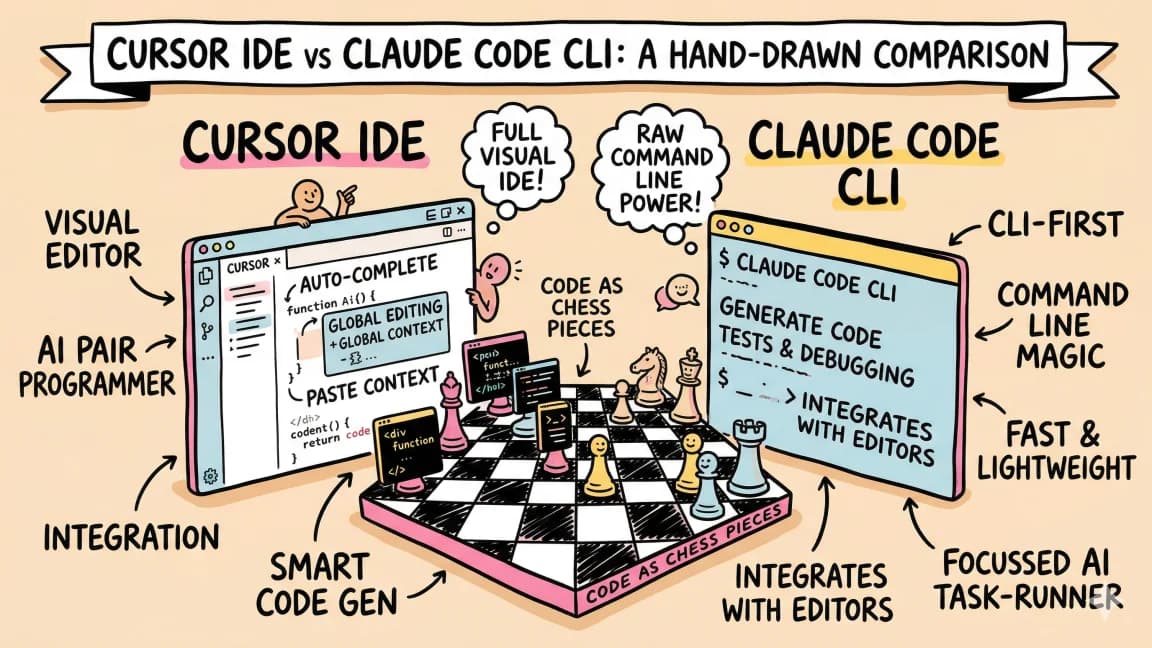
The short answer: use both. Cursor is the fastest way to iterate on code visually. Claude Code is the most capable autonomous agent for multi-file work from the terminal. They solve different problems, and the best setup in 2026 combines them.
Here is the full breakdown, based on using both daily on production TypeScript projects.
Last updated: July 26, 2026. Verify pricing, plan limits, and model access against the official sources in this post before making a purchase decision.
Quick Comparison#
| Feature | Cursor | Claude Code |
|---|---|---|
| Interface | IDE (VS Code fork) | Terminal CLI |
| Best for | Visual editing, UI work | Autonomous tasks, refactors |
| Model | Claude Sonnet 5, Opus 5, Fable 5, GPT-5.x, custom | Claude Sonnet 5 (default), Opus 5, Opus 4.8, Fable 5 (API) |
| Price | $20/mo Pro, $40/mo Teams | $20/mo Pro, $200/mo Max |
| Context | Codebase indexing | CLAUDE.md + file reading |
| Multi-file | Composer mode | Sub-agents, agent teams |
| Parallel chats | Yes (Side Chats, v3.11) | Yes (agent teams) |
| Autocomplete | Tab predictions | No |
| MCP | Yes | Yes |
| Memory | Cursor Rules | CLAUDE.md persistent memory |
| Headless mode | No | Yes (auto mode) |
| CI/CD integration | No | Yes |
| Extension ecosystem | VS Code extensions | MCP servers, skills |
| Learning curve | Low (familiar IDE) | Medium (terminal-native) |
Both tools can use Claude models under the hood. The difference is not the model. It is the interface, the workflow, and the level of autonomy.
Official Sources#
Always verify current pricing and features against the official documentation:
| Tool | Docs | Pricing |
|---|---|---|
| Claude Code | code.claude.com/docs | anthropic.com/pricing |
| Cursor | cursor.com/features | cursor.com/pricing |
| Claude Opus 5 | platform.claude.com/docs | anthropic.com/pricing |
Pricing and model access change frequently. The official pages are the source of truth.
What Changed in July 2026#
Claude Opus 5 launched (July 24): Anthropic released Opus 5 at $5/$25 per MTok with 2x fast mode option. The new model replaces Opus 4.8 as the top-tier reasoning model on the Claude API. Cursor and Claude Code both support it, but Cursor users need the Teams plan or API key for access. See our Opus 5 comparison.
Cursor v3.11 (July 10): Side Chats for parallel conversations that run alongside your main agent session. Conversation Search indexes past chats for fast retrieval. Cloud Agent Hooks for self-correcting loops. See our Cursor v3.11 developer guide.
Claude Code 2.1.207 (July 11): Auto mode enabled by default on Bedrock, Vertex AI, and Foundry. Default model is Sonnet 5 with $2/$10 intro pricing through August 31. Opus 4.8 and Opus 5 available for complex reasoning. Fable 5 is now API-only at $10/$50 per MTok.
Teams pricing changes: Cursor Teams now has separate usage pools for Cursor models vs third-party APIs, with a new Premium seat at $120/mo. Claude Code Max plans unchanged at $100/mo (5x) and $200/mo (20x).
When Cursor Is the Right Choice#
Visual UI Iteration#
Cursor is unbeatable for the build-and-see loop. You describe a component, Composer writes it, your dev server hot-reloads, you see the result in the browser. If something is off, you highlight the code, describe the fix, and Composer rewrites it. The whole cycle takes seconds.
TypeScript
// Highlight this component in Cursor, say "add loading skeleton and error state"
// Composer rewrites it in place, you see the result immediately

export function ProjectList({ projects }: { projects: Project[] }) {
  return (
    <div className="grid grid-cols-3 gap-4">
      {projects.map((p) => (
        <ProjectCard key={p.id} project={p} />
      ))}
    </div>
  );
}
For frontend work, especially React and Next.js components, this tight visual feedback loop is where Cursor earns its $20/month in the first hour.
Tab Completions That Actually Work#
Cursor predicts what you are about to type. Not just variable names. Full function implementations, type definitions, test assertions. You start writing a function signature, and Cursor fills in the body based on your codebase patterns.
TypeScript
// You type the signature:
async function getUserProjects(userId: string): Promise<Project[]> {
  // Cursor predicts the full implementation
  // based on your existing fetch patterns, error handling, and types
Claude Code does not do this. It operates at the prompt level, not the keystroke level. If you spend most of your day writing new code line by line, Cursor's inline predictions save real time.
Reviewing AI-Generated Changes#
When Composer edits multiple files, you see visual diffs for each one. Green lines added, red lines removed. You accept or reject individual hunks. If one file looks good but another needs work, you keep one and re-prompt the other.
This matters when you want to stay in control. You see exactly what the AI changed before anything hits your working tree. Claude Code applies changes directly to files. You can review with git diff afterward, but there is no interactive accept/reject step during generation.
Exploring Unfamiliar Codebases#
Highlight a function you do not understand. Right-click, ask Cursor to explain it. It pulls context from surrounding files, follows imports, and walks through the logic. The chat panel stays open alongside your editor, so you can ask follow-up questions without switching windows.
For onboarding to a new project or understanding someone else's TypeScript generics, this inline exploration is faster than pasting code into a terminal prompt.
When You Want IDE Features#
Cursor is a VS Code fork. That means you get debugging, breakpoints, the integrated terminal, Git GUI, and the full VS Code extension ecosystem. If your workflow depends on specific extensions, Cursor gives you AI coding without giving up your editor.
From the archive
Cursor vs Codex: IDE Agent vs Terminal and Cloud Agent for TypeScript
Mar 19, 2026 • 5 min read
Gemini CLI: Free AI Coding With 1M Token Context
Mar 19, 2026 • 4 min read
GitHub Copilot in 2026: Still Worth It for TypeScript Developers?
Mar 19, 2026 • 5 min read
How to Build AI Agents in TypeScript
Mar 19, 2026 • 10 min read
When Claude Code Is the Right Choice#
Autonomous Multi-File Refactors#
You need to rename a database column and update every query, resolver, type definition, test, and migration that references it. In Cursor, you would use Composer to handle batches of files, review each set, re-prompt, repeat. You are the bottleneck.
In Claude Code, you describe the outcome and walk away.
Terminal
claude -p "Rename the 'userName' column to 'displayName' in the database schema.
Update every query, resolver, type, and test that references it.
Run tsc and vitest after changes to verify nothing is broken.
Fix any failures."
Claude Code reads every relevant file, builds a plan, applies changes across dozens of files, runs the type checker, runs the tests, fixes what breaks, and keeps going until the build is green. You come back to a working codebase. For a deeper look at this workflow, see our guide on Claude Code sub-agents.
CI/CD and Headless Workflows#
Claude Code runs in the terminal. That means it runs everywhere your code runs: SSH sessions, CI containers, cron jobs, GitHub Actions.
Terminal
# Self-healing CI: fix and push when a build breaks
claude -p "The build is failing. Read the error log, identify the issue,
fix the source code, and commit the fix."

# Automated PR review
gh pr list --json number | jq -r '.[].number' | \
  xargs -I {} claude -p "Review PR #{} for type safety and error handling."
Cursor cannot do this. It requires a desktop GUI. If you want AI-assisted development that works in pipelines, servers, and automation scripts, Claude Code is the only option.
Persistent Memory Across Sessions#
Claude Code uses CLAUDE.md files to remember your project context. Architecture decisions, coding standards, deployment procedures, team conventions. You write them once, and every future session starts with that knowledge.
Markdown
# CLAUDE.md
## Stack
Next.js 16, Convex, Clerk, Tailwind

## Conventions
- All API routes use Zod validation
- Error responses follow the ApiError type
- Tests use vitest with the test helpers in __tests__/utils
This compounds over time. After a few weeks of building a project with Claude Code, it knows your patterns cold. Every new feature follows your existing conventions without you having to explain them again.
Cursor has Cursor Rules, which serve a similar purpose but are scoped to the IDE session. Claude Code's memory system integrates with the filesystem, making it portable across machines, team members, and CI environments.
Scripted and Composable Workflows#
Claude Code is a CLI tool. You pipe into it, script around it, and compose it with other tools.
Terminal
# Generate types from an API spec and build a client
curl -s https://api.example.com/openapi.json | \
  claude -p "Generate TypeScript types from this OpenAPI spec.
  Build a type-safe client wrapper. Put types in src/api/types.ts
  and the client in src/api/client.ts."

# Process multiple tasks in sequence
claude -p "Read the TODO comments in src/ and create a GitHub issue for each one."
This composability is fundamental to how terminal tools work. Claude Code fits into shell pipelines, Makefiles, and automation scripts. Cursor is an interactive application. It does not compose.
Long-Running Autonomous Tasks#
Some tasks take 30 minutes or more. Migrating a codebase from one framework to another. Generating comprehensive test coverage for an untested module. Updating every file to match a new API version.
Claude Code handles these without supervision. You start the task, switch to other work (or close your laptop), and check the results later. The agent reads files, makes changes, runs checks, fixes problems, and keeps iterating until the task is complete. For more on this pattern, see Claude Code autonomous hours.
Cursor expects you to be present. Composer generates changes, waits for your review, and continues after you accept. For long tasks, that means you are sitting and watching for the entire duration.
Pricing Breakdown#
Cursor (verified July 26, 2026)#
See cursor.com/pricing for current tiers:
- Free: 2 weeks trial
- Pro ($20/month): Fast requests included, unlimited slow requests. Best value in AI coding
- Pro+ ($60/month): 3x Pro limits, for heavier daily usage
- Ultra ($200/month): 20x Pro limits, for power users
- Teams Standard ($40/month): Separate usage pools for Cursor and third-party models
- Teams Premium ($120/month): 5x Standard usage, for agent-heavy teams
Claude Code (verified July 26, 2026)#
See anthropic.com/pricing for current tiers:
- Pro ($20/month): Limited usage, good for light work. Sonnet 5 default.
- Max 5x ($100/month): Moderate usage, enough for daily development. Opus 5 and Opus 4.8 access.
- Max 20x ($200/month): Heavy usage, unlimited-feeling for full-time development. All models including Opus 5.
Fable 5 is now API-only ($10/$50 per MTok) as of July 7, 2026. Route premium coding through Opus 5 ($5/$25 API, available on subscription) or Sonnet 5 ($2/$10 intro).
Cost Per Workflow#
| Workflow | Cursor Cost | Claude Code Cost |
|---|---|---|
| Light daily use | $20/mo (Pro) | $20/mo (Pro) |
| Full-time individual dev | $20/mo (Pro) | $100-200/mo (Max) |
| Team of 5 | $100-200/mo | $500-1000/mo |
| CI/CD automation | Not possible | $100-200/mo (Max) |
At the $20/month tier, both tools are priced identically. The difference shows up at heavy usage. Cursor stays at $20/month for most individual developers. Claude Code scales to $200/month for power users who run it autonomously throughout the day.
Running both costs $220/month at the max tiers. That is less than one hour of senior developer time in most markets.
The Ideal Setup: Use Both#
The most productive TypeScript developers in 2026 are not choosing one or the other. They use both tools for what each does best.
Start with Claude Code for the heavy lifting:
- Scaffold a new feature across multiple files
- Run a complex refactor that touches dozens of files
- Set up CI pipelines and automation
- Handle tasks you want to run unattended
Switch to Cursor for the finishing work:
- Polish UI components with visual feedback
- Write new code with inline tab completions
- Review and fine-tune AI-generated changes
- Debug with breakpoints and the integrated terminal
The handoff is natural. Claude Code generates the bulk of the changes. You open the project in Cursor, review what changed, make visual adjustments, and polish the details. Each tool handles the part of the workflow it was designed for.
A Real-World Example#
Building a new dashboard page for a Next.js app:
-
Claude Code: "Add a /dashboard page with a sidebar, header, and main content area. Use the existing layout patterns from /settings. Include a stats overview component with placeholder data. Add API routes for fetching dashboard stats with proper Zod validation and error handling. Write tests for the API routes."
-
Cursor: Open the generated components. Tweak spacing, colors, and responsive breakpoints using Composer with the dev server running. Add loading states and empty states with visual preview. Fine-tune the sidebar animation.
Step 1 takes Claude Code five minutes of autonomous work. Step 2 takes you 20 minutes of interactive iteration in Cursor. The whole feature ships in under 30 minutes.
Common Objections#
"I do not want to pay for two tools."
Start with Cursor Pro at $20/month. Add Claude Code Pro at $20/month when you hit tasks that need autonomy. That is $40/month total, less than a single lunch meeting. If either tool saves you one hour per week, it pays for itself many times over.
"Claude Code is too expensive at $200/month."
The $200/month Max tier is for developers who use Claude Code as their primary tool, running it for hours daily. Most developers get plenty of value from the $20 or $100 tiers. Start low and upgrade when your usage justifies it.
"I already use GitHub Copilot."
Copilot and Cursor overlap significantly on inline completions. Cursor's Composer mode and agent capabilities go further than Copilot's current agent mode. Claude Code is a different category entirely. You could replace Copilot with Cursor and add Claude Code for autonomous work. See our best AI coding tools roundup for the full landscape.
"I prefer open-source tools."
Look at Aider. It is a free, open-source terminal agent that works with any model. It covers some of the same ground as Claude Code, though without sub-agents, MCP, or the persistent memory system.
Verdict#
Cursor and Claude Code are not competing for the same job. Cursor is an augmented editor. Claude Code is an autonomous agent. One runs with you. The other runs without you.
If you only pick one:
- Pick Cursor if your work is mostly frontend, component-driven, and visual
- Pick Claude Code if your work is mostly backend, automation-heavy, and multi-file
If you can run both, run both. The combination is faster than either tool alone.
Frequently Asked Questions#
Should I use Cursor or Claude Code in 2026?#
Use both if possible. Cursor is the best tool for visual UI editing and rapid frontend iteration. Claude Code is the best tool for autonomous multi-file tasks, backend work, and CI automation. They complement each other rather than compete.
Can Claude Code replace Cursor completely?#
Not for most workflows. Claude Code runs in the terminal and has no visual diff interface, making it less ideal for UI work where you need to see changes in real time. Cursor's inline editing and visual feedback loop is faster for component-driven frontend work. Claude Code is stronger for autonomous, multi-step tasks that do not require visual review.
Is Cursor worth $20/month if I already have Claude Code?#
Yes, for frontend and visual work. Cursor's Composer mode, inline completions, and visual diffs make UI iteration significantly faster than terminal-based workflows. The $20/month pays for itself within a single day of frontend development.
What is the best AI coding setup for TypeScript developers?#
The most productive TypeScript setup in 2026 combines Claude Code Max ($200/month) for autonomous backend work and complex refactors with Cursor Pro ($20/month) for frontend iteration and visual editing. Add a free tier tool like Gemini CLI for overflow tasks.
For a side-by-side feature comparison with ratings and scores, check the Cursor vs Claude Code comparison page. For more on getting the most out of Claude Code specifically, read What is Claude Code.
Read next
The 10 Best AI Coding Tools in 2026
From terminal agents to cloud IDEs - these are the AI coding tools worth using for TypeScript development in 2026.
8 min readAider vs Claude Code: Open Source vs Commercial AI Coding CLI
Aider is open source and works with any model. Claude Code is Anthropic's commercial agent. Here is how they compare for TypeScript.
5 min readWhat Is Claude Code? The Complete Guide for 2026
Claude Code is Anthropic's AI coding agent for terminal, IDE, desktop, and browser workflows. Learn what it does, how it works, pricing, setup, MCP, skills, hooks, and subagents.
15 min readShare
Developers Digest
Technical content at the intersection of AI and development. Building with AI agents, Claude Code, and modern dev tools - then showing you exactly how it works.
300+ videos30K+ GitHub stars850+ articles
Related Tools
Productivity
C
Codeburn
Interactive TUI dashboard that shows exactly where your Claude Code and Cursor tokens are going, in real time.
View ToolAI Coding
C
Conductor
Mac app for running parallel Claude Code, Codex, and Cursor agents in isolated workspaces. Watch every agent work at onc...
View ToolProductivityNew
A
AgentCanvas
A hosted infinite canvas your headless AI agents drive over MCP. Any MCP-speaking agent - Claude Code, Codex, Cursor, or...
View ToolAI CodingDaily Driver

Claude Code
Anthropic's agentic coding CLI. Runs in your terminal, edits files autonomously, spawns sub-agents, and maintains memory...
View ToolApps from Developers Digest
Developer Tools
Agent Hub
Every coding agent in one window. Stop alt-tabbing between Claude, Codex, and Cursor.
View AppDeveloper ToolsIn Progress
ctx-peek
Inspect Claude Code transcripts to see which files, tools, and tokens are filling the context window.
View AppDeveloper ToolsIn Progress
Skill Builder
Turn a one-liner into a working Claude Code skill. From idea to installed in a minute.
View AppRelated Guides
Guide
Migrating from Cursor to Claude Code
A concrete step-by-step guide to moving your development workflow from Cursor to Claude Code - settings, rules, keybindings, and the habits that transfer.
Getting StartedGuide
AI Agent Frameworks Compared: LangGraph vs CrewAI vs Mastra vs CopilotKit
Deep comparison of the top AI agent frameworks - LangGraph, CrewAI, Mastra, CopilotKit, AutoGen, and Claude Code.
AI AgentsGuide
Subagent Tool Restrictions - Claude Code
Limit which tools a subagent can access.
Claude CodeRelated Videos

Open Design: Turn Websites into Design Assets for Cursor & Claude Code
Open Design: Open-Source n8n App That Turns Any Website into a Brand Kit, Design System, HTML + Images The video introduces Open Design, an MIT-licensed full-stack template that combines AI and n8n a...
Video·
ChatGPT Canvas Full Review & Comparison to Claude, Cursor, V0, Replit Agent & Bolt.new
Learn The Fundamentals Of Becoming An AI Engineer On Scrimba; https://v2.scrimba.com/the-ai-engineer-path-c02v?via=developersdigest My AI-powered Video Editor; https://dub.sh/dd-descript ...
Video·

Generate Videos in Codex + Claude Code with This...
Check out HeyGen! https://heygen.1stcollab.com/developersdigest The video introduces HeyGen, an AI video generation platform with a rich API and a CLI that lets developers create, fetch, and manipula...
Video·
Related Posts

8 min read
AI Coding
The 10 Best AI Coding Tools in 2026
From terminal agents to cloud IDEs - these are the AI coding tools worth using for TypeScript development in 2026.

5 min read
Aider
Aider vs Claude Code: Open Source vs Commercial AI Coding CLI
Aider is open source and works with any model. Claude Code is Anthropic's commercial agent. Here is how they compare for...

15 min read
Claude Code
What Is Claude Code? The Complete Guide for 2026
Claude Code is Anthropic's AI coding agent for terminal, IDE, desktop, and browser workflows. Learn what it does, how it...

15 min read
AI Coding
Every AI Coding Tool Compared: The 2026 Matrix
12 AI coding tools across 4 architecture types, compared on pricing, strengths, weaknesses, and best use cases. The defi...

8 min read
CLI
10 CLI Tools Reshaping AI Development in 2026
From Claude Code to Gladia, the ten CLIs every AI-native developer should know. Install commands, trade-offs, and when t...

8 min read
Claude Code
Claude Code vs Cursor vs Codex: Which Should You Use?
Terminal agent, IDE agent, local-plus-cloud agent. Three architectures compared - how to decide which fits your workflow...
Build with the member tools

Get Smarter About AI Dev
New tutorials, open-source projects, and deep dives on coding agents - delivered weekly.
One email per weekReal code, not theoryFree forever