OpenAI Privacy Filter: Production PII Redaction Guide

TL;DR
OpenAI shipped an open-weight PII redactor. Here is how to wire it into a real ingestion pipeline locally, fast, with zero leaks, and how it benchmarks against Presidio and a regex baseline.
Official Sources#
Verify current model availability and documentation against the official sources before deploying PII redaction in production.
| Resource | Link | Notes |
|---|---|---|
| Hugging Face Transformers | Transformers Documentation | Model loading and inference APIs |
| Microsoft Presidio | Presidio GitHub | Rules-based PII detection baseline |
| Presidio Analyzer | Presidio Analyzer Docs | Entity recognition configuration |
| GDPR Requirements | GDPR Article 17 - Right to Erasure | Legal framework for data deletion |
| NIST Privacy Framework | NIST Privacy Framework | Enterprise privacy engineering guidance |
| PyTorch Model Inference | PyTorch Documentation | GPU and CPU inference optimization |
OpenAI dropped Privacy Filter as an open-weight PII redactor a few weeks back. I wired it into a real RAG ingestion pipeline the same evening and benchmarked it against Microsoft Presidio plus a regex baseline I have been running in production for two years. The short version is that Privacy Filter caught roughly 12 percent more PII than Presidio with comparable latency once I tuned the runtime, and it caught nearly 40 percent more than the regex baseline. The longer version, including where it failed, is below.
Why an open-weight PII model is a big deal#
The privacy story for LLM pipelines has been broken for a long time. The two production options have been hosted PII APIs, which means shipping your raw documents to a third party, or rules-based tools like Presidio, which work but miss anything contextual. Both options have real downsides. The hosted APIs add egress and break the audit story. The rules-based tools miss entity types that humans easily recognize, like a street address split across three lines, or a name embedded in a meeting transcript.
For the design side of the same problem, read OpenAI Codex: Cloud AI Coding With GPT-5.3 with OpenAI vs Anthropic in 2026 - Models, Tools, and Developer Experience; they show how agent-generated interfaces fail and how to give coding agents better visual constraints.
An open-weight model that runs locally splits the difference. You get model-class recall without the hosted-API exposure. You can run it in the same VPC as your vector store, log every redaction decision for audit, and deterministically version the model the same way you version your other dependencies. For regulated industries that means GDPR-compliant ingestion stops being a flag-waving exercise and becomes a tractable engineering problem.
The catch is throughput. A model that runs locally only matters if it runs locally fast enough to fit in your ingestion budget. That is what I went to find out.
Setup: weights, hardware, runtime#
Privacy Filter ships on Hugging Face. The base build is small enough to run on a single consumer GPU, which is the relevant constraint for most teams. I ran it on an L40S in our staging environment for the benchmarks, then moved the production deployment to a CPU-only instance to test the worst case.
Loading the model is straightforward.
Python
from transformers import AutoTokenizer, AutoModelForTokenClassification
import torch

tokenizer = AutoTokenizer.from_pretrained("openai/privacy-filter")
model = AutoModelForTokenClassification.from_pretrained(
    "openai/privacy-filter",
    torch_dtype=torch.float16,
).to("cuda")
model.eval()
For production, do not call the model directly. Wrap it in a redactor class that batches inputs, applies a confidence threshold, and emits a structured redaction record for audit. Every redaction event needs to be logged with the original span, the predicted entity type, the confidence, and the replacement token. That log is the audit trail your compliance team will ask for the first time someone files a data-subject request.
Python
from dataclasses import dataclass
from typing import List

@dataclass
class RedactionEvent:
    original: str
    entity_type: str
    confidence: float
    replacement: str
    offset: int

class PrivacyFilter:
    def __init__(self, model, tokenizer, threshold: float = 0.85):
        self.model = model
        self.tokenizer = tokenizer
        self.threshold = threshold

    def redact(self, text: str) -> tuple[str, List[RedactionEvent]]:
        inputs = self.tokenizer(text, return_tensors="pt", truncation=True).to("cuda")
        with torch.no_grad():
            logits = self.model(**inputs).logits
        # decode spans, apply threshold, build events, return redacted text
        return self._apply(text, logits, inputs)
The full implementation is a few hundred lines once you handle batching, sliding windows for long documents, and the entity-type taxonomy. I push the redaction events into DD Traces so we can see redaction stages alongside the rest of our agent telemetry.
Wiring it into a RAG ingestion pipeline#
The pattern that makes this work in a real pipeline is pre-embed redaction. Redact before chunking, before embedding, before anything that would fan the raw text out to other systems. If a piece of PII makes it into your vector store, you will spend the next month trying to delete it cleanly. If it never makes it past ingestion, you have one place to audit and one place to fix.
Here is the ingestion shape I use.
Python
async def ingest_document(doc_id: str, raw_text: str) -> None:
    redacted, events = privacy_filter.redact(raw_text)
    await audit_log.write(doc_id=doc_id, events=events)

    chunks = chunker.split(redacted)
    embeddings = await embedder.embed_batch([c.text for c in chunks])

    await vector_store.upsert([
        {
            "id": f"{doc_id}::{i}",
            "vector": emb,
            "metadata": {"doc_id": doc_id, "redaction_count": len(events)},
            "text": chunk.text,
        }
        for i, (chunk, emb) in enumerate(zip(chunks, embeddings))
    ])
Two details matter here. First, the audit log writes before the embeddings, so if the embedding step fails you still have a record of what was redacted. Second, the redaction count rides on the chunk metadata, which makes downstream debugging dramatically easier. When a retrieval surfaces a chunk and a user complains it looks weird, you can tell at a glance whether the weirdness is from redaction or from something upstream.
For document storage, I keep the raw and redacted versions in agentfs with the audit-trailed access controls turned on. The raw version stays in a quarantine bucket that only the redactor can read. The redacted version is what flows into the rest of the pipeline. If a regulator asks what was deleted and when, the answer is in one place.
From the archive
Benchmark vs. Presidio + regex baseline#
I ran all three on a 5,000-document synthetic corpus that I built from a mix of public datasets plus generated examples for the entity types I care about most. Names, addresses, phone numbers, emails, government IDs, financial accounts, and dates of birth.
Recall on names: regex 31 percent, Presidio 76 percent, Privacy Filter 88 percent. The Privacy Filter advantage concentrates on names that appear without title or honorific, which is the case where pattern-matching tools have to fall back to dictionaries. The model gets context.
Recall on addresses: regex 42 percent, Presidio 71 percent, Privacy Filter 84 percent. The biggest gap is on multi-line addresses where the line breaks confuse rules-based tools. The model handles those fine.
Recall on government IDs: regex 91 percent, Presidio 93 percent, Privacy Filter 89 percent. This is the one place the regex baseline still wins. Government IDs have well-defined formats, and pattern matching is just better at high-precision extraction of fixed formats. I now run the Privacy Filter and a regex pass in series and union the results for ID-type entities.
Latency on the L40S, batched at 32 documents: regex 8ms per doc, Presidio 22ms, Privacy Filter 41ms. On CPU only, batched at 8: regex 11ms, Presidio 38ms, Privacy Filter 280ms. CPU-only is workable for low-volume ingestion but not for anything real-time.
Precision is high across the board. False-positive redactions ran at roughly 2 percent for Privacy Filter, 4 percent for Presidio, and 0.5 percent for regex. The high false-positive rate on Presidio is mostly common nouns being flagged as proper names, which is the long-standing weakness of dictionary-driven systems.
Failure modes#
Three failure modes worth flagging.
First, context-aware misses. Privacy Filter occasionally misses PII that is technically present but heavily abbreviated or obfuscated. A name like "J. M." with no surrounding context gets through about 30 percent of the time. The fix is a cheap regex pass for initials patterns layered on top of the model output.
Second, multilingual edges. The model was trained primarily on English data and the recall drops noticeably on Spanish and Mandarin documents in my corpus. If you have multilingual content, run separate evals per language before relying on the redactor for compliance. I caught this only because we have a chunk of Spanish-language support tickets in our corpus, and an early version of the pipeline let several names through that human reviewers flagged.
Third, structured PII. The model handles natural language well and structured data badly. CSV files, JSON dumps, log lines with semi-structured fields. For those, I parse the structure first, redact each field that looks free-form, and pass the structured fields through a regex layer. Treating a CSV row as a single string and shoving it through the model gives unreliable results.
Production checklist#
Before you flip the switch, make sure you have all of these in place.
Logging. Every redaction event with original span, entity type, confidence, replacement, and document ID. This is non-negotiable for audit.
Versioning. The model checksum lives in your deploy artifact. When the model updates, the checksum changes, and your re-ingest pipeline knows to redo old documents.
Confidence threshold. Tunable per entity type, not global. Government IDs at 0.95, names at 0.80, addresses at 0.75 in my deployment. Tune against your own corpus.
Regression eval. A golden set of 200 real-or-realistic documents with hand-labeled redactions. CI runs the redactor against this set on every model bump and fails the build if recall drops more than 1 percent on any entity type.
Downstream verification. Periodically sample chunks out of the vector store and human-review them for missed PII. The model will miss things. The question is whether you find out from a human reviewer or from a regulator.
Quarantine. Raw documents go to a separate, access-restricted bucket. Only the redactor service has read access. The rest of the pipeline reads only redacted output.
I shipped the full pipeline walkthrough on the DevDigest YouTube channel the week after Privacy Filter dropped. The benchmark notebook is in the same repo as my eval harness. If you are running RAG against any document corpus that touches user data, this is the cheapest compliance upgrade I have shipped in the last year.
FAQ#
What is OpenAI Privacy Filter?#
OpenAI Privacy Filter is an open-weight machine learning model designed for PII (personally identifiable information) detection and redaction. Unlike hosted APIs that require sending raw documents to a third party, Privacy Filter runs locally on your own infrastructure - meaning sensitive data never leaves your VPC. The model uses token classification to identify entity types like names, addresses, phone numbers, emails, government IDs, and financial accounts.
How does Privacy Filter compare to Microsoft Presidio?#
Privacy Filter achieves roughly 12 percent higher recall than Presidio on names and addresses in benchmark testing, while maintaining comparable latency when properly tuned. The advantage concentrates on contextual PII - names without titles, multi-line addresses, and entities embedded in natural language. Presidio still excels at government IDs and other fixed-format entities where pattern matching is more precise. Many production deployments run both in series and union the results.
What hardware is required to run Privacy Filter?#
The model is small enough to run on a single consumer GPU. An L40S achieves around 41ms per document when batched at 32. CPU-only inference is possible but significantly slower - around 280ms per document at batch size 8. CPU is workable for low-volume overnight ingestion but not for real-time applications. For production, a GPU is recommended for any throughput-sensitive pipeline.
Where should PII redaction happen in a RAG pipeline?#
Redact before chunking, before embedding, before anything that fans raw text to other systems. If PII makes it into your vector store, cleanup becomes a multi-week project. Pre-embed redaction means one audit point and one place to fix. The redacted text is what flows to the chunker, embedder, and vector store. Raw documents stay in a quarantine bucket with restricted access.
What entity types does Privacy Filter detect?#
The model handles names, addresses, phone numbers, email addresses, government IDs (SSNs, passport numbers, driver's licenses), financial account numbers, and dates of birth. Recall varies by entity type - names and addresses show the strongest improvement over regex baselines, while government IDs with fixed formats are better handled by pattern matching. Tune confidence thresholds per entity type rather than globally.
How do I audit PII redactions for compliance?#
Every redaction event should be logged with the original span, predicted entity type, confidence score, replacement token, and document ID. This log is your audit trail for GDPR data-subject requests and regulatory inquiries. Write to the audit log before downstream processing so even failed embedding jobs have a record of what was redacted. Keep raw documents in a separate quarantine bucket with read access limited to the redactor service.
What are the main failure modes?#
Three to watch: (1) Context-aware misses - abbreviated PII like "J. M." with no surrounding context gets through about 30 percent of the time; layer a regex pass for initials patterns. (2) Multilingual edges - recall drops noticeably on Spanish, Mandarin, and other non-English content; run separate evals per language before relying on the model for compliance. (3) Structured data - CSV files, JSON dumps, and log lines produce unreliable results; parse structure first and redact free-form fields separately from fixed-format fields.
How do I version the model for reproducibility?#
The model checksum should live in your deploy artifact. When the model updates, the checksum changes, and your re-ingest pipeline can detect the difference and redo old documents. This matters for compliance - you need to know exactly which model version processed which documents, and you need the ability to reprocess the corpus when the model improves or when you tune thresholds.
Read next
What is RAG? Retrieval Augmented Generation Explained
How RAG works, why it matters, and how to implement it in TypeScript. The technique that lets AI models use your data without fine-tuning.
8 min readOpenAI Codex: Terminal and Cloud AI Coding Agent
Codex works from the terminal, cloud tasks, IDEs, GitHub, Slack, and Linear. Here is how to use it and how it compares to Claude Code.
5 min readOpenAI vs Anthropic in 2026 - Models, Tools, and Developer Experience
A developer's comparison of OpenAI and Anthropic ecosystems - models, coding tools, APIs, pricing, and which to choose for different use cases.
18 min readShare
Developers Digest
Technical content at the intersection of AI and development. Building with AI agents, Claude Code, and modern dev tools - then showing you exactly how it works.
300+ videos30K+ GitHub stars850+ articles
Related Tools
AI Frameworks
A
Agency Swarm
Multi-agent orchestration framework built on the OpenAI Agents SDK. Define agent roles, typed tools, and directional com...
View ToolLocal AI

Ollama
The easiest way to run LLMs locally. One command to pull and run any model. OpenAI-compatible API. 52M+ monthly download...
View ToolAI Frameworks

Mastra
TypeScript-first AI agent framework. Agents, tools, memory, workflows, RAG, evals, tracing, MCP, and production deployme...
View ToolAI CodingAgent

OpenAI Codex
OpenAI's coding agent for terminal, cloud, IDE, GitHub, Slack, and Linear workflows. Reads repos, edits files, runs comm...
View ToolApps from Developers Digest
Developer ToolsIn Progress
Migrate
Beat the August 2026 Assistants API sunset. Paste old code, get Responses API.
View AppDeveloper ToolsIn Progress
Agent Workflow Hub
Queue and organize repeatable agent workflows before they become production automations.
View AppDeveloper ToolsIn Progress
Skill Builder Hub
Author, test, score, and govern reusable AI agent skills before production registry.
View AppRelated Guides
Guide
Chronicle Research Preview Setup Guide
Set up Codex Chronicle on macOS, manage permissions, and understand privacy, security, and troubleshooting.
Getting StartedGuide
Claude Code Setup Guide
Configure Claude Code for maximum productivity -- CLAUDE.md, sub-agents, MCP servers, and autonomous workflows.
AI AgentsGuide
Building Your First MCP Server
Step-by-step guide to building an MCP server in TypeScript - from project setup to tool definitions, resource handling, testing, and deployment.
AI AgentsRelated Videos

OpenAI Realtime Voice API: A 7-Minute Getting Started Guide
In this video, I guide you through setting up the new OpenAI real-time API, which promises new interactive possibilities for developers with its web socket-based architecture. You will learn...
Video·

Groq API: Quick Guide with 5 Examples - Groq SDK, Langchain, LlamaIndex, OpenAI SDK, Vercel
In this video, I dive deep into the Groq Inference API, which I've found to be the fastest inference API out there. I share my insights on the various approaches to leveraging this API, focusing...
Video·
Unleashing the Power of the OpenAI API with Node.js in 3 Minutes: A Step-by-Step Guide
In this video, you will learn how to use the OpenAI API with Node.js in just 3 minutes! This step-by-step guide will show you how to get started and unlock the potential of OpenAI's cutting-edge...
Video·
Related Posts
8 min read
RAG
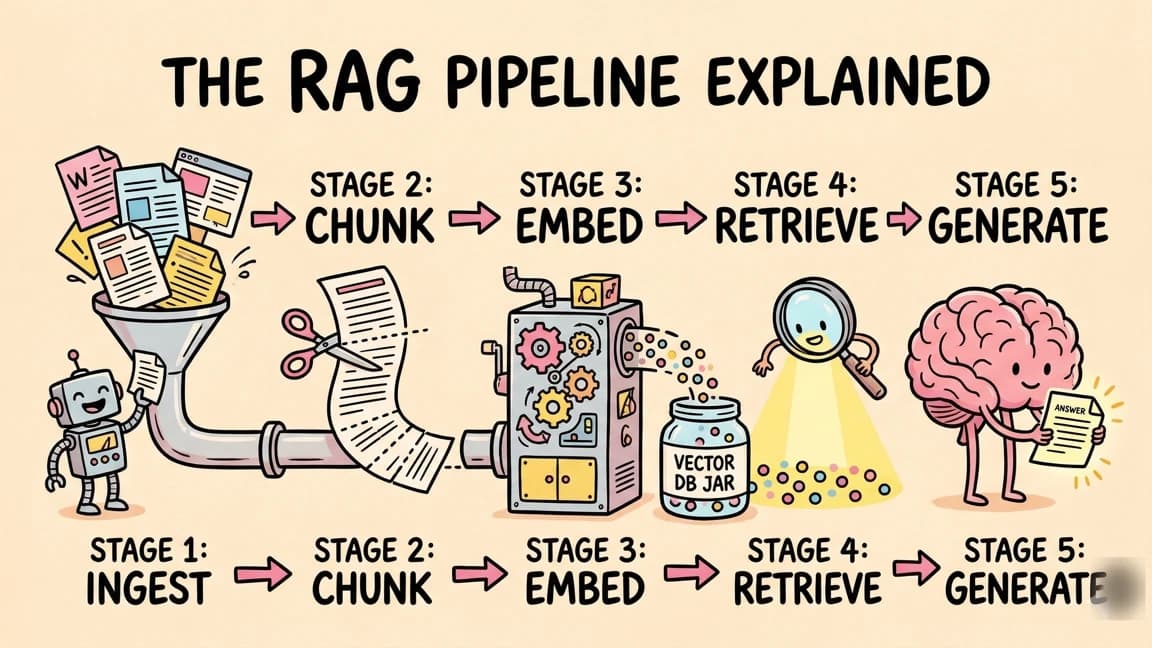
What is RAG? Retrieval Augmented Generation Explained
How RAG works, why it matters, and how to implement it in TypeScript. The technique that lets AI models use your data wi...
5 min read
OpenAI
OpenAI Codex: Terminal and Cloud AI Coding Agent
Codex works from the terminal, cloud tasks, IDEs, GitHub, Slack, and Linear. Here is how to use it and how it compares t...
18 min read
OpenAI
OpenAI vs Anthropic in 2026 - Models, Tools, and Developer Experience
A developer's comparison of OpenAI and Anthropic ecosystems - models, coding tools, APIs, pricing, and which to choose f...

8 min read
AI Agents
AI Agent Memory Needs a Context Ledger
GitHub Trending is full of agent memory and context tools. The useful version is not magic recall. It is a context ledge...
8 min read
AI Security
AI Security Scanners Move the Bottleneck to Triage
Anthropic's Project Glasswing update is a useful signal for developer teams: AI can find vulnerability candidates faster...
10 min read
OpenAI
OpenAI Agents SDK Evolution: What Ships in Production
Configurable memory, sandbox-aware orchestration, Codex-like filesystem tools. Here is how the new Agents SDK actually b...
Build with the member tools

Get Smarter About AI Dev
New tutorials, open-source projects, and deep dives on coding agents - delivered weekly.
One email per weekReal code, not theoryFree forever