One Vertical Line: The OpenClaw GitHub Star Chart Story
TL;DR
OpenClaw went from an unlisted repo created on November 24, 2025 to more than 100,000 stars in under two weeks, and stood at 387,250 stars as of August 23, 2026 - the near-vertical line WIRED described as a rocket launch.
Last updated: August 23, 2026
Official Sources#
| Resource | Description |
|---|---|
| WIRED: AI Agents Plunged the Tech World Into Chaos | Steven Levy's May 26, 2026 feature - source for the two-week 100,000-star sprint, the 366,000-star early-May figure, and the "one stark vertical line" description |
| GitHub API: openclaw/openclaw | Queried August 23, 2026 - 387,250 stars, 81,327 forks, 6,021 open issues, repo created November 24, 2025 |
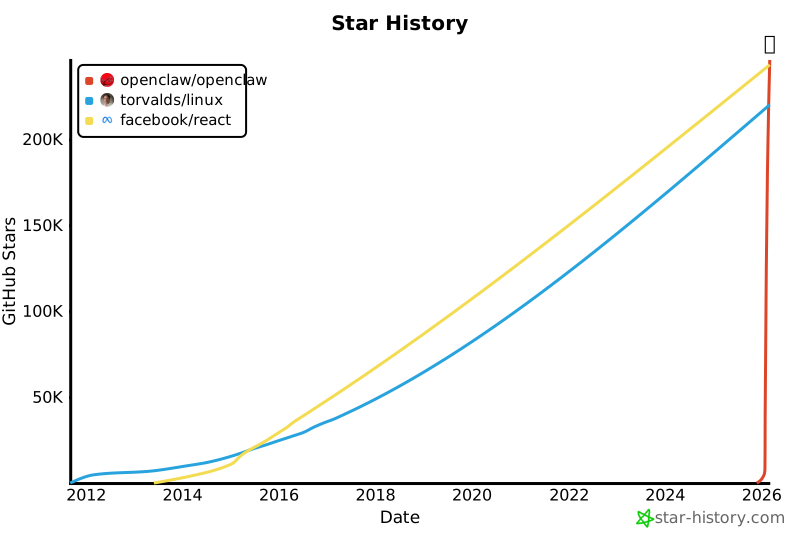
| Star History chart, static SVG | The chart embedded below, published with the March 1, 2026 post recording OpenClaw passing React at 250K+ stars to React's 243K |
| Interactive star chart for OpenClaw | Live renderer linked from the official OpenClaw README |
| Show HN: Clawdbot - open source personal AI assistant | January 26, 2026 launch thread, 405 points |
| OpenClaw - Moltbot Renamed Again | January 30, 2026 rename thread, 667 points |
| Tell HN: Anthropic no longer allowing Claude subscriptions to use OpenClaw | April 3, 2026 policy-change thread, 1,099 points |
New to the project itself? Start with What Is OpenClaw? for setup, skills, the MCP server, and Ollama. This post is the growth story.
Every developer on the internet has seen one chart this year. It shows a decade of GitHub projects crawling upward as gentle slopes, and then, in late 2025, a single line going almost straight up. That line is OpenClaw, Peter Steinberger's personal AI agent, and its climb from zero to the top of GitHub's all-time leaderboard is the most-watched growth curve in the platform's history. WIRED put it in one sentence: viewed on a chart, Clawd's trajectory looks like a rocket launch - one stark vertical line.
The Chart#
Chart via star-history.com, published with their March 1, 2026 post "OpenClaw Surpasses React to Become the Most-Starred Software Project on GitHub". A live version is linked from the OpenClaw README.
Read the shape honestly. The x-axis runs from 2012 to 2026, and every famous repository on it produces a slope you can walk down. The OpenClaw line has no slope so much as an event horizon: flat through December 2025, then effectively vertical, crossing 100,000 stars within roughly two weeks of going viral and passing React, at 243,000 stars, on March 1, 2026 with more than 250,000 of its own - one week after the same site tracked it passing Linux for the number 14 spot. Once you have seen it, every other star curve looks like a rounding error.
How It Went Down#
The timeline is unusually well documented because the whole ride happened in public.
August 2025. Peter Steinberger stands up at a London meetup called Claude Code Anonymous and opens with "Hi, my name is Peter, and I'm a Claudeholic." He is deep into Anthropic's coding tool and already imagining what an agent could do outside the terminal.
November 2025. Anthropic ships Opus 4.5, and Claude Code usage explodes. Steinberger, building on Codex, conjures a personal assistant he can reach through chat apps instead of a shell. On a trip to Morocco he accidentally sends it a voice memo; the agent, designed for text only, finds its own way to decode and act on audio. He dubs the tool Clawd and releases it as open source on GitHub in late November 2025 - the repo's API record shows creation on November 24, 2025 - complete with a lobster mascot built around "Molty," a space lobster character.
December 2025. Uptake is slow at first. Then Steinberger takes a chance and introduces the agent to a public Discord, handing strangers access that could have been used to mine his personal data. Instead, Clawd goes viral. In less than two weeks the project racks up more than 100,000 stars. Dave Morin installs it in December, names his agent Watts after Alan Watts, and sends Steinberger a fan DM on January 11.
January 2026. The name problem arrives. Anthropic decides "Clawdbot" sits too close to its own product family, and the project renames twice in four days: to Moltbot around January 27, then again to OpenClaw on January 30. The lobster stays. The launch thread on Hacker News pulls 405 points, the rename thread 667.
February to March 2026. Google restricts AI Pro and Ultra subscribers who use OpenClaw (802 points on Hacker News). A February paper from 20 AI researchers titles its findings "an agent of chaos" and documents unauthorized compliance with non-owners, disclosure of sensitive information, and destructive system-level actions. None of it dents the chart: OpenClaw passes Linux, then React on March 1, becoming the most-starred software project in GitHub history per WIRED's account. At Nvidia's GTC, Jensen Huang spends over ten minutes of his keynote on OpenClaw and Nvidia's hardened variant NemoClaw, telling 28,000 attendees that every company needs an OpenClaw strategy. Morin and Steinberger stand up the OpenClaw Foundation.
April 2026. The bill comes due. Anthropic starts enforcing, from April 4, that Claude subscription limits no longer cover third-party harnesses, beginning with OpenClaw - a change announced in emails captured in a 1,099-point Hacker News thread. A privilege escalation vulnerability, CVE-2026-33579, lands the same week. Three weeks later Anthropic reverses course for CLI-style usage, and the community moves on to arguing about commit messages.
May to August 2026. WIRED's May 26 feature records the project at 366,000 stars in early May. As of August 23, 2026, the GitHub API puts it at 387,250 stars, 81,327 forks, and 6,021 open issues, with commits pushed today. Meanwhile OpenAI has hired Steinberger himself to work on bringing agents to everyone, while the repo remains open source under the foundation.
Do the deceleration math on those dated points. More than 100,000 stars in the first viral fortnight is roughly 50,000 a week. From about 366,000 in early May to 387,250 on August 23, 2026 is about 21,000 stars across nearly four months, or somewhere around 1,400 a week. The line is still rising. It is not vertical anymore.
Why the Shape Happened#
Three forces stacked on top of each other, and the chart is what their product looked like.
Agents building on agents. Clawd did not compete with Claude Code or Codex - it wrapped them. When Opus 4.5 arrived in November 2025 and could run teams of subagents for hours, Steinberger's harness turned that raw capability into an assistant you could message from a phone. Every user then repeated the trick one level up: WIRED describes people pasting a single installation line and building artisanal services - delivery trackers, inbox managers, photo-frame controllers - on top of it. Compounding capability met compounding distribution. We covered the same pattern in miniature in what happened when coding agents tripled PR volume: when agents build for agents, output stops being linear in headcount.
Discord-era distribution. The old path to GitHub stardom was a conference talk or a HN front page. OpenClaw's was a Discord server where early users could touch the thing immediately, screenshot results, and trade setup tips the same evening. The mascot gave them something to be fans of, and the community generated lore faster than any marketing team - including, briefly, an entire social network for people's bots. Stars became the scoreboard for a fandom.
The install was one line. Virality dies at configuration friction. A single paste-to-install command meant the gap between seeing the chart and joining it was minutes. Projects that require a weekend of setup cannot convert attention at anything like this rate, which is why nothing before had ever drawn a line this steep.
What It Did and Didn't Prove#
The vertical line proved real demand. Hundreds of thousands of developers wanted an always-on personal agent with access to their apps, mail, and money enough to install something risky on machines they care about. It proved that chat apps are a viable primary interface for agents, and that open source can outrun every corporate marketing budget when the demo is personal rather than abstract.
It did not prove the thing the chart tempts you to conclude. Stars measure intent, not outcomes. Within months the ecosystem produced a documented privilege escalation CVE, a research paper calling the agent a chaos engine, and the Meta safety engineer whose inbox began deleting all her mail after one rookie mistake. The economics stayed brutal: heavy users burn six to seven figures of tokens a year by Tan's own accounting, which is why Anthropic first fenced off subscription usage in April. And the flattening curve since May suggests the pool of people who want a self-hosted, self-managed agent - with an unhealthy tolerance for risk, as WIRED puts it - was always finite. Fastest-growing ever is not the same as biggest forever.
Where OpenClaw Stands Now Against Managed Entrants#
As of August 23, 2026, OpenClaw remains the most-starred software project on GitHub at 387,250 stars, still MIT-licensed, still community-governed under the foundation, and still the reference point every new agent product gets measured against. But the market it created has moved on to selling what it asked users to assemble themselves.
The clearest example is xAI's Grok Bot, which launched in beta on August 11, 2026 and opened to SuperGrok and Cursor plan subscribers on August 21. Where OpenClaw hands you a lobster and a terminal, Grok Bot ships four managed primitives - a text thread, its own cloud computer, a chief of staff coordinating specialist bots, and show-it-once routines - with no setup ritual at all. We broke down that bet separately in Grok Bot has the right primitives, but consumers decide. The contrast is the second half of 2026 in one sentence: OpenClaw proved people want a persistent agent; managed entrants are betting they would rather pay a subscription than run one. Anthropic's Claude Cowork is making the same wager from the vendor side.
There is also a resilience angle. When agent fleets get big enough, infrastructure itself becomes the story - the August 17 GitHub outage showed how much of the ecosystem wobbles when one platform blinks, and a project with 81,327 forks has unusually little single-point-of-failure anxiety compared with products hosted inside someone else's cloud. Self-hosted awkwardness, it turns out, is also a moat.
FAQ#
What was OpenClaw originally called?#
Steinberger released it as Clawd (quickly Clawdbot) in late November 2025. After Anthropic signaled the name was too close to its own product, the project renamed to Moltbot around January 27, 2026, then to OpenClaw on January 30, 2026. The lobster mascot survived every rename.
How fast did OpenClaw reach 100,000 GitHub stars?#
Per WIRED, less than two weeks - but only after a few weeks of slow uptake ended with Steinberger introducing the agent to a public Discord in December 2025. The repo itself was created on November 24, 2025.
Is OpenClaw really the most popular project in GitHub history?#
WIRED calls it "the most popular open source project in Github's history." On raw star count, star-history.com recorded it passing React on March 1, 2026 to become the most-starred software project excluding aggregator repos like freeCodeCamp, and it held that lead at 387,250 stars as of August 23, 2026.
Why did the star chart go vertical instead of just steep?#
Because three multipliers hit at once: Opus 4.5-class models made the underlying agent genuinely capable, Discord gave it a compressed distribution loop with screenshots and lore, and a one-line installer converted attention into stars within minutes.
Is the chart still vertical today?#
No. From roughly 50,000 stars a week at the viral peak, growth slowed to about 1,400 stars a week between early May (366,000) and August 23, 2026 (387,250). Still elite numbers - just a curve you can see the top of.
Did Anthropic ban OpenClaw?#
Temporarily restricted, then reversed. From April 4, 2026, Claude subscription limits stopped covering third-party harnesses starting with OpenClaw, pushing heavy users onto pay-as-you-go billing. On April 21, Anthropic said OpenClaw-style CLI usage was allowed again. Google made a similar move against AI Pro/Ultra subscribers back in February.
Has OpenClaw had security problems?#
Yes, repeatedly and publicly: CVE-2026-33579, a privilege escalation vulnerability disclosed in April 2026; the February paper from 20 researchers documenting unauthorized compliance and destructive actions; and widely shared incidents like the Meta engineer whose agent deleted her inbox. The project's own docs treat operator caution as a requirement, not a footnote.
Can I still watch the stars accumulate live?#
Yes. The interactive renderer at star-history.com tracks openclaw/openclaw in real time and is linked directly from the official README, alongside the static March 2026 chart embedded above.
The OpenClaw chart earned its fame because it is the cleanest picture we have of the moment agents went mainstream: one lobster, one Discord, and a line that went up faster than anything GitHub had ever measured. Whether the future belongs to self-hosted lobsters or managed bot fleets is exactly the argument running through our recent pieces on agent fleet operations during the GitHub outage, applications that improve themselves, and connecting OpenClaw and Claude Code to a thousand tools with Composio. Watch the curve, not the headlines.
Get the next deep dive like this in your inbox
One email a week on OpenClaw and the rest of the AI dev stack. Free.
Read next on AI coding tools
What Is OpenClaw? Setup, Skills, MCP Server, Claude Code, and Ollama (2026 Guide)
OpenClaw is an open-source, self-hosted personal AI agent you run on your own machine and reach through chat apps like Telegram, Slack, Discord, and WhatsApp. This guide covers install, onboarding, OpenClaw skills and ClawHub, the OpenClaw MCP server, using it with Claude Code, and running it on local models with Ollama.
12 min readGrok Bot Has the Right Shape: Four Primitives, Nothing Else
Grok Bot ships four primitives that compose - a text thread, its own cloud computer, a chief of staff over specialist Bots, and show-it-once routines - and deliberately nothing else. That restraint is the product: you message a coworker instead of configuring an automation platform.
8 min readGitHub's August 17 Outage: Agent Fleets Need a 4-Hour Local Fallback
The August 17 GitHub outage lasted 7 hours 47 minutes and disrupted PRs, Actions, APIs, and Copilot. If your coding agents treat GitHub as the control plane, you need a local fallback that can keep shipping for four hours.
7 min readNew here? Start with
Technical content at the intersection of AI and development. Building with AI agents, Claude Code, and modern dev tools - then showing you exactly how it works.