Qwen-UI-Agent Points at the Next GUI Agent Runtime
TL;DR
Alibaba's Qwen-UI-Agent report is less interesting as a leaderboard and more interesting as a product spec: mobile, desktop, browser, CLI, and DeepSearch in one stateful agent runtime.
| Research notes | |
|---|---|
| Primary report | arXiv:2607.28227 |
| Hugging Face signal | Qwen-UI-Agent on HF Papers |
| Project page | tongyi-mai.github.io/Qwen-UI-Agent |
| Code release | Tongyi-MAI/Qwen-UI-Agent |
| Google Trends check | Checked August 1, 2026 in the US over the past three months. Exact Qwen UI Agent returned 0 average interest. Broader query averages were AI agent 61.35, Claude Code 58.19, Qwen 11.91, mobile agent 5.62, AI coding agent 4.01, browser agent 3.47, computer use agent 0.81, and GUI agent 0.57. Treat this as durable category framing, not launch demand for the exact product name. |
Last updated: August 1, 2026
The useful thing about Alibaba's new Qwen-UI-Agent report is not that another model claims another set of benchmark wins.
The useful thing is the runtime shape.
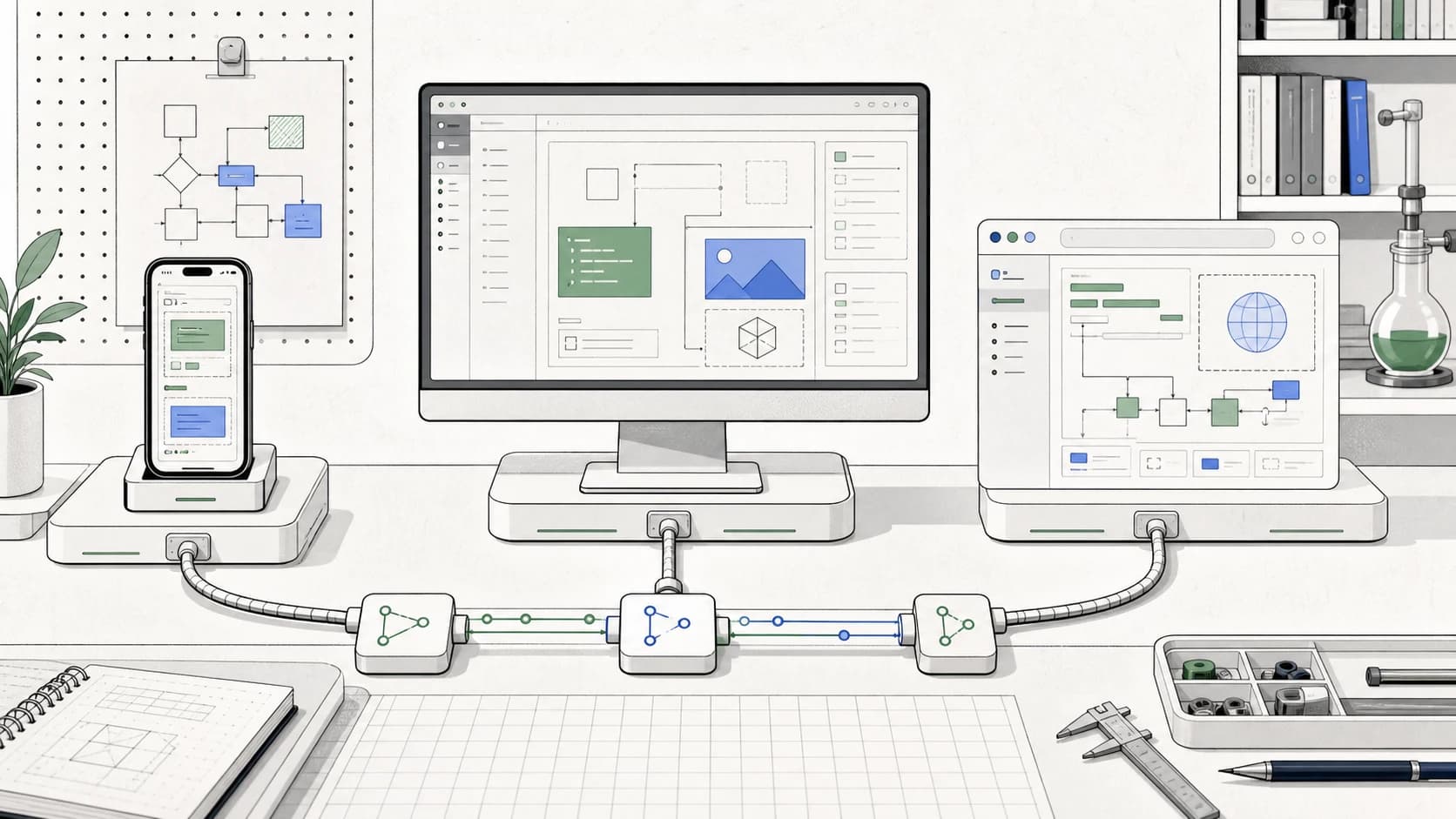
Qwen-UI-Agent, published July 30 and surfaced on Hugging Face Papers, frames GUI agents as cross-platform executors: mobile, desktop computer use, browser tasks, CLI actions, and DeepSearch inside one training and harness system. That is a different ambition from "the model can click buttons." It is closer to saying the operating environment for agents is becoming a product surface.
If you are building with OpenAI computer use, Codex and Claude Code controls, or browser-based research agents, the takeaway is practical: GUI agents are moving from single-app demos toward stateful workflows that mix screens, shells, search, and long-horizon recovery.
What Qwen-UI-Agent Actually Claims#
The report describes Qwen-UI-Agent as a real-world-centric foundation GUI agent spanning mobile, computer-use, web, and DeepSearch environments. The system combines sandbox environments with a large-scale real-device mobile runtime. Its action space can interleave GUI operations with CLI execution, and it can generate batched actions in a single model turn.
That combination matters because real user workflows are rarely pure GUI work.
A useful agent may need to:
- inspect a page in a browser
- switch to a mobile app
- run a CLI command
- search the web for missing context
- return to the original interface
- remember what changed across the whole workflow
The Qwen team also describes an AutoResearch-style data flywheel where agents construct tasks and environments, diagnose failures, and plan later training iterations. Online reinforcement learning supports trajectories longer than 100 turns, with more than 10,000 concurrent environments accelerating rollout.
Those details are easy to skim past. They are the real story. The benchmark table is the proof claim. The harness, data flywheel, and action model are the architecture claim.
The Benchmark Numbers Are Useful, But Not Sufficient#
The report says Qwen-UI-Agent reaches 82.1% on MobileWorld, 92.2% on MobileWorld-Real, and 97.5% on AndroidDaily. For computer use, it reports 79.5% on OSWorld-Verified and 40.0% partial progress on OSWorld-v2. For browser use, it reports 73.6% on WebArena, plus 81.5% on ScreenSpot-Pro with zoom.
Those are strong numbers, especially on mobile. The project page also compares against frontier systems including Claude Opus 4.8, Gemini 3.1 Pro, GPT-5.6 Sol, GPT-5.5, Seed 2.1 Pro, and Qwen 3.7 Plus.
But the safe reading is narrow. These are reported evaluation results in the authors' setup. Some baseline values on the project page are marked as author-reproduced rather than copied from model-provider reports. That does not make them useless. It does mean you should not turn the chart into a universal "best GUI agent" claim.
For developers, the more durable lesson is this:
GUI-agent quality is no longer just visual grounding. It is workflow control.
Can the agent keep state over many turns? Can it recover from UI drift? Can it use a shell when a shell is the right tool? Can it ask search when the screen does not contain enough evidence? Can the harness tell whether partial progress was real?
That is the bar production teams should copy.
The CLI Part Is the Product Clue#
The most interesting design choice is the unified action space that mixes GUI operations and CLI execution.
That may sound like an implementation detail. It is not. It is the bridge between computer-use agents and coding agents.
Developers already know this from terminal agents. A capable agent does not only edit files. It searches, runs tests, reads logs, checks git state, opens docs, and uses repo-specific tools. The screen is just another source of state. The shell is another actuator. Search is another evidence channel.
The same pattern appears in SearchOS, which treats research progress as shared state rather than a growing chat transcript. It appears in long-horizon terminal benchmarks, where partial progress and recovery matter more than a single final answer. It appears in agent context reduction, where the system has to decide which evidence belongs in the next step.
Qwen-UI-Agent pushes that pattern into GUI work. The agent should not be trapped inside pixels when a CLI command can answer the question. It should not be trapped inside a terminal when the task requires a mobile UI. It should not be trapped inside one browser tab when the workflow spans multiple tools.
That is why the runtime matters more than the mascot model name.
From the archive
The RipGrep Musl Segfault That Led to a One-Line Linux Kernel Patch
Aug 1, 2026 • 7 min read
Stateless MCP Is Here: What the 2026-07-28 Spec Changes and How to Host a Fleet of Servers on One Bun Process
Aug 1, 2026 • 7 min read
The Fix for Broken Benchmarks Is Architecture, Not Smarter Models
Aug 1, 2026 • 11 min read
Vercel AI Gateway Adds Team and Project Spend Budgets: The Cost-Cap Math for Agent Builders
Aug 1, 2026 • 5 min read
What Builders Should Copy#
Most teams will not run Qwen-UI-Agent directly this week. That is fine. The patterns are still useful.
First, separate grounding from workflow. A model that can click the right button is necessary, but not enough. Your product needs state, permissions, task receipts, retry policy, and a way to preserve evidence across turns.
Second, give the agent more than one action channel. Browser-only agents hit a ceiling. Shell-only agents hit a ceiling. Mobile-only agents hit a ceiling. A useful worker should route between the UI, CLI, APIs, search, and repository context with explicit permissions.
Third, track partial progress. OSWorld-v2 partial-progress scoring is a better mental model than all-or-nothing demos. A real agent can fail the final step and still produce useful state: what it tried, what changed, what evidence it found, which screen blocked it, and what should happen next.
Fourth, build failure memory into the harness. The report's AutoResearch-style loop is a reminder that agent improvement is not only a model-training problem. Your product can capture failed trajectories, classify the cause, and feed that into prompts, tests, tools, and task design before you ever fine-tune a model.
The Counterargument#
There is a real risk in this category: broad agents can become broad liabilities.
An agent that can operate a phone, a browser, a desktop, a shell, and search has a much larger blast radius than a chatbot. It can leak data through the wrong channel, click through a destructive flow, mix stale web evidence with current app state, or execute a command that no UI-only agent could have reached.
That is why a cross-platform GUI agent needs stronger controls than a normal assistant:
- per-channel permissions
- visible action receipts
- task-scoped credentials
- sandboxed browsers and devices
- reversible operations where possible
- durable logs for screen actions and shell commands
- human checkpoints before irreversible changes
This is also why the security and governance work around coding agents carries over. The same approval-boundary lessons from Codex and Claude Code controls apply when the agent's workspace is a whole device.
The Search Demand Reality#
Google Trends does not show durable demand for the exact phrase Qwen UI Agent yet. That is normal for a paper that just appeared.
The adjacent category is different. AI agent and Claude Code are durable high-interest lanes. Qwen, mobile agent, browser agent, and AI coding agent have enough signal to frame the query cluster, but not enough to pretend this exact release has mainstream search demand.
So this should not be treated as a broad SEO post about a household product. It is a developer-infrastructure post about a research signal: GUI agents are becoming multi-channel runtimes.
That makes it worth covering now, before the category gets flattened into another leaderboard.
What To Watch Next#
The next serious GUI-agent releases should be judged less by isolated screen-click benchmarks and more by runtime evidence:
- Does the agent mix GUI, CLI, browser, API, and search actions cleanly?
- Can it explain which channel it used and why?
- Can it preserve state across long workflows without trusting stale assumptions?
- Does it expose partial progress when it fails?
- Are credentials scoped by task and channel?
- Can teams replay the action trace after an incident?
If the answer is no, the demo may still be impressive. It is just not a production worker yet.
Qwen-UI-Agent is worth watching because it points at the right product boundary. The future GUI agent is not a model that clicks screens. It is a controlled runtime that can act across the interfaces where work actually happens.
FAQ#
What is Qwen-UI-Agent?#
Qwen-UI-Agent is Alibaba's research GUI agent for mobile, desktop computer-use, browser, and DeepSearch workflows. The July 2026 technical report describes a unified action space that can combine GUI operations and CLI execution.
Is Qwen-UI-Agent open source?#
The project has a public GitHub repository for the technical-report website and release materials. Treat the release status of model weights, training data, and runtime components as source-specific and verify the linked repository before planning production use.
Why does Qwen-UI-Agent matter for developers?#
It matters because it frames GUI agents as cross-platform runtimes rather than isolated clickers. Developer workflows increasingly span browsers, terminals, apps, device state, and search, so agent systems need explicit routing and receipts across those channels.
How is a GUI agent different from a coding agent?#
A coding agent usually operates over files, commands, tests, and repository state. A GUI agent operates through visual interfaces. The interesting category is the overlap: agents that can use both UI actions and CLI/API tools inside one governed workflow.
Should teams build around GUI agents now?#
Start with narrow, auditable workflows. Use GUI agents where screen interaction is truly required, keep credentials scoped, log actions, and require human approval before irreversible operations. Do not give a broad GUI agent full device control just because a benchmark looks strong.
Continue Reading#
- GPT-5.4 Developer Guide: Computer Use, Reasoning, and Production Tradeoffs
- Codex and Claude Code Controls Show Where Agent Products Are Going
- SearchOS Shows Deep Research Agents Need Shared State
- Long-Horizon Terminal Bench And The New Agent Eval Bar
- Agent Context Reduction Pattern
- StateAct Shows Computer-Use Agents Need Program State, Not Just Pixels
Sources#
- Qwen-UI-Agent Technical Report on arXiv, submitted July 30, 2026 and fetched August 1, 2026.
- Qwen-UI-Agent on Hugging Face Papers, fetched August 1, 2026.
- Qwen-UI-Agent project page, fetched August 1, 2026.
- Tongyi-MAI/Qwen-UI-Agent GitHub repository, fetched August 1, 2026.
- Hugging Face July 2026 monthly papers, fetched August 1, 2026.
- Google Trends query clusters checked August 1, 2026 with patched local pytrends:
Qwen UI Agent,Qwen agent,browser agent,mobile agent,AI agent,GUI agent,computer use agent,AI coding agent,Claude Code, andQwen.
Read next
GPT-5.4 for Developers: The Production Guide
GPT-5.4 ships state-of-the-art computer use, steerable thinking, and a million-token window. Here is the implementation guide for builders, with real OpenAI SDK code, the 272K pricing cliff, and where it actually beats 5.3 and 5.5 in production.
12 min readCodex and Claude Code in July 2026: Agent Controls Are the Feature
The late-July Codex and Claude Code updates point in the same direction: coding agents are competing on approval modes, resumable work, MCP auth, artifacts, and review surfaces as much as raw model quality.
8 min readSearchOS Shows Deep Research Agents Need Shared State
SearchOS turns web research from a growing chat transcript into shared state: frontier tasks, evidence graphs, coverage maps, and failure memory. That is the pattern serious deep-research agents need.
8 min readShare
Developers Digest
Technical content at the intersection of AI and development. Building with AI agents, Claude Code, and modern dev tools - then showing you exactly how it works.
300+ videos30K+ GitHub stars850+ articles
Related Tools
AI CodingOpen source

DeepSeek-TUI
Open-source terminal agent runtime with approval modes, rollback snapshots, MCP servers, LSP diagnostics, and a headless...
View ToolAI FrameworksAgent UI

CopilotKit
Frontend stack for agent-native apps. React hooks, prebuilt copilot UI, AG-UI runtime, frontend tools, shared state, and...
View ToolAI Frameworks
C
Composio
Gives AI agents access to 250+ external tools (GitHub, Slack, Gmail, databases) with managed OAuth. Handles the auth and...
View ToolAI Frameworks

OpenAI Agents SDK
Lightweight Python framework for multi-agent systems. Agent handoffs, tool use, guardrails, tracing. Successor to the ex...
View ToolApps from Developers Digest
SaaS Products
Overnight Agents
Spec out AI agents, run them overnight, wake up to a verified GitHub repo.
View AppDeveloper Tools
Agent Hub
Every coding agent in one window. Stop alt-tabbing between Claude, Codex, and Cursor.
View AppDeveloper Tools
DD Traces
See exactly what your agent did, locally. No cloud, no signup.
View AppRelated Guides
Guide
Claude Code Setup Guide
Configure Claude Code for maximum productivity -- CLAUDE.md, sub-agents, MCP servers, and autonomous workflows.
AI AgentsGuide
MCP Servers Explained
What MCP servers are, how they work, and how to build your own in 5 minutes.
AI AgentsGuide
Building Your First MCP Server
Step-by-step guide to building an MCP server in TypeScript - from project setup to tool definitions, resource handling, testing, and deployment.
AI AgentsRelated Videos

Buzz: Open-Source Collaboration for Humans + AI Agents
Buzz by Block: Open-Source Slack-Style Collaboration for Humans + AI Agents (Demo & Setup) Check out Arcade: https://arcade.dev.plug.dev/xiDRwlA Repo: https://github.com/block/buzz The video introd...
Video·

Agents 101: How to Build and Deploy Anything with AI Agents
Build Anything with Vercel, the Agentic Infrastructure Stack Check out Vercel: https://vercel.plug.dev/cwBLgfW The video shows a behind-the-scenes walkthrough of how the creator rapidly builds and d...
Video·
TRAE: Custom AI Agents That Actually Understand Your Codebase
Check out Trae here! https://tinyurl.com/2f8rw4vm In this video, we dive into @Trae_ai a newly launched AI IDE packed with innovative features. I provide a comprehensive demonstration...
Video·
Related Posts

12 min read
OpenAI
GPT-5.4 for Developers: The Production Guide
GPT-5.4 ships state-of-the-art computer use, steerable thinking, and a million-token window. Here is the implementation...
8 min read
Codex
Codex and Claude Code in July 2026: Agent Controls Are the Feature
The late-July Codex and Claude Code updates point in the same direction: coding agents are competing on approval modes,...
8 min read
AI Agents
SearchOS Shows Deep Research Agents Need Shared State
SearchOS turns web research from a growing chat transcript into shared state: frontier tasks, evidence graphs, coverage...
11 min read
AI Agents
Terminal-Bench Shows Harness Scaling Is the Coding-Agent Benchmark Now
StateM pushes Terminal-Bench 2.1 to 95.3% raw accuracy by scaling the harness around the model. The lesson for coding-ag...
8 min read
Context Engineering
The 98% Context Reduction Pattern
Efficient agents do not stuff every tool result into the model context. They keep intermediate state in code, files, and...
7 min read
AI Agents
Terminal-Universe Turns Agent Traces Into Training Environments
Qwen's Terminal-Universe paper argues that terminal-agent trajectories are more useful when you reconstruct the workspac...
Build with the member tools

Get Smarter About AI Dev
New tutorials, open-source projects, and deep dives on coding agents - delivered weekly.
One email per weekReal code, not theoryFree forever