RTX Spark for Local LLMs: Will It Run a Coding Agent?
TL;DR
NVIDIA's RTX Spark laptops ship October 16 with up to 128 GB of unified memory. What the specs say, the 600 GB/s number that is not memory bandwidth, and which local coding models fit.
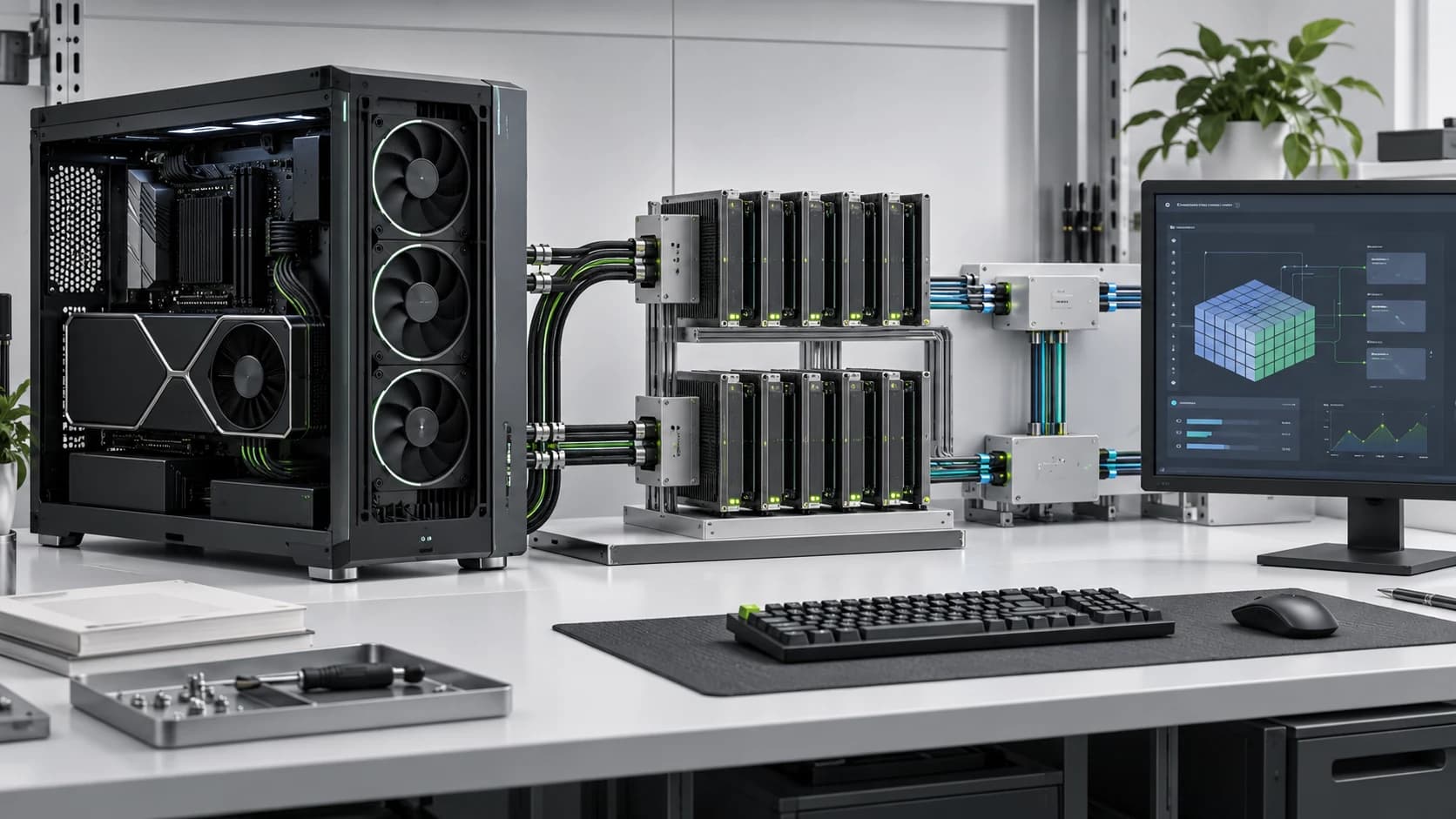
NVIDIA RTX Spark laptops go on sale October 16 with up to 128 GB of unified memory and a petaflop of FP4 compute, and NVIDIA says they run models "up to 120B parameters with 1M context." For local LLMs the number that decides your coding-agent speed is memory bandwidth, and NVIDIA's own spec table does not list one. The 600 GB/s figure in the launch post is the link between the CPU and GPU, not the memory. Below: what NVIDIA actually published, a back-of-envelope ceiling for the models developers run, and what to check before you preorder.
We have not tested an RTX Spark machine; none are in the wild yet. Everything here is NVIDIA's spec sheet, community estimates labelled as such, and arithmetic you can redo.
What NVIDIA published#
The launch post from October 7 says laptop preorders opened that day, laptops ship Friday, October 16, and compact desktops follow in November. Systems come from Acer, ASUS, Dell, HP, Lenovo, Microsoft, MSI and Gigabyte. The RTX Spark product page lists two N1X configurations:
| Top configuration | Smaller configuration | |
|---|---|---|
| GPU | 6,144-core Blackwell | 5,120-core Blackwell |
| CPU | 20-core Grace | 18-core Grace |
| Memory | up to 128 GB LPDDR5X | up to 64 GB LPDDR5X |
| Power (laptop) | 45 - 80 W | 45 - 80 W |
| OS | Windows 11 | Windows 11 |
The desktop version uses the 140 W top configuration. NVIDIA's headline claims are one petaflop of FP4 AI performance, full CUDA support, and local models "with no API bills." Prices are not on NVIDIA's page; they come from each laptop maker.
The 600 GB/s that is not memory bandwidth#
The launch post describes the Grace CPU as "connected at 600 GB/s" to the GPU. That is the chip-to-chip link. The spec table has a row for memory type (unified LPDDR5X) and capacity, and no row for memory bandwidth.
That matters because token generation is mostly a memory-reading job. Each new token needs the active weights streamed from memory once, so a rough ceiling on speed is memory bandwidth divided by bytes read per token. The community noticed the gap on day one: an r/LocalLLaMA thread titled "RTX Spark does not have 600GB/s Bandwith" argues the number is the interconnect, and on Hacker News a commenter put memory bandwidth near 300 GB/s with the 600 GB/s as "internal" and irrelevant to inference. NVIDIA's earlier DGX Spark is widely cited at 273 GB/s. One r/LocalLLM reply guesses 400 GB/s for the laptops. None of these appears in NVIDIA's launch post or product-page spec table, so treat the range as roughly 273 to 400 GB/s until NVIDIA or a reviewer publishes a measured figure.
A ceiling you can calculate#
Decode speed ceiling (tokens per second) is roughly bandwidth divided by the gigabytes of weights read per token. It ignores compute, KV cache reads and overhead, so real speeds land below it. Using 300 GB/s as an assumed middle value:
| Model | Weights read per token | Ceiling at 300 GB/s |
|---|---|---|
| Qwen3.8-27B dense, 4-bit (18 GB download, per our guide) | about 18 GB | about 16 tok/s |
| Qwen3.8-27B dense, 8-bit (30 GB) | about 30 GB | about 10 tok/s |
| Qwen3.8-Flash-Next, 6B active per token, 4-bit (rough) | about 3.5 GB | about 85 tok/s |
The Flash Next row is a rough estimate: the model card lists 125B total and 6B activated parameters, and we assume about 0.55 bytes per parameter at 4-bit. It reads only the active experts per token, which is why the 125B model can beat the 27B dense model on this kind of hardware. Qwen's own 27B launch numbers and the Flash Next speeds are covered in the Strata walkthrough, where a 12 GB gaming GPU plus 64 GB of RAM reaches 53 to 94 tokens per second by the Strata author's measurements.
The takeaway: 128 GB of fast-enough memory is a capacity story. It lets you hold a big sparse model and a long context at once. It does not make a dense 27B model fly. A dense model on this class of hardware lands in the "usable for chat, slow for agent loops" band, and agent loops make dozens of model calls per task.
What a builder does Monday#
- Do not preorder on the petaflop number. Wait for a review that reports tokens per second for a named model and quantization, with the runtime and context length stated.
- When you have a machine, measure instead of trusting any table. With Ollama,
ollama run qwen3.8:27b --verboseprints an eval rate after each reply; run it with a long prompt, because speed drops as context grows. The model tag comes from the Ollama library as cited in our Qwen guide. - Check the runtime before the hardware. The spec table lists Windows 11 only, on an Arm CPU. Confirm your runtime (compared here) ships a Windows Arm build with CUDA, or you will be waiting on ports. NVIDIA says CUDA runs natively, which is the real advantage over AMD and Apple options.
- Point your agent at a sparse model first. The best local coding models list is the place to compare sizes by hardware tier.
Who wins and loses#
CUDA is the differentiator. A developer who wants vLLM, TensorRT or NVFP4 kernels on a thin laptop, and the same stack on a DGX box later, has no other option. NVIDIA's pitch is that code moves from the laptop to its larger systems unchanged.
The pressure lands on two groups. Apple's high-memory laptops and AMD's Strix Halo machines compete on the same memory-bandwidth axis, and the HN thread kept comparing against both; one commenter called the bandwidth "more akin to the Strix Halo." And for the dual-GPU desktop crowd, a $2k used-GPU build still has far higher bandwidth per dollar at 48 GB, with no battery and a lot more noise.
What people are actually saying#
- Disappointment on bandwidth. The most upvoted line of criticism on the Hacker News thread (428 points) is that capacity is great but bandwidth looks like a DGX Spark repeat. One commenter lists a 5090 at roughly 1,792 GB/s against the Spark class at 273 GB/s and says it "will cap inference rate pretty heavily."
- CUDA as the reason to buy. Other commenters agree the chip is similar to Strix Halo but argue CUDA support is what developers want.
- Skepticism about the headline compute. One commenter says the petaflop figure applies to sparse models and is about half that for dense ones. NVIDIA's page says only "up to 1 petaflop FP4."
- Windows on Arm doubts. Several comments question whether Windows on Arm will attract enough software; others point out that most games and creative apps are shipping Arm builds.
- Buyers' remorse reports exist. A r/LocalLLaMA thread from someone who returned an ASUS Spark box says the missing 600 GB/s memory bandwidth was the deal-breaker. That is about the DGX Spark class, not the new laptops.
Those threads are opinion and early measurements, not benchmarks. The HN thread dates from the Computex announcement, so it predates the final retail specs.
Continue Reading#
- Run Qwen3.8-Flash-Next on a Gaming PC With Strata - the sparse 125B model on a 12 GB GPU
- Qwen3.8-27B vs Opus 4.6 Max: Local Agentic Coding Benchmarks - the dense model that sets the bandwidth ceiling above
- The Best Local Coding LLMs in 2026 - what to run by hardware tier
- Ollama vs LM Studio vs vLLM vs llama.cpp - picking a runtime for agents
- Jamesob's Guide to Running SOTA LLMs Locally - the desktop GPU alternative
Sources#
- NVIDIA Blog: NVIDIA, Microsoft Kick Off a New Beginning for Windows PCs With RTX Spark and AI Agents - October 7, 2026 (vendor)
- NVIDIA RTX Spark product page and specs - read October 14, 2026 (vendor)
- Qwen3.8-Flash-Next model card - parameter counts
- Hacker News: Nvidia RTX Spark
- r/LocalLLaMA: RTX Spark does not have 600GB/s Bandwith
- r/LocalLLaMA: DGX Spark has 273GB/s memory bandwidth
- r/LocalLLaMA: It felt good to return my Asus Spark
- Ollama library: qwen3.8 tags
Get the next deep dive like this in your inbox
One email a week on Local Models and the rest of the AI dev stack. Free.
Read next on local and open-weight models
Run Qwen3.8-Flash-Next on a Gaming PC With Strata
Strata runs the 125B Qwen3.8-Flash-Next on a 12 GB GPU with 64 GB of RAM at up to 94 tokens per second. Hardware needs, speeds by quant, the license catch, and when the $0.15 hosted API is the better call.
8 min readQwen3.8-27B vs Opus 4.6 Max: Local Agentic Coding Benchmarks
Qwen3.8-27B is a 27B dense Apache-2.0 model that beats Opus 4.6 Max on SWE-bench Pro (61.7 vs 53.4). Benchmarks, hardware, cost and when to run it.
10 min readThe Best Local Coding LLMs in 2026: Run Enterprise-Grade AI Without the Cloud
Choosing a local coding LLM in 2026 means balancing benchmark performance, hardware cost, and the compliance pressure to keep code off third-party servers. Here is what to run and on what hardware.
8 min readNew here? Start with
Technical content at the intersection of AI and development. Building with AI agents, Claude Code, and modern dev tools - then showing you exactly how it works.