Unstract: Open-Source AI Document Parsing at Scale
TL;DR
Unstract is an open-source, no-code platform that uses LLMs to extract structured JSON from PDFs, invoices and scans. How Prompt Studio and self-hosting work.
Last updated: June 6, 2026
Every organization has the same problem: important information locked inside unstructured documents. Invoices, contracts, receipts, medical forms, bank statements, handwritten notes. The data exists, but it is trapped in formats that software cannot easily consume. Traditional approaches to this problem involve either manual data entry (expensive, slow, error-prone) or brittle rule-based parsers that break whenever the document format changes slightly.
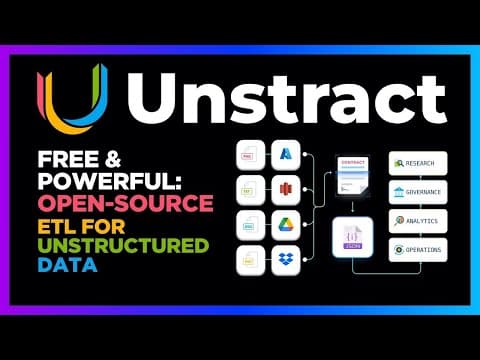
Unstract takes a different approach. It is an AI-powered, no-code platform that uses large language models to extract structured data from virtually any document type. Upload a PDF, define the fields you want to extract, and the model returns clean, structured JSON that you can store in a database, pipe into an API, or feed into downstream systems. The platform is open source and available on GitHub, with a hosted version for teams that want a managed solution.
The Problem with Unstructured Data#
The scale of the unstructured data problem is hard to overstate. In many organizations, entire teams of data entry specialists spend their days reading documents and manually entering information into systems. This was the reality at countless companies for decades - and in many industries, it still is.
The issue is not just cost. Manual data entry introduces errors. Humans misread numbers, skip fields, and make transcription mistakes. When the volume of documents is high, these errors compound. A single misread invoice number can cascade through accounting systems. A wrong address on a form can delay processing for weeks.
Rule-based document parsers were the first attempt at automation. You define patterns - "the total amount is always on the third line from the bottom" or "the customer name follows the word 'Attn:'" - and the parser follows those rules. This works until the document format changes, the font is different, the layout shifts, or you receive documents from a new vendor with a different template. Then the rules break and someone has to write new ones.
LLM-based document parsing sidesteps this fragility entirely. Instead of rigid rules, you describe what you want in natural language. "Extract the customer name, address, and payment total from this invoice." The model reads the document, understands the layout and content, and returns the requested data. If the invoice format changes, the model adapts. If a field is in an unexpected location, the model still finds it.
How Unstract Works#
The core workflow in Unstract revolves around the Prompt Studio, a visual interface where you define extraction schemas for your documents.
Here is how it works in practice:
- Upload a document. This can be a PDF, scanned image, or any supported file format.
- Define extraction keys. For a credit card statement, you might define keys like "issuer name," "customer name," "customer address," "payment info," and "line items."
- Add descriptions for each key. This is where you tell the model what each field means. For "customer name," you write: "The customer to whom this credit card statement belongs." For "issuer name": "The bank or financial institution that issued this credit card."
- Specify data types. Each key can be text, number, date, or other structured types.
- Run the extraction. The model processes the document and returns structured JSON with all the requested fields populated.
The extracted data comes back in a clean format ready for API consumption:
{
  "issuer_name": "Chase Bank",
  "customer_name": "Jane Smith",
  "customer_address": "123 Main St, Springfield, IL 62701",
  "minimum_payment": 205.39,
  "line_items": [
    { "description": "Amazon.com", "amount": 89.99 },
    { "description": "Whole Foods Market", "amount": 67.42 }
  ]
}
The Prompt Studio is organized around projects. You create separate projects for different document types - one for invoices, one for resumes, one for contracts. Each project has its own extraction schema and can process batches of documents. Upload a stack of invoices, run the extraction, and get structured data for all of them.
Workflows and API Deployment#
Beyond the Prompt Studio, Unstract supports workflows that chain together multiple processing steps. A workflow might include:
- File classification: Automatically sort incoming documents into categories based on content.
- Text extraction: Convert documents to their text representation.
- Data extraction: Pull specific fields from the text using the LLM.
- Validation: Cross-check extracted data against business rules.
Once a workflow is configured, you can deploy it as an API endpoint. The deployment generates ready-to-use code in JavaScript, Python, and curl. Send a document to the endpoint, get structured data back. This makes it straightforward to integrate Unstract into existing systems - a webhook from your email system when an invoice arrives, a file watcher on a shared drive, or a manual upload interface for processing teams.
ETL Pipelines#
For organizations that need to move extracted data directly into databases or data warehouses, Unstract includes ETL pipeline support. You configure the source (documents), the transformation (AI extraction), and the destination (your database).
Supported destinations at the time of recording include Snowflake, Redshift, BigQuery, PostgreSQL, MySQL, and several others. This means you can build a pipeline where documents arrive, get processed by the AI, and the extracted data flows directly into your analytics infrastructure without any intermediate steps.
LLM Flexibility#
One of Unstract's strengths is its flexibility in model selection. The platform supports a wide range of LLM providers:
- Ollama for fully local, private processing
- Anthropic (Claude)
- OpenAI (GPT-4o and others)
- Google (Gemini)
- AWS Bedrock
- Azure OpenAI
- Mistral
- Vertex AI
- Replicate (coming soon)
This flexibility matters for several reasons. Different organizations have different compliance requirements about where data can be processed. Some industries require data to stay on-premises, making Ollama the right choice. Others have existing cloud provider relationships and want to use the same infrastructure. Unstract accommodates all of these scenarios.
You can also switch models without changing your extraction logic. If a new model releases with better document understanding, you plug it in and your existing workflows benefit immediately.
Vector Database Integration#
Unstract also supports vector database integration for document search and retrieval. The platform connects to PostgreSQL (pgvector), Pinecone, Weaviate, Milvus, and others.
The vector approach works by converting document text into numerical embeddings - dense mathematical representations that capture meaning. When you search for information across thousands of documents, the system compares your query embedding against the stored document embeddings and returns the most semantically relevant results.
This is fundamentally different from keyword search. A keyword search for "overdue payment" only finds documents containing those exact words. A vector search finds documents about late invoices, missed payments, outstanding balances, and delinquent accounts - because the embeddings capture the meaning, not just the words.
For organizations with large document archives, combining AI extraction with vector search creates a powerful capability: ask questions about your documents in natural language and get accurate, sourced answers.
LLM Whisperer: Handling Difficult Documents#
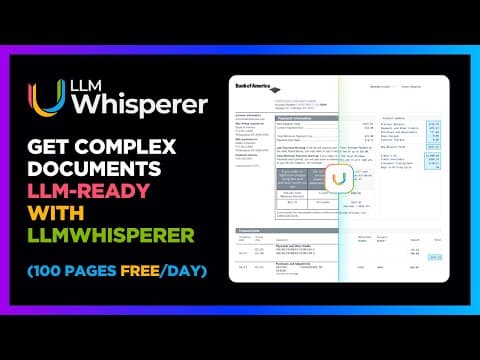
One of the more impressive features in the Unstract ecosystem is LLM Whisperer, a text extraction engine designed specifically for challenging documents. Scanned PDFs, crooked images, handwritten text, forms with checkboxes - the kinds of documents that trip up traditional OCR.
The key differentiator is layout preservation. LLM Whisperer does not just extract text. It maintains the spatial relationships between elements on the page. A form with columns, checkboxes, and handwritten entries comes through with the structure intact. This matters because the layout often carries meaning. A checkbox in a specific column means something different than the same text in a different column.
Testing with a real bank application form - complete with handwritten text, crooked scanning, and checkbox fields - showed accurate extraction of names, social security numbers, addresses, and checkbox states. The output preserved the document layout, making it usable as input for LLM-based data extraction.
LLM Challenge: Dual Verification#
A particularly thoughtful feature is LLM Challenge, available in the Prompt Studio. When enabled, the system uses two separate LLMs to independently extract data from the same document. The results are compared, and discrepancies are flagged. This dual-extraction approach catches hallucinations early in the process.
LLMs occasionally fabricate information when extracting data from documents, especially when a field is ambiguous or the text is partially illegible. Having a second model independently verify the extraction significantly reduces the risk of incorrect data entering your systems. For high-stakes document processing - financial records, legal contracts, medical forms - this kind of verification is essential.
Self-Hosting#
The open-source version of Unstract is available on GitHub. Setup is straightforward: clone the repository, run the startup command, and access the platform on a local port. This gives you the full platform running on your own infrastructure, which matters for organizations with strict data residency requirements.
The hosted version offers a 14-day free trial for teams that want to evaluate without managing infrastructure. For production use, the hosted version handles scaling, updates, and maintenance.
Who Should Use Unstract#
Unstract is most valuable for organizations that process high volumes of documents regularly. If your team spends significant time extracting data from PDFs, invoices, contracts, or forms, this is the category of tool that can reduce that work by an order of magnitude.
The no-code interface makes it accessible beyond the engineering team. Operations staff, finance teams, and compliance officers can configure extraction schemas without writing code. The API deployment option means engineers can integrate document processing into existing systems when needed.
For developers building document processing into their applications, Unstract provides a higher-level abstraction than calling LLM APIs directly. Instead of writing prompts, handling document parsing, managing extraction logic, and building verification pipelines, you configure it visually and deploy it as an API.
The open-source model also means you can inspect the code, contribute improvements, and customize the platform for your specific needs. For organizations that need document AI but cannot send sensitive documents to a third-party cloud service, self-hosted Unstract with a local Ollama backend provides a fully private pipeline.
Official Sources#
| Resource | Link |
|---|---|
| Unstract Homepage | unstract.com |
| Unstract GitHub Repository | github.com/Zipstack/unstract |
| Unstract Documentation | docs.unstract.com |
| LLM Whisperer | unstract.com/llmwhisperer |
| Zipstack (Parent Company) | zipstack.com |
| Unstract Blog | unstract.com/blog |
FAQ#
What is Unstract and how does it differ from traditional document parsers?#
Unstract is an open-source, no-code platform that uses large language models to extract structured data from PDFs, invoices, scanned documents, and other unstructured files. Unlike traditional rule-based parsers that break when document formats change, Unstract uses natural language descriptions to define extraction schemas. You describe what you want - "extract the customer name, address, and payment total" - and the LLM adapts to different layouts, fonts, and document structures automatically. This eliminates the brittle pattern-matching that made legacy document automation systems expensive to maintain.
Can I run Unstract on my own infrastructure for data privacy?#
Yes. Unstract is fully open source under the AGPL-3.0 license and can be self-hosted on your own infrastructure. For organizations with strict data residency requirements, you can pair self-hosted Unstract with a local LLM backend like Ollama, creating a completely private document processing pipeline where no data leaves your network. Clone the repository from GitHub, run the startup command, and access the platform locally.
What LLM providers does Unstract support?#
Unstract supports a wide range of LLM providers: Ollama for local processing, Anthropic (Claude), OpenAI (GPT-4o and others), Google Gemini, AWS Bedrock, Azure OpenAI, Mistral, and Vertex AI. This flexibility lets you choose based on compliance requirements, existing cloud relationships, or cost considerations. You can also switch models without changing extraction logic - if a better model releases, plug it in and your existing workflows benefit immediately.
How does LLM Whisperer handle difficult documents like scanned PDFs or handwritten text?#
LLM Whisperer is Unstract's specialized text extraction engine for challenging documents. Unlike standard OCR that just extracts text, LLM Whisperer preserves spatial relationships between elements on the page. Scanned PDFs, crooked images, handwritten entries, and checkbox forms come through with layout intact. This matters because document structure often carries meaning - a checkbox in column A means something different than the same text in column B. Testing with bank application forms containing handwritten text and checkboxes showed accurate extraction with layout preservation.
What is LLM Challenge and how does it prevent extraction errors?#
LLM Challenge is a dual-verification feature in the Prompt Studio. When enabled, two separate LLMs independently extract data from the same document. Results are compared, and discrepancies are flagged for review. This catches hallucinations - cases where an LLM fabricates information from ambiguous or illegible text. For high-stakes document processing like financial records, legal contracts, or medical forms, dual-extraction verification significantly reduces the risk of incorrect data entering your systems.
Can Unstract integrate with my existing data infrastructure?#
Yes. Unstract includes ETL pipeline support for moving extracted data directly into databases and data warehouses. Supported destinations include Snowflake, Redshift, BigQuery, PostgreSQL, MySQL, and others. You can also deploy extraction workflows as API endpoints with ready-to-use code in JavaScript, Python, and curl. This enables integration patterns like webhooks triggered by incoming emails, file watchers on shared drives, or direct connections to your analytics infrastructure.
What document types can Unstract process?#
Unstract handles PDFs, scanned images, and other common document formats. The Prompt Studio lets you create separate projects for different document types - invoices, contracts, resumes, receipts, medical forms, bank statements - each with its own extraction schema. Batch processing is supported, so you can upload multiple documents and extract data from all of them in a single run. The vector database integration also enables semantic search across large document archives.
How does Unstract compare to manual data entry or outsourced document processing?#
Manual data entry is expensive, slow, and error-prone. Humans misread numbers, skip fields, and make transcription mistakes that compound at scale. Unstract automates this work with LLM-based extraction that adapts to document variations without reprogramming. For organizations processing high volumes of invoices, contracts, or forms, this can reduce processing time by an order of magnitude while improving accuracy. The no-code interface means operations staff, finance teams, and compliance officers can configure extraction schemas without engineering involvement.
Continue Reading#
Get the next deep dive like this in your inbox
One email a week on Document AI and the rest of the AI dev stack. Free.
Read next
What is RAG? Retrieval Augmented Generation Explained
How RAG works, why it matters, and how to implement it in TypeScript. The technique that lets AI models use your data without fine-tuning.
8 min readThe Solo Developer's AI Toolkit in 2026
How solo developers and indie hackers ship products 10x faster using AI coding tools. The complete stack for building alone.
8 min readAider vs Claude Code: Open Source vs Commercial AI Coding CLI
Aider is open source and works with any model. Claude Code is Anthropic's commercial agent. Here is how they compare for TypeScript.
5 min readNew here? Start with
Technical content at the intersection of AI and development. Building with AI agents, Claude Code, and modern dev tools - then showing you exactly how it works.