Anthropic IPO: What the S-1 Means for Developers
TL;DR
Anthropic filed its S-1 for a Nasdaq listing under ANT. The revenue and loss figures, the risk factors that touch API users, and what to change in your stack on Monday.
Anthropic has filed a Form S-1 for an initial public offering, so the "Anthropic IPO" searches that spiked today now have a primary document behind them. The company says it intends to list Class A common stock on the Nasdaq Global Select Market under the symbol "ANT". For a developer the useful question is not the share price. It is what a public Anthropic has to tell investors about pricing, usage limits, model retirement and compute, because those are the levers that touch your bill and your uptime.
Last updated: October 26, 2026
What Anthropic actually announced#
The Anthropic announcement is short. It says the registration statement has been filed with the SEC but is not yet effective, that the number of shares and the price range are not set, and it names Goldman Sachs and Morgan Stanley as contacts for the preliminary prospectus. Nothing can be sold until the statement becomes effective.
The substance is in the S-1 itself. The figures below are from its summary financial table and risk factors. I read the filing through a text-extraction tool rather than end to end, so treat the numbers as the ones I could confirm in passages, and check the filing before quoting anything in a financial context. The compute commitment totals and the revenue split by product are not covered here because I could not verify them.
- Revenue: $41 million (2023), $386 million (2024), $4,585 million (2025), and $16,286 million for the six months ended June 30, 2026, against $1,163 million in the same period of 2025. The filing says revenue grew 1,368% year over year in the three months ended June 30, 2026.
- Net loss: $(1,531) million, $(8,309) million, $(41,965) million, and $(80,748) million for the six months to June 2026. The table in the same place shows an operating loss of $(693) million for that half-year, so almost all of the net loss sits below the operating line. The footnote that explains the gap is one I did not read, so I am not going to guess at it.
- Distribution: the filing says sales through cloud-provider marketplaces were approximately 11%, 32% and 47% of revenue in the successive periods it lists, with a further figure for the latest period that I could not read.
These are company-reported figures in a filing that is still under SEC review, so numbers can change in amendments.
The angle: your vendor is now legally obliged to describe its own fragility#
The strategic read is a Stratechery-style one. A private lab can change a price or retire a model with a blog post. A public one has to describe those moves as risks to shareholders, and the risk-factor headings are a map of what can change under you. Three are worth a developer's attention:
- Pricing. One risk factor is titled "Our pricing structures for our models, platform, and applications change from time to time, which could adversely affect our business." Read that as a warning that list prices, plan tiers and limits are not a fixed contract. If you budget around today's Claude Code plan limits, the filing is telling you not to.
- Agentic compute cost. A risk-factor passage warns that compute efficiency could deteriorate as agentic usage grows, and that the company may be committed to older compute as hardware changes. Long-running coding agents burn far more tokens than chat. A vendor that says this to investors has a reason to meter agent workloads more tightly over time.
- Distribution concentration. The risk factor on customers and distribution channels, together with the marketplace share above, shows how much revenue flows through the big clouds. If you buy Claude through a cloud marketplace, you are in the majority path, and your terms are partly set by that cloud. Our Claude on Google Cloud setup guide covers what that route looks like.
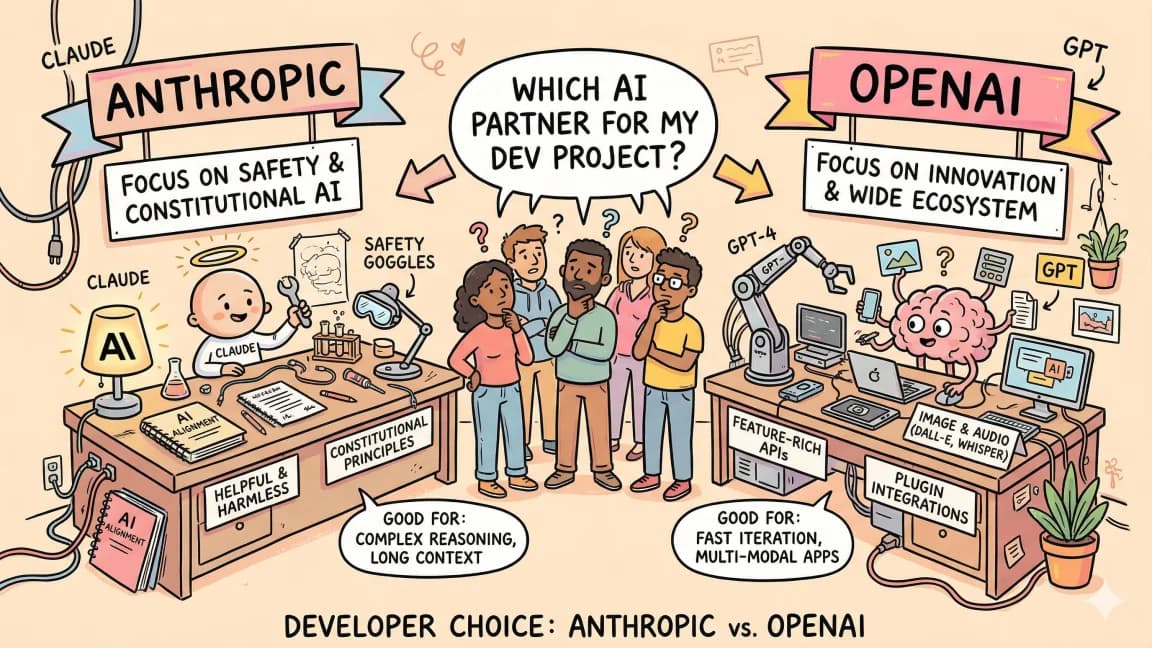
The second-order effect is competitive. OpenAI and Google will price against a public comparable, and developers choosing between them should use our OpenAI vs Anthropic comparison and the frontier API pricing table as the baseline, not the vendor's launch-day numbers. The AI coding tools pricing roundup is the place to compare the subscription side.
What to do on Monday#
None of this means Anthropic is going away. Revenue growth like that is the opposite of a vendor in trouble, and the filing is not a prediction of API changes. It means treating a single-vendor dependency as an engineering choice you can re-open:
- Put the model ID behind config. One environment variable or settings entry per model role (planner, coder, reviewer) so a swap is a config change, not a refactor.
- Pin versions where the API lets you and keep a dated note of which model each workflow was tested on, so a retirement notice has a known blast radius.
- Set a spend ceiling per agent run, not just per month. The filing's own language about agentic usage is the reason.
- Keep one tested fallback model from a second vendor for the two or three workflows that cannot go down, and run it in CI once a week so the fallback is not a theory.
- Read the S-1 risk factors yourself if you run Claude in production. They are a primary-source list of what the company thinks can go wrong.
What people are actually saying#
The Hacker News thread passed 1,000 points and over 1,100 comments within hours, so the sample below is a slice, not a consensus.
- The bear case. Several commenters point at the six-month net loss and argue the filing marks a late stage of the AI hype cycle. One highlights the loss figure directly, and another predicts it accelerates a market correction.
- The counter-case. One commenter argues revenue per compute dollar is rising and the payback on compute is under a year. That is a claim about the commenter's reading, not something I verified in the filing.
- The growth reaction. A commenter calls adding a zero to revenue every year "wild", which matches the table above.
- The pricing complaint. One commenter describes rising enterprise plan pricing and slowing growth metrics as the start of "enshittification". I did not verify the pricing claim, and it conflicts with the revenue growth in the filing.
- The commodity argument. Others say foundation models are becoming an interchangeable utility with thin moats, which is the argument for the fallback-model advice above.
- The practitioner report. One developer tried to use Claude to analyze the S-1 and hit cyber-safeguard flags. That is anecdotal and unverified.
FAQ#
What is the Anthropic ticker symbol?#
The announcement says Anthropic intends to list on the Nasdaq Global Select Market under the symbol "ANT". The offering is not yet effective, so nothing is trading.
When is the Anthropic IPO date?#
No date has been announced. The announcement says the number of shares and the price range have not been set and that the registration statement is not yet effective.
Will the Anthropic IPO change Claude API pricing?#
Nothing in the announcement says so. The S-1 does list pricing changes as a risk factor, so plan for pricing and limits to move over time rather than assuming today's numbers hold.
Continue Reading#
- Claude Code Usage Limits Playbook - how to budget agent runs against plan limits
- OpenAI vs Anthropic in 2026 - models, tools and pricing side by side
- AI Coding Tools Pricing in 2026 - subscription costs across the coding agents
- Frontier Model API Pricing - per-token prices to compare against
- Anthropic vs OpenAI Developer Experience - the day-to-day tradeoffs
- Claude on Google Cloud - the marketplace route in practice
- Claude Code - plans, install routes and alternatives
Sources#
| Source | URL |
|---|---|
| Anthropic: files S-1 with the SEC | https://www.anthropic.com/news/s1-sec |
| Anthropic Form S-1 (SEC EDGAR) | https://www.sec.gov/Archives/edgar/data/2130357/000162828026067168/anthropicpbc-sx1.htm |
| Hacker News: Anthropic S-1 | https://news.ycombinator.com/item?id=50242939 |
Get the next deep dive like this in your inbox
One email a week on News and the rest of the AI dev stack. Free.
Read next on Claude Code
Claude Code Usage Limits in 2026: The Practical Playbook for Pro and Max Teams
Claude Code usage limits are mostly an ops problem. A playbook for Pro and Max teams: lock auth mode, bound subagents, add hooks and route work by difficulty.
9 min readOpenAI vs Anthropic in 2026 - Models, Tools, and Developer Experience
A developer's comparison of OpenAI and Anthropic ecosystems - models, coding tools, APIs, pricing, and which to choose for different use cases.
18 min readAI Coding Tools Pricing Comparison 2026
AI coding tools pricing, verified Sep 28, 2026: Claude Code, Codex, Cursor, Copilot, Antigravity, Windsurf and more. Free tiers, pro plans and hidden costs.
12 min readTechnical content at the intersection of AI and development. Building with AI agents, Claude Code, and modern dev tools - then showing you exactly how it works.