Astral Joins OpenAI: What It Means for Python Developers
TL;DR
Astral, the team behind Ruff and uv, is joining OpenAI. What it means for Python developers, AI tooling and why OpenAI is investing in developer infrastructure.
Last updated: June 4, 2026
Official Sources#
| Resource | Link |
|---|---|
| Astral announcement | astral.sh/blog |
| Ruff GitHub | github.com/astral-sh/ruff |
| uv GitHub | github.com/astral-sh/uv |
| OpenAI Codex | openai.com/codex |
| ty type checker | github.com/astral-sh/ty |
Astral Is Joining OpenAI#
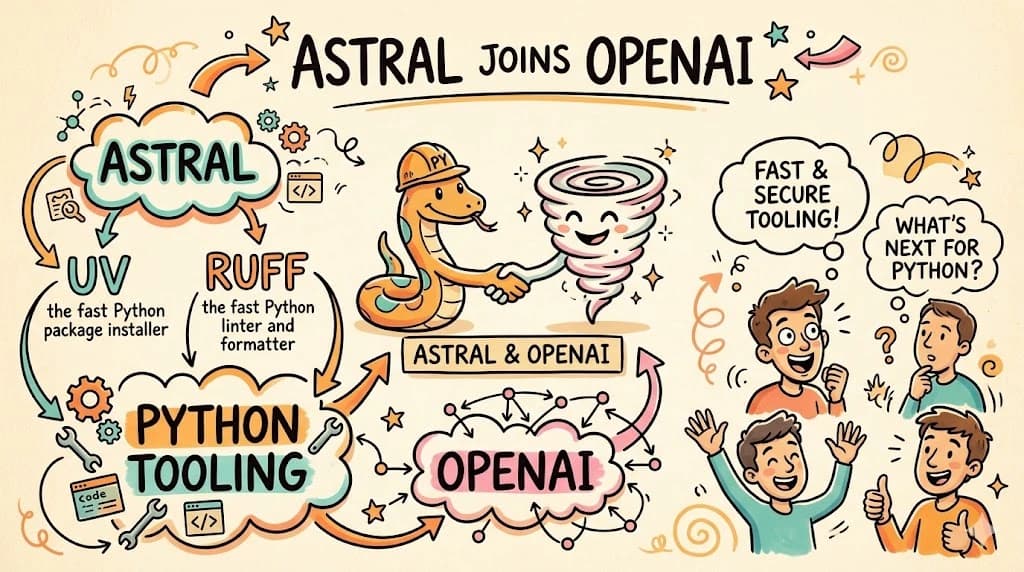
Astral, the company behind Ruff (the Rust-based Python linter with 50K+ GitHub stars) and uv (the blazing-fast Python package manager with 40K+ stars), has entered an agreement to join OpenAI. Founded by Charlie Marsh roughly three years ago, Astral built tools that became foundational to modern Python development, reaching hundreds of millions of downloads per month across Ruff, uv, and their newer type checker ty. The team will join OpenAI's Codex division. Critically, all three tools will remain open source. As Marsh wrote in the announcement: "OpenAI will continue supporting our open source tools after the deal closes. We'll keep building in the open, alongside our community."
For broader context, pair this with OpenAI Codex: Cloud AI Coding With GPT-5.3 and OpenAI vs Anthropic in 2026 - Models, Tools, and Developer Experience; those companion pieces show where this fits in the wider AI developer workflow.
OpenAI Is Betting on the Developer Toolchain#
This move signals something bigger than a talent acquisition. OpenAI is not just building AI models. They are assembling the full developer toolchain around those models. Codex already handles AI-powered coding, but pairing it with the team that built the fastest Python linter and package manager on the planet changes the equation. When you control the tools developers use every day - how they install packages, how they lint code, how they manage environments - you have a direct channel into every Python workflow. OpenAI is positioning itself not just as the model provider, but as the platform that developers build on top of. Marsh framed it as pursuing the "highest-leverage" opportunity to advance programming productivity, and it is hard to argue with the logic. The people who made Python tooling 10-100x faster are now working on AI-assisted development at the company with the most resources to ship it.
What This Means for Python Developers#
If you use Ruff or uv today, nothing changes immediately. Both tools stay open source, development continues, and the community remains central to the roadmap. But over time, expect deeper integration between these tools and OpenAI's Codex platform. Think AI-aware linting that understands intent, not just syntax. Package resolution that factors in what your agent is trying to build. Environment management that spins up exactly what a coding agent needs without manual configuration. The Astral team already proved they can rebuild decades-old Python infrastructure from scratch and make it dramatically better. Now they have the backing and the AI models to push that even further. For a practical look at how CLI tools like these fit into modern AI development workflows, check out clis.developersdigest.tech for comparisons and breakdowns.
The Bigger Picture: AI Companies Are Acquiring Developer Tools#
Zoom out and the pattern is unmistakable. Microsoft acquired GitHub and built Copilot directly into VS Code. Anysphere (Cursor) raised billions to build an AI-native IDE - see our Cursor vs Codex comparison for how that rivalry plays out day to day. Windsurf got acquired by OpenAI earlier this year. And now Astral joins that same OpenAI umbrella. Every major AI company has realized the same thing: the model alone is not the moat. The moat is the developer surface area. The editor, the terminal, the package manager, the linter, the deployment pipeline. Whoever owns the most touchpoints in a developer's daily workflow has the strongest distribution channel for AI capabilities. We are watching the developer toolchain get consolidated under AI companies in real time. The question is no longer whether AI will reshape how we write software. It is which company will own the most surface area when it does.
FAQ#
Will Ruff and uv stay open source after Astral joins OpenAI?#
Yes. Ruff, uv and the newer type checker ty will all remain open source. In the announcement Charlie Marsh wrote: "OpenAI will continue supporting our open source tools after the deal closes. We'll keep building in the open, alongside our community."
Which part of OpenAI is the Astral team joining?#
The Astral team will join OpenAI's Codex division, pairing the people who built Ruff and uv with OpenAI's AI-powered coding product.
Do I need to change anything if I use Ruff or uv today?#
Nothing changes immediately. Both tools stay open source, development continues, and the community remains central to the roadmap. Over time, expect deeper integration between these tools and OpenAI's Codex platform.
Related apps#
- AI Models - Compare 210+ AI models side by side. Pricing, context windows, speed benchmarks, and capabilities.
- Overnight Agents - Spec out AI agents, run them overnight, wake up to a verified GitHub repo.
Related#
- Subscribe to DevDigest on YouTube for hands-on walkthroughs
Continue Reading#
Get the next deep dive like this in your inbox
One email a week on OpenAI and the rest of the AI dev stack. Free.
Read next on AI coding tools
OpenAI Codex: Terminal and Cloud AI Coding Agent
Codex works from the terminal, cloud tasks, IDEs, GitHub, Slack, and Linear. Here is how to use it and how it compares to Claude Code.
5 min readOpenAI vs Anthropic in 2026 - Models, Tools, and Developer Experience
A developer's comparison of OpenAI and Anthropic ecosystems - models, coding tools, APIs, pricing, and which to choose for different use cases.
18 min readGPT-5: OpenAI's Most Capable Model
GPT-5 routes each query by complexity instead of making developers pick a reasoning mode. Its benchmarks, front-end coding gains and four API models explained.
7 min readNew here? Start with
Technical content at the intersection of AI and development. Building with AI agents, Claude Code, and modern dev tools - then showing you exactly how it works.