Deep Research Agents Need Constraint Ledgers
TL;DR
Deep research agents need constraint ledgers: a persistent record of constraints, evidence obligations, failed paths and open questions, drawn from AREX.
Last updated: July 27, 2026
The next useful deep-research feature is not a longer report. It is a better memory of what the report is not allowed to forget.
That is the thread connecting several July Hugging Face papers. SearchOS framed web research as shared state. DeepSearch-World framed search agents as trainable systems inside a verifiable environment. AREX pushes the loop further: an agent improves its research process by tracking the constraints it failed to satisfy, then feeding those constraints back into the next attempt.
That sounds academic until you build one of these systems. A research agent does not usually fail because it cannot write a coherent paragraph. It fails because it loses the hard edges of the task: compare only primary sources, find the counterexample, do not reuse the same secondary article, distinguish claim from evidence, preserve the caveat, check if the target page already exists, or stop when the search surface is blocked.
Deep research agents need constraint ledgers.
The Take#
A constraint ledger is a persistent artifact that records what the agent must obey, what it has already checked, what remains unresolved, and which failures should change the next run.
It is different from a notes file. Notes describe what happened. A ledger changes what the agent does next.
For developer-facing research tools, that ledger should track:
| Ledger item | What it stores | Why it matters |
|---|---|---|
| Required constraints | source rules, query limits, scope, freshness, duplicate checks | prevents the final answer from optimizing for fluency |
| Evidence obligations | claims that need primary support or opposing views | turns citations into work items |
| Failed paths | blocked sources, empty queries, rate limits, stale docs | avoids burning budget on repeats |
| Open conflicts | places where sources disagree or dates are uncertain | keeps uncertainty visible |
| Regression checks | tests the next run must pass before publishing | connects research to shipping |
This is the research-agent version of agent memory needing a context ledger. Memory is useful only when it is specific enough to steer future behavior.
Why AREX Is Interesting#
AREX, short for Autonomous Recursive EXecution, is a July 2026 paper that studies self-improving web-research agents. The paper's core idea is not "let the model think harder." It gives the agent an execution loop where failed or incomplete attempts produce explicit constraints for the next attempt.
That matters because most deep-research systems have a hidden quality loop. They search, draft, judge, revise, and then present the polished answer. The user sees the citations and maybe a plan, but not the durable record of what the judge found missing.
AREX makes that missing layer more concrete. The agent decomposes a task, executes research steps, evaluates the result against task-specific requirements, and recursively generates new work when constraints are unsatisfied. In practical terms, it says the system should remember the reason a draft was not good enough.
That is the part builders should copy. Not necessarily the exact paper architecture, benchmark setup, or prompt format. Copy the habit of turning critique into structured state.
The Problem With Answer-Only Research#
Most research agents still treat the final answer as the product and the trace as exhaust.
That is backwards for any workflow with real stakes. The final answer is only the visible projection of a larger research state. If the state is weak, the prose can still look excellent while hiding gaps.
The failure modes are familiar:
- The agent cites the easiest source and misses the official changelog.
- It finds one benchmark result but not the benchmark criticism.
- It writes "recently" without preserving the exact publication date.
- It treats a 429 or login wall as if the source had nothing relevant.
- It creates a duplicate article because the repo search used the wrong keyword.
- It summarizes opposing opinions as a vibe instead of linking the actual objection.
Those are not just model failures. They are state failures.
In long-running agent harnesses, the useful pattern is to externalize progress, checks, and recovery. Deep research needs the same thing, but with evidence and constraints instead of tests and diffs.
What Google Trends Said Today#
Google Trends was mandatory for this run, and it was attempted locally with pytrends for the selected cluster: deep research agent, AI research agent, AI coding agent, Claude Code, and self improving AI agent.
The check failed with TooManyRequestsError: Google returned a response with code 429, so this post uses no fresh numeric Trends values.
That matters editorially. The topic is not being chosen because an exact paper title has obvious search volume. Exact names like AREX or DeepSearch-World are likely too narrow for durable demand. The durable search lane is the builder problem: how to make research agents reliable, auditable, and recoverable.
The ranking fallback is source quality plus developer relevance: July HF paper velocity, primary arXiv/project pages, existing DevDigest interest in deep research and agent memory, and duplicate-risk checks against recent posts.
The Opposing View#
There is a reasonable objection: constraint ledgers can become paperwork for the model.
If the ledger is just another long markdown file, it will rot. If every critique becomes a permanent rule, the agent becomes brittle. If the UI exposes every intermediate concern, users get a compliance dashboard when they asked for an answer.
The answer is to keep the ledger small and operational.
Do not store everything. Store only what changes the next action:
- a source that must be checked before publication
- a claim that still needs evidence
- a contradiction that must be resolved or disclosed
- a failed query that should not be repeated blindly
- a validation gate that must pass before the artifact ships
This is also why ledgers should expire or be scoped. A failed query from July 2026 may be useful during the same run and dangerous six months later. The ledger should preserve the reason, date, and scope so the agent can decide whether to retry.
A Practical Ledger Shape#
For product builders, the primitive can be simple.
type ConstraintStatus = "open" | "satisfied" | "blocked" | "waived";

type ResearchConstraint = {
  id: string;
  kind: "source" | "claim" | "duplicate" | "opposition" | "validation";
  statement: string;
  reason: string;
  status: ConstraintStatus;
  evidenceUrls: string[];
  lastCheckedAt: string;
  blocker?: string;
};

type ResearchLedger = {
  topic: string;
  startedAt: string;
  constraints: ResearchConstraint[];
  failedPaths: Array<{
    queryOrSource: string;
    failure: string;
    observedAt: string;
    retryAfter?: string;
  }>;
  unresolvedQuestions: string[];
};
The agent loop then becomes straightforward:
- Start with the user request and known standing rules.
- Convert each non-negotiable into a constraint.
- Search and read sources.
- Mark constraints satisfied only when evidence exists.
- Record blockers explicitly.
- Generate the draft from the ledger, not only from chat history.
- Run validation against the ledger before publishing.
That final step is the difference. The ledger should be machine-checkable enough to fail the run.
For example, a blog automation can require Google Trends checked to be either satisfied with query rows or blocked with exact error text. It should never be silently absent. A product-comparison agent can require official pricing page checked for each vendor. A security-research agent can require opposing view captured before synthesis.
How This Fits With SearchOS and DeepSearch-World#
SearchOS, DeepSearch-World, and AREX are pointing at the same direction from different angles.
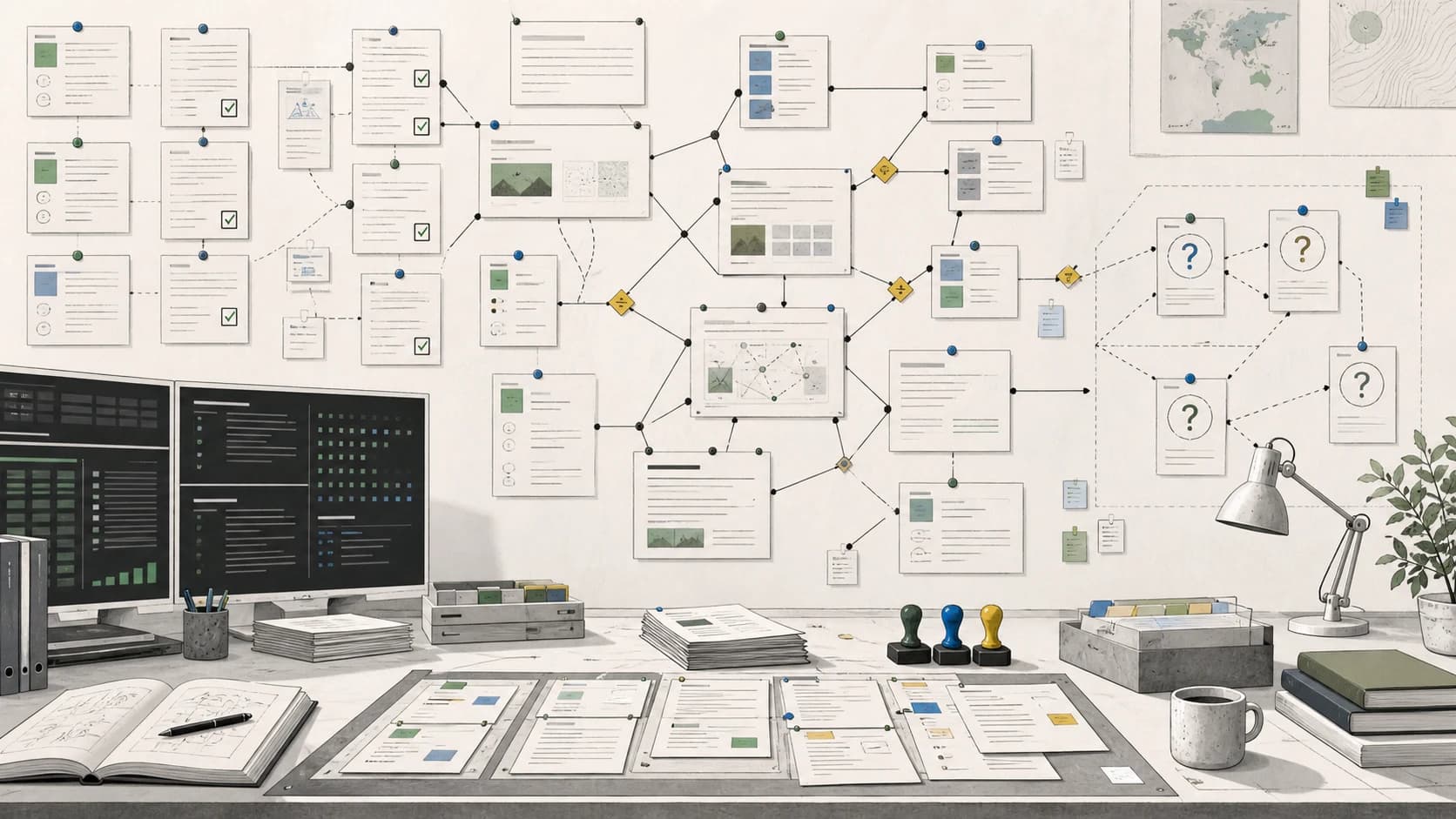
SearchOS says collaborative research agents need shared state: frontier tasks, evidence graphs, coverage maps, and failure memory.
DeepSearch-World says search agents need reproducible environments where progress can be verified and failures can become training signal.
AREX says recursive improvement should be driven by unmet constraints, not vague "try again" prompting.
Put together, the shape is clear: research agents are moving from answer generation to state management. The most useful systems will not only browse better. They will know what remains unproven.
That also connects to the broader discussion around recursive self-improvement and self-improving AI agents. The realistic near-term loop is not a model rewriting its own weights. It is an agent improving its process by preserving mistakes, constraints, and corrections as artifacts.
The Builder Checklist#
If you are building a deep-research agent, add these checks before adding more models:
| Check | Minimum implementation |
|---|---|
| Source discipline | every major claim points to an official or primary source when one exists |
| Duplicate risk | search your own corpus before creating a new artifact |
| Opposing evidence | store at least one credible objection for contested claims |
| Blockage logging | record rate limits, login walls, missing pages, and stale docs |
| Constraint resolution | require each open constraint to be satisfied, blocked, or explicitly waived |
| Post-run memory | write the few lessons that should change the next run |
This is not glamorous infrastructure. It is the difference between a research agent that writes plausible reports and one that can be trusted to run repeatedly.
The Bottom Line#
Deep research is becoming less about summarization and more about operational memory.
The model can draft the answer. The browser can fetch the pages. The search API can rank links. But the product needs a place to store the obligations the agent has not yet satisfied.
That place is the constraint ledger.
FAQ#
What is a constraint ledger for AI research agents?#
A constraint ledger is a persistent record of requirements, evidence obligations, blockers, failed paths, and unresolved questions that should guide the agent's next action and final validation.
How is a constraint ledger different from agent memory?#
Agent memory can store broad lessons or facts. A constraint ledger is narrower: it stores the active obligations for a specific research task and marks whether each one is satisfied, blocked, or waived.
Why do deep research agents need this?#
Long research tasks fail when hidden assumptions and missing evidence disappear inside the transcript. A ledger makes the open work inspectable and reusable across retries, subagents, and reviewers.
Is AREX a production-ready framework?#
Treat AREX as a research signal, not a drop-in production framework. The useful production lesson is to convert critique and failed checks into structured state that the next run must obey.
Was Google Trends checked for this post?#
Yes. The local pytrends check was attempted on July 27, 2026, but Google returned a 429 Too Many Requests response, so no fresh Trends numbers were used.
Continue Reading#
- SearchOS Shows Deep Research Agents Need Shared State
- AI Agent Memory Needs a Context Ledger
- Long-Running Agents Need Harnesses, Not Hope
- Recursive Self-Improvement with Fable 5
- Self-Improving AI Agents: How Agents Learn from Mistakes
- OpenAI Deep Research: The AI Agent That Does Your Homework
- Your Agent Has a Five-Constraint Budget - the August evidence wave that turned this July sketch into a spec: constraints die in compaction and handoff, and the ledger is the side channel that keeps them alive
Sources#
- Hugging Face Papers, July 2026 monthly page - checked July 27, 2026.
- AREX: Towards a Recursively Self-Improving Agent for Deep Research - arXiv, published July 23, 2026. Checked July 27, 2026.
- AREX on Hugging Face Papers - weekly and monthly discovery context, checked July 27, 2026.
- DeepSearch-World: Self-Distillation for Deep Search Agents in a Verifiable Environment - arXiv, checked July 27, 2026.
- SearchOS-V1: Towards Robust Open-Domain Information-Seeking Agent Collaboration - arXiv, checked July 27, 2026.
- Google Trends via local pytrends for
deep research agent,AI research agent,AI coding agent,Claude Code, andself improving AI agent- blocked with HTTP 429 on July 27, 2026.
Get the next deep dive like this in your inbox
One email a week on AI Agents and the rest of the AI dev stack. Free.
Read next on AI coding tools
SearchOS Shows Deep Research Agents Need Shared State
SearchOS turns web research from a growing chat transcript into shared state: frontier tasks, evidence graphs, coverage maps, and failure memory. That is the pattern serious deep-research agents need.
8 min readAI Agent Memory Needs a Context Ledger
AI agent memory works best as a context ledger: source-linked, scoped, expiring memory that agents can inspect and users can audit, not magic recall.
8 min readLong-Running Agents Need Harnesses, Not Hope
Long-running coding agents need a harness: task contracts, scoped workspaces, logs, checkpoints, verification gates, and cost limits to recover from failure.
9 min readNew here? Start with
Technical content at the intersection of AI and development. Building with AI agents, Claude Code, and modern dev tools - then showing you exactly how it works.