Factory Droid Pricing Explained: Plans, Rate Limits and Multipliers (2026)
TL;DR
Droid pricing in plain terms: the free BYOK tier, Pro, Plus and Max, the three rolling rate limits, Droid Core, Extra Usage, and how model multipliers decide how fast your plan drains.
Last updated: November 26, 2026
Factory's pricing page fits on one screen, but the number on the plan card is the least interesting part of what you pay. What actually decides your bill is three rolling rate limits, a per-model multiplier, and a fallback pool of open models called Droid Core. This post walks through each piece using Factory's own pricing page, the individual plans doc and the models page, all checked on November 26, 2026.
If you are new to the product itself, start with our Factory Droid review and setup guide and come back here when you are picking a plan.
The plans at a glance#
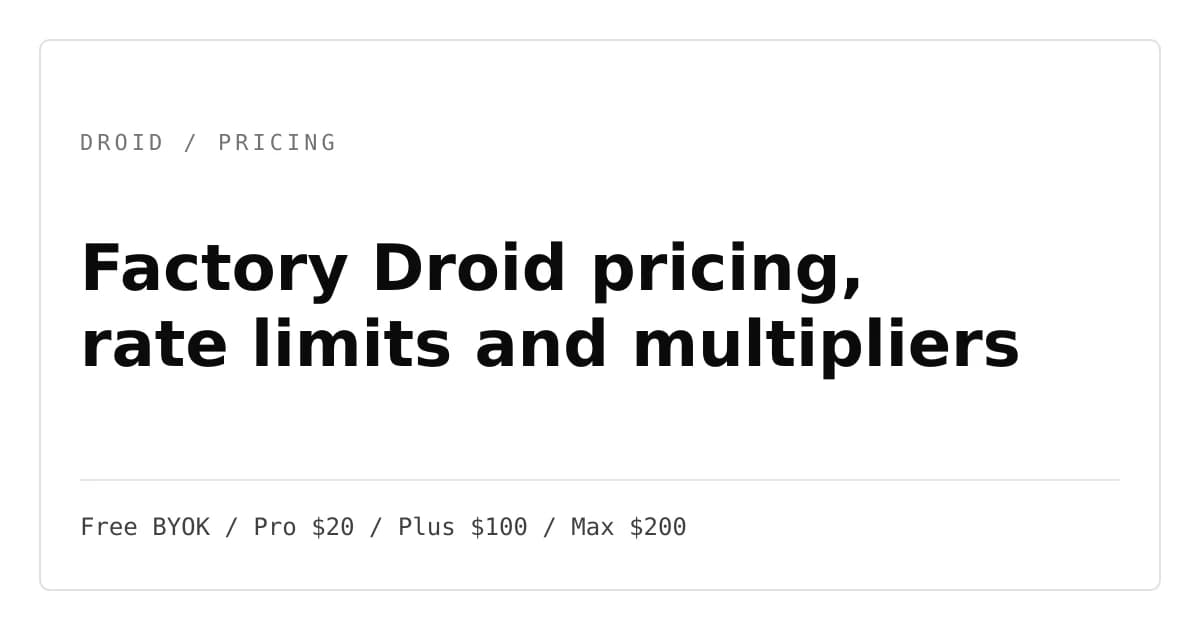
| Plan | Price | Inference | What you get |
|---|---|---|---|
| Free | $0 | Bring your own | Sign in with ChatGPT, GitHub Copilot, OpenRouter or Vercel AI Gateway, or connect your own API keys or endpoint |
| Pro | $20/mo per individual | Factory managed | Desktop, CLI and SDK, full model availability |
| Plus | $100/mo per individual | Factory managed | Everything in Pro, about 5x the usage of Pro |
| Max | $200/mo per individual | Factory managed | Everything in Pro, about 10x the usage of Pro |
| Teams | $60/mo per team + $40/mo per seat | Factory managed | Everything in Pro for up to 10 seats, centralized billing |
| Business | Contact sales | Factory managed | Custom limits, SSO, SAML/SCIM, ZDR, audit logs, basic admin controls |
| Enterprise | Contact sales | Factory managed | Dedicated compute, on-prem options, sub-organizations, data residency |
Two things stand out against other terminal agents. First, the free tier is real: it is the full harness with no Factory inference attached, so you can run Droid against a ChatGPT or Copilot subscription you already pay for. Second, the paid tiers scale by usage multiple, not by feature. Plus and Max do not unlock different tools than Pro; they buy roughly 5x and 10x the headroom.
How the three rate limits work#
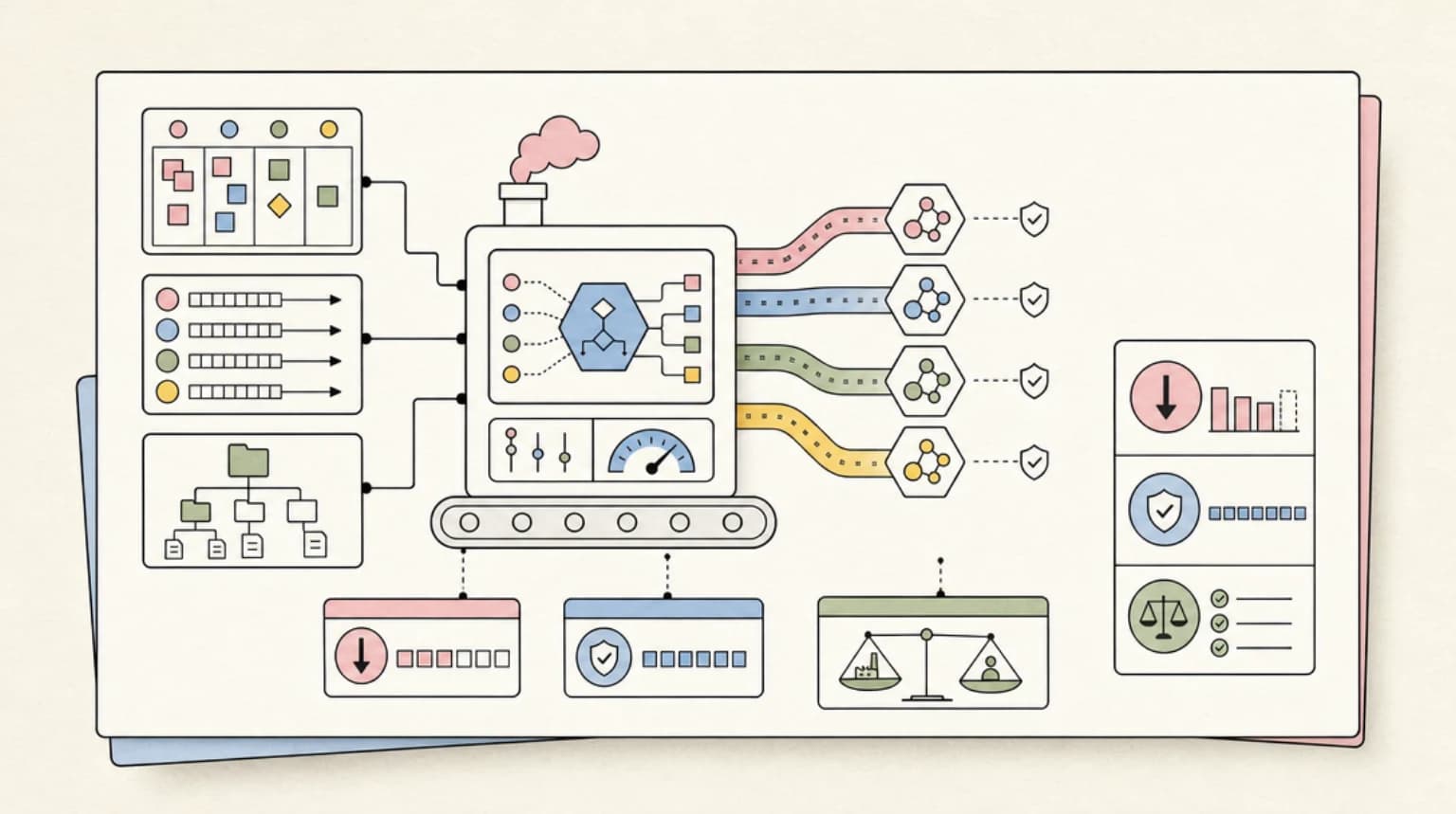
Every paid individual plan is governed by three rolling windows: 5 hours, 7 days and 30 days. Factory's docs are explicit that they run independently: "Hitting the 5-hour cap does not eat into weekly or monthly any faster, and vice versa. You need headroom in all three to send a request."
That last sentence is the one to plan around. A heavy afternoon can lock you out on the 5-hour window while you still have most of the month left, and a steady week of long sessions can exhaust the 7-day window even though no single afternoon was heavy. Each window starts when you first use Droid and resets after it elapses, rather than on a calendar boundary.
What counts against the limits: "Droid sessions consume Factory Standard Credits based on model usage, along with compute usage for cloud environments." So a session on a Factory-hosted Droid Computer or cloud environment draws down the same budget as the model calls.
When you hit a limit mid-session, the current request finishes and the next one returns a rate limit error. Running /limits lets you switch to Droid Core or turn on Extra Usage and retry immediately. Standard Usage does not roll over month to month.
Droid Core: the fallback pool#
Droid Core is the part most pricing roundups skip. Factory describes it as a "free open-weight model pool with separate Rate Limits after Standard Usage runs out." Enabling it does not cost extra; it keeps you on Standard Usage billing but restricts you to the Core models, so you can keep working after your premium-model limits are gone.
The November 2026 Core list includes Inkling, Mistral Large 4, GLM-5.3, Kimi K3.1 Pro, Qwen3.8 Max, Nemotron 3.5 Super, DeepSeek V4.1 Flash, MiniMax M3.1 Flash, Muse Spark 1.3 and Beam 1.0. Factory notes the list changes as new models ship, and the source of truth is Settings > Models in your account.
The practical takeaway: on a Pro plan, Droid Core is what turns "out of usage until Thursday" into "slower models until Thursday." For boilerplate, test scaffolding and mechanical refactors, that is often no loss at all. Our model routing recipes post covers which task types tolerate a cheaper model.
Extra Usage: prepaid overflow#
Extra Usage is prepaid, USD-denominated credit with a $10 minimum. It never expires and, unlike Standard Usage, it rolls over. Once you toggle it on, it stays on until you turn it off or run out, so treat it like a card on file with a hard cap you chose in advance.
Extra Usage matters most for one feature: Missions require Extra Usage to be enabled. Missions use the same rolling limits as regular sessions, and a Mission that hits a rate limit pauses rather than failing. If you plan to run multi-hour Missions, budget for Extra Usage from day one. We cover when Missions are worth that cost in Droid Missions vs Workstreams vs custom droids.
Multipliers decide how fast you drain#
Every model on Factory carries a multiplier against Standard Usage. The plan sets the size of the bucket; the multiplier sets how fast each turn empties it. A selection from the models page as of November 26, 2026:
| Model | Model ID | Multiplier |
|---|---|---|
| Claude Fable 5.2 | claude-fable-5.2 | 3.2x |
| Claude Opus 5.5 | claude-opus-5-5 | 1.6x |
| Claude Opus 5.5 Fast | claude-opus-5-5-fast | 3.2x |
| Claude Sonnet 5.5 | claude-sonnet-5-5 | 0.8x |
| Claude Haiku 5.5 | claude-haiku-5-5 | 0.04x |
| GPT-6.2 Astra | gpt-6.2-astra | 3.2x |
| GPT-6.2 Sol | gpt-6.2-sol | 0.8x |
| GPT-6 Luna | gpt-6-luna | 0.04x |
| GPT-5.5 Pro | gpt-5.5-pro | 12x |
| Gemini 4 Neon | gemini-4-neon | 1.2x |
| Gemini 4 Carbon | gemini-4-carbon | 0.8x (promo, 1.6x after Dec 1, 2026) |
| Grok 4.7 | grok-4.7 | 0.8x |
| GLM-5.3 (Droid Core) | glm-5.3 | 0.56x |
| Kimi K3.1 Pro (Droid Core) | kimi-k3.1-pro | 0.8x |
| MiniMax M3.1 Flash (Droid Core) | minimax-m3.1-flash | 0.06x |
Read the ratios, not the absolute values. Factory does not publish how many Standard Credits a Pro plan holds, so you cannot turn these into dollars per task from public docs alone. What you can say with confidence:
- Sonnet 5.5 and GPT-6.2 Sol at 0.8x stretch a plan twice as far as Opus 5.5 at 1.6x. For most day-to-day coding, that is the default worth trying first.
- Fast variants roughly double the multiplier. Opus 5.5 Fast is 3.2x against 1.6x for standard Opus 5.5. You are paying for latency, not quality.
- Haiku 5.5 and GPT-6 Luna at 0.04x are 40 times cheaper per unit than Opus 5.5. That makes them the obvious choice for subagents doing search, summarization or file triage. Our Haiku 5.5 vs GPT-6 Luna for subagents comparison goes deeper.
- Promotional multipliers expire. Gemini 4 Carbon and Argon return to 1.6x after December 1, 2026, and Gemini 3.8 and 3.7 Flash return to 0.6x after January 1, 2027. If you pinned one of them in a custom droid or a CI job, revisit it.
- GPT-5.5 Pro at 12x is an outlier. One Pro turn costs as much as fifteen Sonnet 5.5 turns.
You can check your own burn rate inside the CLI: /cost shows usage statistics for the session and /stats [period] covers a date range.
Factory Router changes the math#
If you do not want to pick multipliers by hand, Factory Router selects a model per task automatically. Factory's own announcement claims 20-25% lower spend, which is a vendor number we have not reproduced; our Factory Router explainer separates what is claimed from what is documented. The relevant point for pricing is that routing moves your effective multiplier below whatever single model you would otherwise default to, as long as the router sends easy turns to cheap models.
Which plan should you pick?#
Free, if you already pay for a model. A ChatGPT, Copilot or OpenRouter account plus Droid's harness is a legitimate setup, and it is the cheapest way to try Missions-style workflows, AGENTS.md and custom droids before committing. Factory documents Droid Core and Extra Usage under the paid individual plans, so expect the Free tier to be exactly what you bring.
Pro, for most individuals. $20 buys Factory-managed access to every model, with Droid Core as the safety net. Default to a 0.8x model like Sonnet 5.5 or GPT-6.2 Sol and you get twice the turns you would on Opus 5.5. If you keep hitting the 5-hour window, that is a signal to change your default model before it is a signal to upgrade.
Plus, if you run long sessions on Opus-class models. About 5x the usage of Pro for 5x the price is linear, not a discount. Upgrade when the 7-day window, not the 5-hour one, is what stops you.
Max, for Missions and parallel work. At about 10x Pro for 10x the price, Max is for people running multiple sessions or Missions most days. Pair it with Extra Usage so a Mission pauses rather than stalls your week.
Teams, for small shops. $60 plus $40 per seat lands at $460 per month for ten people, with centralized billing. Business and Enterprise add the governance controls (SSO, ZDR, audit logs, model access policies) that larger organizations usually need before an agent touches production code.
How Droid compares on price#
At the entry level, Droid lines up with Claude Code and Codex at $20 per month. The structural difference is what the $20 buys. Claude Code subscriptions cover Claude models only; Droid's plans cover Anthropic, OpenAI, Google, xAI and open models from one bucket, with multipliers translating between them. For a side-by-side of every major agent's plans, see our AI coding tools pricing breakdown and the Claude Code vs Droid comparison.
The trade is predictability. A flat subscription to one model family is easier to reason about. Droid's model gives you more levers - model choice, Droid Core, Extra Usage, Router - and rewards you for using them, but it also means two people on the same plan can get very different amounts of work out of it.
FAQ#
Is Factory Droid free?#
Yes, with a catch. The Free plan costs $0 but includes no Factory-managed inference: you bring your own, either by signing in with ChatGPT, GitHub Copilot, OpenRouter or Vercel AI Gateway, or by connecting your own API keys or a custom endpoint. You pay the model provider, not Factory.
How much does Droid Pro cost?#
Pro is $20 per month per individual and includes the Desktop app, CLI and SDK with full model availability. Plus is $100 per month for about 5x the usage of Pro, and Max is $200 per month for about 10x. Teams is $60 per month per team plus $40 per month per seat, up to 10 seats.
How do Droid rate limits work?#
Paid individual plans have three rolling windows - 5 hours, 7 days and 30 days - that run independently. You need headroom in all three to send a request. Standard Usage is consumed first, then you can fall back to the Droid Core open-model pool or to prepaid Extra Usage. Run /limits in Droid to see where you stand.
What is a Droid model multiplier?#
Each model on Factory carries a multiplier that scales how fast it consumes your plan. On the November 2026 models page, Claude Opus 5.5 is 1.6x, Claude Sonnet 5.5 is 0.8x, Claude Haiku 5.5 is 0.04x, GPT-6.2 Sol is 0.8x and GPT-5.5 Pro is 12x. A 0.8x model stretches the same plan twice as far as a 1.6x model.
Do Missions cost extra?#
Missions use the same rolling rate limits as regular sessions, but Factory requires Extra Usage to be enabled before a Mission can run, and a Mission pauses if it hits a rate limit. Factory recommends running Missions on Droid Core models where possible.
Continue Reading#
- Droid vs Codex
- Factory Droid: Review and Setup Guide
- droid exec: Run Factory Droid Headless in CI
- Droid Missions vs Workstreams vs Custom Droids
- Factory Router, Explained
- All Droid guides
Sources#
- Factory pricing: factory.com/pricing
- Individual plans: docs.factory.com/pricing/individuals
- Organization plans: docs.factory.com/pricing/organizations
- Available models and multipliers: docs.factory.com/models
- Factory Router: docs.factory.com/model-independence/factory-router
- Droid CLI reference (
/limits,/cost,/stats): docs.factory.com/droid-cli/cli-reference
Get the next comparison like this in your inbox
One email a week on Droid and the rest of the AI dev stack. Free.
Read next on AI coding tools
Factory Droid: Review and Setup Guide (2026)
Factory Droid review and setup: a terminal-native AI coding agent with multi-model routing, headless CI and browser automation, and if it fits your workflow.
8 min readClaude Code vs Droid (Factory AI): Which Terminal Agent?
Claude Code vs Droid compared: two of the most capable terminal-native AI coding agents in 2026 on pricing, model flexibility, multi-agent work and team fit.
8 min readFactory Router, Explained: How Automatic Model Routing Cuts Coding-Agent Spend 20-25%
Factory Router explained: automatic model routing and failover for Droid sessions, which spend and reliability claims are vendor claims, and router vs DIY.
10 min readNew here? Start with
Technical content at the intersection of AI and development. Building with AI agents, Claude Code, and modern dev tools - then showing you exactly how it works.