Droid vs Codex (2026): Factory vs OpenAI for Terminal Coding Agents
TL;DR
Factory Droid vs OpenAI Codex compared on models, pricing, headless CI, multi-agent work, extensibility and openness, with a clear recommendation for each kind of developer.
Last updated: November 26, 2026
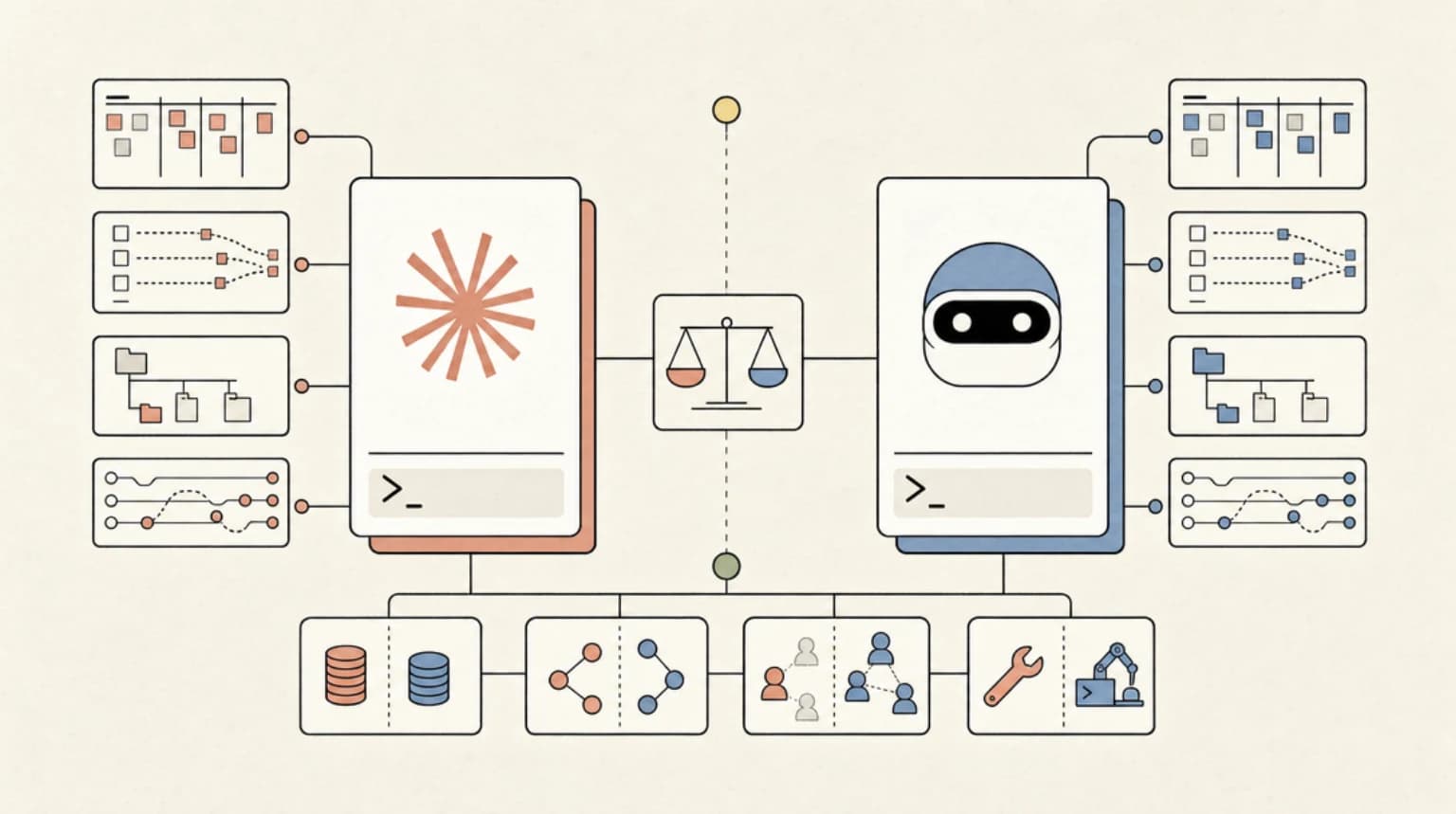
Factory's Droid and OpenAI's Codex look alike from the outside. Both are terminal-first coding agents with a desktop app, both read AGENTS.md, both have a headless mode for CI, and both start at $20 a month. Underneath, they are built on opposite bets. Codex is OpenAI's agent for OpenAI's models, open source and bundled into ChatGPT plans. Droid is a model-independent harness that runs Anthropic, OpenAI, Google, xAI and open-weight models from one plan, with heavier built-in orchestration.
This comparison uses Factory's docs and pricing, and OpenAI's Codex pricing and changelog, all checked on November 26, 2026. Current versions: Droid CLI v1.21.0 and Codex CLI 0.172.0.
The short answer#
- Pick Codex if you already pay for ChatGPT, mostly want OpenAI's GPT-6.x models, value an open-source CLI you can read and patch, and want cloud tasks and GitHub code review bundled into the subscription.
- Pick Droid if you want to switch between Claude, GPT, Gemini and open models in one session, care about cost control through cheaper models, or want structured multi-agent features (Missions, Workstreams) without building your own orchestration.
- Try both cheaply: Droid's Free plan lets you sign in with ChatGPT and run Droid's harness on the same subscription Codex uses. That is the fairest head-to-head you can run.
At a glance#
| Factory Droid | OpenAI Codex | |
|---|---|---|
| Models | Anthropic, OpenAI, Google, xAI, open-weight (Droid Core), BYOK | OpenAI GPT-6.x family; API-key and custom providers possible |
| Source | Proprietary | Open source (Apache-2.0), written in Rust |
| Entry price | Free (bring your own inference), Pro $20/mo | Free and Go ($8) limited, Plus $20/mo |
| Top individual tier | Max $200/mo (~10x Pro) | Pro $100, $200 or $500/mo |
| Usage model | Three rolling windows (5h, 7d, 30d) plus per-model multipliers | Five-hour allowance on Plus (none on Pro), weekly limits may apply, credits for overflow |
| Surfaces | CLI, Factory App (desktop), SDKs, Slack/Linear/Jira/Teams delegation | CLI, desktop app, IDE extension, web, iOS, Slack |
| Headless | droid exec, Factory-AI/droid-action | codex exec, openai/codex-action |
| Project instructions | AGENTS.md (also reads CLAUDE.md) | AGENTS.md |
| Multi-agent | Custom droids, Missions, Workstreams | Subagents, agent command center, cloud tasks |
| Extensibility | Skills, hooks, MCP, plugins, custom droids | Skills, hooks, MCP, plugins, subagents |
Models: the core difference#
Codex is built around OpenAI's models. On ChatGPT plans you get the GPT-6.x line - Codex CLI 0.171.0 (November 20) added GPT-6.2 Sol and Astra to its catalogs, and the Plus plan lists GPT-6.1 Sol and GPT-6 Luna. API-key sessions get whatever your key can access, and Codex supports custom providers, including a built-in Vertex AI provider since 0.165.0. In practice, though, Codex is where you go to use OpenAI's models with OpenAI's harness.
Droid's whole pitch is the opposite. The models page lists Claude Fable 5.2, Opus 5.5, Sonnet 5.5 and Haiku 5.5, the GPT-6.2 Sol and Astra models, Gemini 4, Grok 4.7, and a Droid Core pool of open models such as GLM-5.3, Kimi K3.1 Pro and DeepSeek V4.1 Flash. You switch with /model mid-session, give each subagent its own model, or let Factory Router pick per task. Each model bills at a multiplier: GPT-6.2 Sol is 0.8x, Opus 5.5 is 1.6x, Haiku 5.5 and GPT-6 Luna are 0.04x.
If your team has already decided "we use OpenAI," this difference matters less. If you want Claude for refactors, GPT for one kind of task and a cheap open model for subagents, Droid is the only one of the two that does it natively.
Harness quality: what the benchmarks do and do not say#
Factory's Droid 1.0 announcement reports Terminal-Bench 4 results with GPT-6.1 Sol in both harnesses: Droid at 57.6% against Codex at 54.0%, at what Factory says is 12% lower cost per passed task. That is a like-for-like model comparison, which makes it more interesting than most agent benchmarks, but it is a vendor running its own benchmark. Treat it as evidence that harness design moves results by a few points, not as a verdict. Our Terminal-Bench harness scaling post explains why the harness now matters this much.
The design behind Droid's number is worth knowing: Droid 1.0 made programmatic tool calling (Script mode) the default, so the agent writes a small program that makes many tool calls and only the program's output enters the context. Codex has gone a different direction recently, with 0.163.0 running independent read-only tools in parallel. Both are attacking the same problem: long sessions drowning in tool output.
Pricing#
At $20 both are a real product, and the comparison gets interesting above that.
Codex comes with ChatGPT. Plus ($20) covers Codex in the CLI, IDE, web and iOS plus cloud code review and Slack. OpenAI publishes estimated local messages per five-hour period for Plus; Pro plans ($100, $200 or $500) currently have no five-hour limit, though weekly limits may apply, and Pro $500 adds Ultrafast mode. When you run out, you buy ChatGPT credits. An API key is the pay-per-token alternative, without the cloud features. Our Codex usage limits guide goes deeper.
Droid has a genuinely free tier (bring your own inference, including a ChatGPT sign-in), then Pro at $20, Plus at $100 for about 5x Pro's usage, and Max at $200 for about 10x. Usage runs against three independent rolling windows, and the model multiplier decides how fast each turn drains them. When premium limits run out, Droid Core's open models keep you working, and prepaid Extra Usage covers the rest. Details in our Droid pricing explainer.
Neither vendor publishes a dollar cost per task you can compare directly. The practical difference: Codex's value scales with how much you use ChatGPT itself, and Droid's value scales with how willing you are to route work to cheaper models.
Headless and CI#
Both have a mature non-interactive mode, and the designs are close cousins.
codex exec uses sandbox modes (read-only, workspace-write, danger-full-access) with approval policies, and OpenAI ships openai/codex-action, which keeps the API key behind a proxy. 0.171.0 added codex exec --remote; see our 0.171 notes.
droid exec is read-only by default and opts into mutations with --auto low|medium|high, plus tested permission rules, per-run tool allowlists (--only-tools, --remove-tools), worktree isolation (-w) and a headless --mission mode. Factory's PR review ships as Factory-AI/droid-action.
Our two guides cover the details side by side: codex exec in CI and droid exec in CI. If CI is your main use case, the deciding factor is usually the model you want running there, not the flags.
Multi-agent work#
This is where the products diverge most in philosophy.
Codex gives you primitives and a control surface: subagents, git worktrees, cloud tasks that run on OpenAI's infrastructure, and since 0.167.0 an agent command center (codex agents) for watching and steering many tasks at once. You compose the workflow yourself. Our Codex worktrees and durable sessions post shows the pattern.
Droid ships opinionated orchestration products on top of its subagents ("custom droids"). Missions interview you, build a plan of features and milestones, and run it from Mission Control with workers and validators. Workstreams are a standing orchestrator in the Factory App that delegates to a team of agents across machines and brings work back as pull requests. You get more structure out of the box and less to build, at the price of more token spend; see Missions vs Workstreams vs custom droids.
Openness and extensibility#
Codex's CLI is open source under Apache-2.0. You can read exactly what it sends, file issues against real code, and fork it. For security-conscious teams and for anyone building their own agent, that counts for a lot.
Droid is proprietary, but it is very configurable and leans on shared conventions. It reads AGENTS.md and CLAUDE.md, discovers skills from the shared .agents/skills/ folder, supports MCP servers, hooks, plugins and internal plugin marketplaces, and can import Claude Code subagents. Our Droid setup guide walks through each layer. Both tools reading AGENTS.md means the most important file in your repo already works with either.
Enterprise#
Both have SSO, admin controls and audit logging at the top tiers. Codex Enterprise adds SCIM, EKM, RBAC, data residency and a Compliance API for audit logs. Factory leans harder on deployment flexibility: Factory Private, airgapped deployment with your own model endpoints, OpenCompute sandboxes in your own cloud, and per-group usage limits and model access policies. If you need to keep inference inside your own network or on models from several labs, Factory has more options. If your organization already standardizes on ChatGPT Enterprise, Codex comes with it.
Verdict#
These are both excellent agents, and the competition between them is making each better quickly - both shipped new CLI versions several times a week through November. The choice comes down to one question: do you want to be on one lab's models or all of them?
If the answer is OpenAI, Codex gives you the native harness, an open-source CLI and cloud features bundled into a subscription you may already have. If the answer is "whichever model is best for this task," Droid is built for exactly that, and its Missions and Workstreams go further on orchestration than anything Codex ships today. If you are still unsure, sign in to Droid's Free plan with your ChatGPT account and run both on the same week of tickets.
For the other big matchup, read Claude Code vs Droid.
FAQ#
Is Droid better than Codex?#
Neither is better across the board. Factory reports Droid scoring 57.6% against Codex's 54.0% on Terminal-Bench 4 with the same GPT-6.1 Sol model, but that is a vendor benchmark. Codex is the stronger fit if you want OpenAI models, an open-source CLI and ChatGPT bundling; Droid is stronger for multi-model work and built-in orchestration.
Can Droid use OpenAI models like Codex does?#
Yes. Droid's managed plans include the GPT-6.2 Sol and Astra models and older GPT-5.x models, each at a usage multiplier, and its Free plan lets you sign in with ChatGPT and use your existing subscription as the inference source.
Which is cheaper, Droid or Codex?#
Both start at $20 per month for individuals. Codex Plus includes cloud tasks and code review as part of ChatGPT, while Droid Pro covers models from several labs and can fall back to cheaper open models when premium limits run out. Which is cheaper depends on how much you use ChatGPT itself and how much work you can route to low-multiplier models.
Do Droid and Codex both support AGENTS.md?#
Yes. Both read AGENTS.md as their project instruction file, and Droid also reads CLAUDE.md, so one well-written file works across both agents.
Is Codex open source?#
The Codex CLI is open source under the Apache-2.0 license and written in Rust. Droid is proprietary.
Continue Reading#
- Claude Code vs Droid (Factory AI)
- Factory Droid Pricing Explained
- Codex Usage Limits and Pricing in 2026
- Set Up Factory Droid Properly
- All Droid guides
Sources#
- Factory pricing: factory.com/pricing
- Factory available models: docs.factory.com/models
- Droid 1.0 announcement: factory.com/news/frontier-harness
- Droid Exec: docs.factory.com/droid-exec/overview
- Factory release notes: docs.factory.com/changelog/release-notes
- Codex pricing: learn.chatgpt.com/docs/pricing
- Codex changelog: learn.chatgpt.com/docs/changelog
- openai/codex repository: github.com/openai/codex
- openai/codex-action: github.com/openai/codex-action
Get the next comparison like this in your inbox
One email a week on Droid and the rest of the AI dev stack. Free.
Read next on AI coding tools
Claude Code vs Droid (Factory AI): Which Terminal Agent?
Claude Code vs Droid compared: two of the most capable terminal-native AI coding agents in 2026 on pricing, model flexibility, multi-agent work and team fit.
8 min readFactory Droid Pricing Explained: Plans, Rate Limits and Multipliers (2026)
Droid pricing in plain terms: the free BYOK tier, Pro, Plus and Max, the three rolling rate limits, Droid Core, Extra Usage, and how model multipliers decide how fast your plan drains.
9 min readCodex Usage Limits and Pricing in 2026: Pro 100, Pro 200, Pro 500, Resets, and 'Model at Capacity' Errors
Codex usage limits and pricing per ChatGPT plan: what Plus, Pro $200 and Pro $500 buy, how resets work, and what to do about 'Selected model is at capacity'.
14 min readNew here? Start with
Technical content at the intersection of AI and development. Building with AI agents, Claude Code, and modern dev tools - then showing you exactly how it works.