Gemini Omni 1.1 Flash Goes GA: Scene Extension, Keyframe Control, and 4K in the Gemini API
TL;DR
Google made Gemini Omni 1.1 Flash generally available today: 10-second scene-extension context, first and last frame interpolation, 360p drafts at a third of the cost, and 4K upscaling. Verified pricing: about $0.10 per second of 720p video.
Google moved Gemini Omni 1.1 Flash out of preview on August 27, 2026. The update, now generally available on the paid tier of the Gemini API, is a control-plane release more than a quality release: scene extension that reads 10 seconds of prior context instead of the final second, first and last frame interpolation, video references in multimodal input, 360p drafts at roughly a third of the cost, and upscaling to 4K. Verified against Google's pricing page today, a second of 720p video bills out at about $0.10.
That puts Omni 1.1 at the same per-second price as Veo 3.1 Fast, with editing capabilities that Veo's per-second SKUs do not include. For developers, the API went from a generator to a composable editor.
Official Sources#
| Resource | Description |
|---|---|
| Gemini Omni 1.1 Flash announcement | Today's release notes, capability walkthroughs, and customer quotes |
| Gemini API pricing | Per-million-token rates, verified August 27, 2026 |
| Gemini API Omni docs | API reference, prompting guide, and integration patterns |
| Gemini Omni model page | Model family scope and capabilities |
| Agent Platform API reference | Enterprise route for Omni 1.1 |
What Actually Shipped#
Google frames the release as five new controls, and each one is a concrete API capability:
- Scene extension with real context. The model analyzes up to 10 seconds of prior footage when continuing a video, a jump from previous builds that only referenced the final second. Extensions work in 10-second increments up to 40 seconds cumulative, chained through a
previous_interaction_idparameter - a stateful editing session rather than a stateless re-prompt. - First and last frame interpolation. Give the API a start and end frame and it generates the continuous video between them: camera orbits, whip-pan transitions, seamless loops.
- Video references in multimodal input. Up to 3 seconds of reference video maintains character and visual consistency across shots.
- 360p drafts. Previews generate up to 60% faster and cost about a third of 720p output, per Google's throughput note and the cost math below.
- 4K upscaling. Final renders at 1080p or 4K instead of the preview's ceiling.
The model id is gemini-omni-1.1-flash, paid tier only, in Google AI Studio and the Gemini Enterprise Agent Platform. Google also rolled scene extension into Google Flow for AI Plus, Pro, and Ultra subscribers.
Pricing, Verified Today#
Google bills Omni output by token, not by second. The pricing page, fetched August 27, 2026, lists:
| Item | Price (USD, per 1M tokens) |
|---|---|
| Input (text / image / video / audio) | $1.50 |
| Output (text) | $9.00 |
| Output (video) | $17.50 |
The published conversion: 5,792 tokens per second of 720p video, which works out to approximately $0.10 per second at standard pricing. The gemini-omni-flash-preview and gemini-omni-1.1-flash entries carry identical rates, so this is a GA at the same price, not a price cut - the value is in what the new controls unlock. There is no free tier entry for either model.
Worked examples, at the published 5,792 tokens per second:
- One 10-second 720p shot: about 57,900 video tokens, roughly $1.01.
- A 30-second scene from three chained 10-second extensions: about $3.03.
- The same 30-second scene drafted in 360p: about $1.00, per the one-third cost of preview output.
- A 4K final render: billed at the same $17.50 per 1M video tokens, though Google has not published the per-second token rate for 4K on the page we verified, so treat the 4K per-second cost as higher than 720p and unpublished.
How to Run It#
Omni 1.1 Flash is not available through OpenCode or other coding agents' model catalogs - it is a hosted video API, not a coding model - so the vendor SDK is the route. Scene extension is the headline pattern. From the announcement:
from google import genai

client = genai.Client()

interaction = client.interactions.create(
    model="gemini-omni-1.1-flash",
    previous_interaction_id=previous_video_interaction.id,
    input=[
        {"type": "text", "text": "Continue the scene."}
    ],
    response_format={
        "resolution": "360p",
    },
)
The pattern that matters: draft in 360p, iterate on prompt and keyframes, then upscale the keeper to 1080p or 4K. That is model routing applied to video - the cheap pass does the exploratory work and the expensive pass runs once, the same shape as the spend-cutting routing recipes we track for LLM agents.
Where It Sits#
| Gemini Omni 1.1 Flash | Veo 3.1 | MiniMax H3 | |
|---|---|---|---|
| Price per second (720p-ish) | ~$0.10 | $0.10 (fast) / $0.40 (standard) | 0.80 CNY at 2K (~$0.11) |
| Editing controls (extension, keyframes) | Yes | No published equivalents | No |
| Native audio in output | Sold as full omni pipeline | Yes (audio price line) | Yes, stereo |
| Max output | 4K (upscaled, 40s cumulative) | 4K | 15s at 2K |
| Open weights | No | No | Promised, per our H3 coverage |
The $0.10-per-second band is now the market price for video generation (FLUX 3's benchmark table treats Gemini Omni Flash as the bar it measures against). Differentiation has moved to the control plane - how much of the final shot the developer decides instead of the model.
The Developer Take#
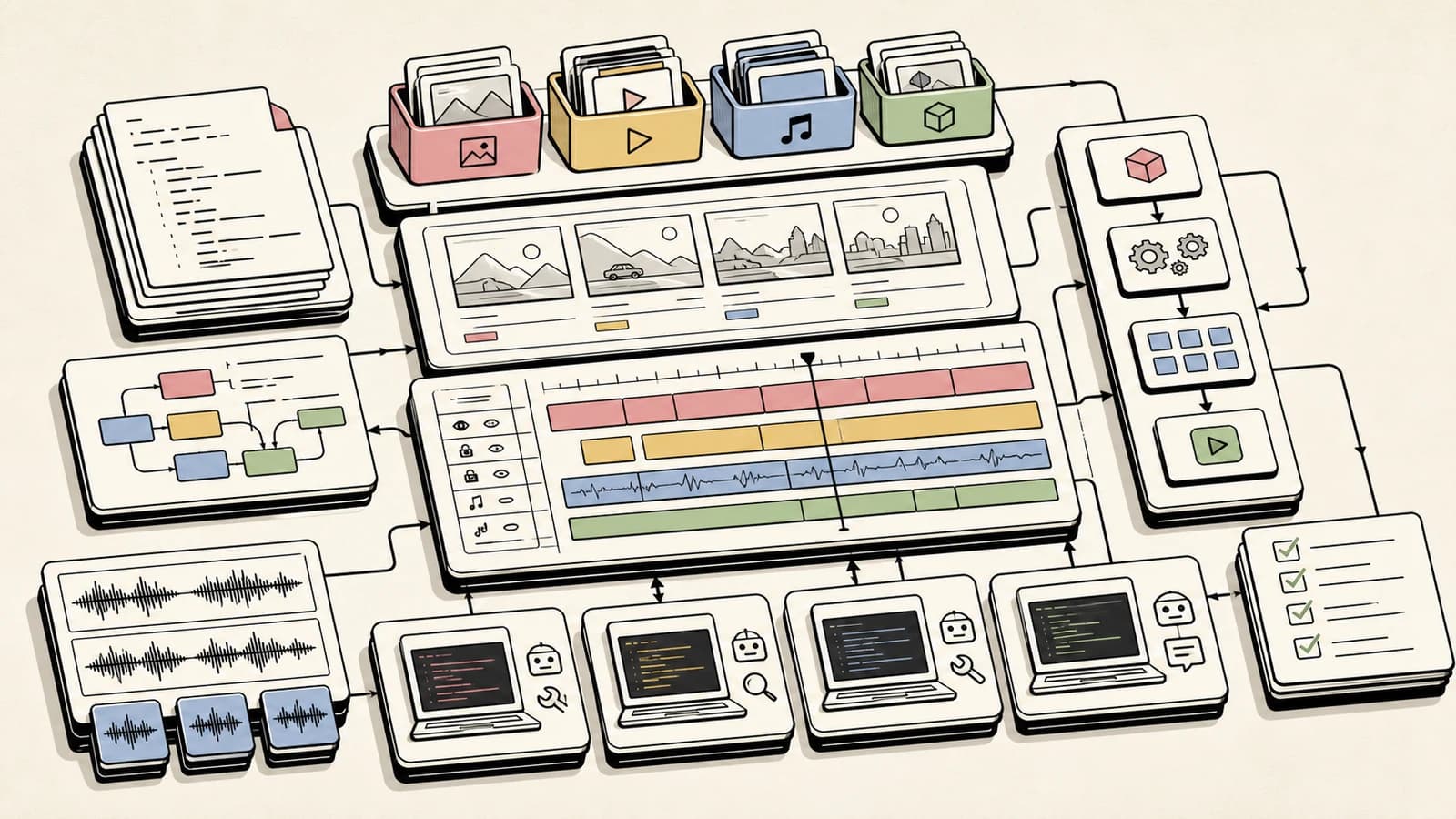
Three things stand out. First, previous_interaction_id chaining turns the API into a stateful editing session, which is the real shift: builds like OpenMontage can treat scene extension as a graph walk instead of a queue of independent generations. Second, the 360p draft loop makes agentic iteration affordable - a 30-second scene costs about $1 to concept in drafts and $3 to finish, which changes the economics of "render many, keep one" pipelines. Third, the integrations Google named today - Adobe Firefly, Figma Weave, Runway, GMI Cloud - suggest this becomes the underlying model for a wave of editing surfaces rather than a standalone studio. For developers building video tools, the API that matters next is the one that takes your edit decisions as input, and Omni 1.1 is the first major vendor model to make that its headline feature.
Continue Reading#
- MiniMax H3: An Omni-Modal Video Model With Native Audio, 2K Output, and Open Weights Coming - the open-weights competitor in the same price band
- FLUX 3: Black Forest Labs' Unified Multimodal Foundation Model - the benchmark set that treats Omni Flash as the bar
- OpenMontage: Agentic Video Production - how coding agents orchestrate video pipelines today
- Gemini's Agentic Video Understanding Cuts Video Tokens by 88% - the analysis side of the same Flash-tier stack, dynamic instead of 1 FPS
- Make Claude Code 10x Better at Design - agents driving generation models from the CLI, including Gemini Omni
- DeepSeek V4 Flash 0731 Release Guide - the house shape for a GA release, applied to a coding model
- Gemini 3.8 Live and 3.8 Live Extended Thinking - the audio-to-audio dialogue pair in the same Gemini API, benchmarked against the Speech-to-Speech Index
Sources#
- Gemini Omni 1.1 Flash announcement, Google DeepMind (fetched August 27, 2026)
- Gemini API pricing, Google (fetched August 27, 2026)
- Gemini API Omni documentation, Google
- Gemini Enterprise Agent Platform, Omni 1.1 Flash reference
- New creative controls in Google Flow, Google
Get the next deep dive like this in your inbox
One email a week on News and the rest of the AI dev stack. Free.
Read next
MiniMax H3: An Omni-Modal Video Model With Native Audio, 2K Output, and Open Weights Coming
MiniMax launched H3, an omni-modal generation model that takes text, image, video, and audio input and outputs 2K video with native stereo sound at 0.80 CNY per second. Open weights are promised in the coming days.
8 min readFLUX 3: Black Forest Labs Ships a Unified Multimodal Foundation Model for Image, Video, Audio, and Robotics
Black Forest Labs released FLUX 3, a single multimodal model trained jointly on images, video, and audio that also drives robots on Audi production lines. Here is what it does, how it works, and how to try it.
10 min readOpenMontage Shows the Real Future of AI Video: Agents, Not Editors
OpenMontage is trending because it treats video production like a repo-shaped agent workflow: scripts, assets, render pipelines, review loops, and coding agents working across the whole process.
7 min readNew here? Start with
Technical content at the intersection of AI and development. Building with AI agents, Claude Code, and modern dev tools - then showing you exactly how it works.