The Model, IDE, CLI, and Agent Framework Changes That Actually Matter
TL;DR
The AI coding market is noisy. The changes that matter are easier to spot when you separate model capability, editor loops, terminal agents, background agents, agent frameworks, UI layers, context, security, and cost.
Most AI coding news is not worth rebuilding your workflow around.
A model gets a benchmark lift. An editor ships a new agent mode. A CLI gains another surface. A framework adds another integration. A pricing page changes the name of a pool.
Some of that matters.
Most of it is noise.
The trick is to separate the layers:
model
IDE
CLI
background agent
agent framework
agent UI
context layer
security layer
cost layer
When you do that, the market is easier to read. The question stops being "what launched?" and becomes "which layer changed enough that I should change how I work?"
This is the practical filter I would use.
Sources Worth Reading#
| Source | Useful signal |
|---|---|
| Claude Opus 4.8 | The important model story is better coding, long-horizon task execution, dynamic workflows, and honesty. |
| Claude Code overview | Terminal agents are becoming the daily operating surface for repo-aware engineering work. |
| Claude Code security | Local agent defaults, permission modes, sandboxing, hooks, and review settings are part of the product now. |
| OpenAI Codex app | Codex is being shaped around supervising multiple agents, worktrees, skills, automations, and review queues. |
| OpenAI Codex agent loop | The durable pattern is task setup, environment state, tool use, evidence, review, and iteration, not one prompt. |
| GitHub Copilot app preview | GitHub is turning Copilot work into isolated coding sessions that can start from issues, PRs, prompts, and past sessions. |
| GitHub Copilot plans | Copilot is increasingly a governed platform with cloud agent, policies, AI credits, MCP, and enterprise controls. |
| GitHub Copilot usage-based billing | Agent sessions consume like jobs, so pricing changes can affect workflow routing. |
| Cursor secure indexing | Editor quality is becoming a context plumbing problem, not only a model problem. Vendor benchmarks should stay labeled as vendor benchmarks. |
| Vercel AI SDK 5 | The lightweight SDK lane is still the right starting point for simple TypeScript AI features and controlled agent loops. |
| LangGraph 1.0 GA | Durable graph execution, persistence, interrupts, and human approval remain the explicit-control lane. |
| Mastra agents | TypeScript agent frameworks now compete on workflows, memory, tools, MCP, evals, traces, and operability. |
| Mastra human-in-the-loop | Approval belongs inside the workflow design, especially before risky tool calls or irreversible actions. |
| CopilotKit Generative UI | Agent UI is becoming its own layer: tool rendering, state rendering, app-state sync, A2UI, and MCP Apps. |
| OpenAI prompt injection guidance | Agent security is moving from filters toward source-sink controls and blast-radius reduction. |
Last updated: May 30, 2026. Treat pricing, model access, and plan limits as current-source checks, not durable facts.
The Take#
The changes that matter are the changes that move work between layers.
A model benchmark matters only if it changes which work you can safely delegate.
An IDE feature matters only if it changes how quickly you can inspect, steer, and accept edits.
A CLI feature matters only if it makes long-running local work more reliable, auditable, or scriptable.
A framework feature matters only if it makes product agents easier to operate after the demo.
That is the filter.
The best AI coding stack right now is not "the smartest model." It is the combination of:
- a strong model for hard judgment,
- an editor loop for visible iteration,
- a terminal agent for local repo work,
- a background agent for isolated work,
- a framework for repeatable product agents,
- a UI layer for user collaboration,
- a context system that reduces wandering,
- a security loop that limits damage,
- a cost loop that catches waste.
For the full stack recommendation, read the new AI coding stack I would pick today. This post is the change filter behind that stack.
1. Model Changes Matter When They Change Delegation#
Model releases are easy to overread.
The question is not:
Did the benchmark go up?
The question is:
What work can I delegate now that I would not delegate last month?
That is why Claude Opus 4.8 is interesting. The useful story is not only coding performance. Anthropic framed the release around coding, long-horizon task execution, dynamic workflows, and improved honesty. Those are agent-operation qualities.
For coding agents, honesty matters because silent confidence is expensive. A model that surfaces uncertainty, recovers from failed checks, and asks for evidence before editing is more useful than one that simply writes more code.
The practical test:
Can the model handle a longer task with fewer hidden wrong turns?
Can it explain what it verified?
Can it stop when it does not know?
Can it recover from failing tests without thrashing?
If yes, the model changed your delegation boundary.
If no, it is probably just a leaderboard update.
Model routing matters here too. The bigger change is not always a new model. Sometimes it is better metadata: context limits, tool support, latency, modalities, cache behavior, and price. That is why model routing infrastructure belongs in the same conversation as model releases.
2. IDE Changes Matter When They Improve the Review Loop#
The IDE layer is not dead. It is becoming more specific.
Terminal agents are better for deep autonomous work. But visual editing still matters when you are shaping UI, reviewing diffs, or making taste decisions.
The editor changes worth watching are not only "more chat in the sidebar."
They are:
- better codebase indexing,
- faster semantic search,
- cleaner diff acceptance,
- stronger local context,
- background sessions that do not destroy the active editing loop,
- rules and memories that follow the repo.
Cursor's secure indexing post is useful because it points at the right problem: context plumbing. The exact numbers are vendor benchmarks, so do not treat them as universal truth. The direction is still right. An AI editor wins when it can bring the right project context into the edit loop without making the developer wait or leak more than intended.
The practical test:
Does the IDE reduce review time?
Does it route the agent to the right files faster?
Does it make accepting or rejecting changes cheaper?
Does it help with visible polish?
If yes, the IDE change matters.
If it is only another chat entry point, it probably does not.
3. CLI Changes Matter When They Make Agent Runs Operable#
The CLI is where serious local agent work keeps landing.
That is not nostalgia for terminals. It is because the shell is where real engineering evidence lives:
- files,
- tests,
- typecheck,
- git,
- package managers,
- scripts,
- local services,
- logs,
- deployment tools.
Claude Code's docs, Codex's local CLI direction, and the broader terminal-agent market all point at the same pattern: the CLI is becoming the agent operating surface.
The CLI changes that matter are:
- permission profiles,
- hooks,
- MCP support,
- resumable context,
- subagent delegation,
- clear command logs,
- headless runs,
- CI compatibility,
- scoped network and filesystem access.
The practical test:
Can I run this agent in the same places I run engineering work?
Can I prove what commands it ran?
Can I stop or constrain dangerous behavior?
Can I reuse the workflow in CI or automation?
If yes, the CLI changed the operating model.
If it just exposes the same chat through another binary, it is not enough.
4. Background Agent Changes Matter When Work Becomes Queueable#
Cloud and background agents matter when they turn agent work into a queue.
OpenAI's Codex app and GitHub's Copilot app preview are both pointing in that direction. The unit of work is no longer only a prompt. It is a session with a repo, branch, task, log, diff, and review path.
That is a real change.
It means you can route work by isolation level:
| Work shape | Best lane |
|---|---|
| Needs local machine state | CLI or IDE |
| Needs visual review while editing | IDE |
| Can run in an isolated repo session | Background agent |
| Needs GitHub policy and team governance | Copilot or another GitHub-native agent |
| Needs a product user interface | App agent framework plus UI layer |
Background agents are not autonomous engineers. They are queued workers.
That distinction keeps the workflow honest.
The practical test:
Can this task be described with clear acceptance criteria?
Can it run without local secrets or machine state?
Can I review the result as a PR, patch, or report?
Can a failed run be discarded cheaply?
If yes, queue it.
If not, keep it local.
5. Framework Changes Matter When They Improve Operability#
Agent frameworks are entering the second phase.
The first phase was "look, the agent can call tools."
The second phase is:
- workflows,
- memory,
- evals,
- traces,
- human approval,
- durable execution,
- model routing,
- MCP,
- local dev studios,
- production observability.
That is why Mastra is worth tracking for TypeScript teams. It is not interesting because it can wrap a model. It is interesting because it gives agent work a backend operating model: agents, workflows, memory, tools, MCP, evals, traces, and human-in-the-loop patterns.
Vercel AI SDK still matters too, but in a different lane. It is the lighter starting point for simple TypeScript AI features: streaming, tools, structured output, and controlled loops. You do not need a full agent framework for one response.
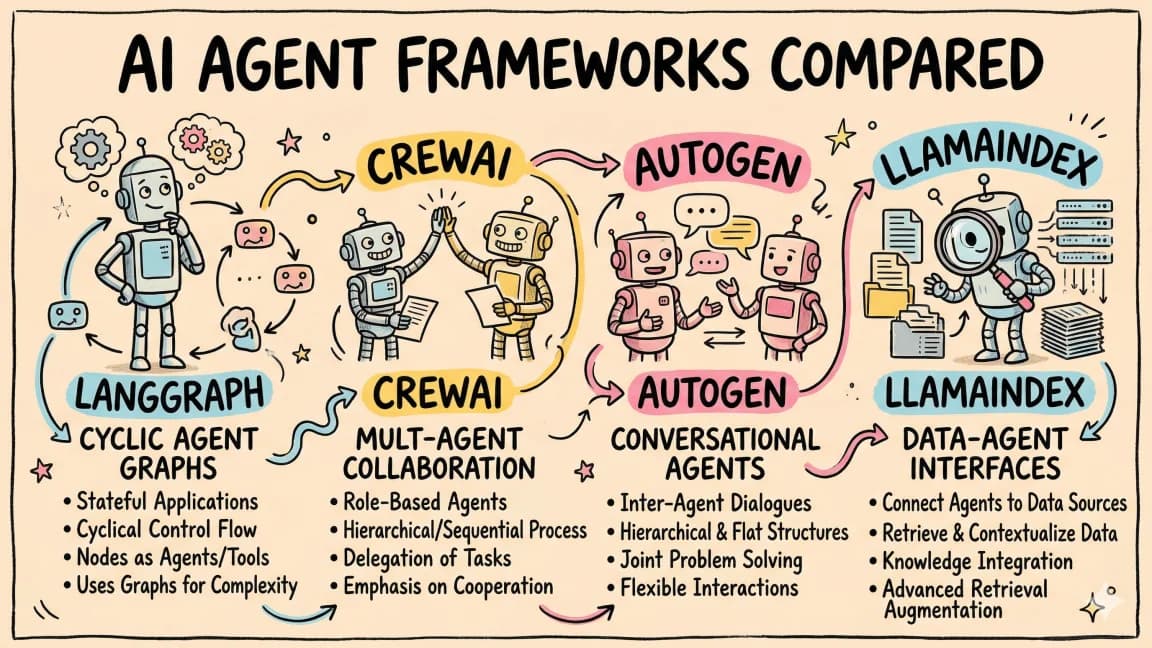
LangGraph remains the explicit graph-control lane when you need durable state machines, interrupts, resumable execution, and debugging through LangSmith. CopilotKit sits at a different layer again: user-facing state, controls, and rendered tool output. The useful comparison is not "which framework wins?" It is "which layer owns the problem?"
The practical split:
Use a lightweight SDK when the feature is one interaction.
Use an agent framework when the feature is a repeatable process.
For more detail, read Mastra for durable TypeScript agents, when CopilotKit is the UI layer, and Mastra vs CopilotKit vs LangGraph.
6. UI-Agent Changes Matter When Users Need Control#
Agent UI is finally separating from agent orchestration.
That is a good thing.
CopilotKit's strongest signal is not "chat component." It is the idea that users need a live contract with an agent:
- shared state,
- rendered tool calls,
- approval cards,
- agent progress,
- generative UI,
- app-state synchronization,
- frontend actions,
- adapters to backend agents such as Mastra and LangGraph.
This matters because product agents should not all look like chat.
If the agent is drafting an email, show the draft. If it is changing a plan, show the plan. If it is running a workflow, show the step state. If it wants to spend money, deploy, delete, email, or write to a system, show an approval surface.
The practical test:
Does the UI expose the agent's state and next action?
Can the user approve risky work in context?
Can the product render tool output as first-class UI?
If yes, the UI layer changed the product.
If no, it is just another chat box.
7. Context Changes Matter When They Reduce Wandering#
Context is becoming infrastructure.
This is where MCP, code indexes, skills, repo maps, memories, and local docs all meet. They are different tools for the same pressure: agents waste too much time rediscovering what the project already knows.
MCP matters because it standardizes tool connection. But MCP does not solve context by itself. A tool protocol still needs:
- scoped auth,
- current indexes,
- useful schemas,
- structured errors,
- observability,
- permission boundaries,
- source provenance.
The practical test:
Does this context layer reduce repeated search?
Does it point the agent to source truth?
Does it preserve provenance?
Does it avoid dumping stale text into every run?
If yes, it matters.
If it only adds another giant prompt file, be careful.
8. Security Changes Matter When They Reduce Blast Radius#
The security lesson is getting clearer: you cannot prompt your way out of dangerous tool access.
OpenAI's prompt injection guidance makes this explicit. Filters help, but manipulated agents still need source-sink controls, scoped permissions, and limits on what an untrusted instruction can cause.
For coding agents, the security baseline is:
- scoped repo access,
- deny secrets by default,
- command allowlists,
- network restrictions,
- human approval for risky writes,
- logs,
- signed or reviewable artifacts,
- rollback paths.
This is why permissions, logs, and rollback are not optional once agents touch real systems.
The practical test:
If the agent is manipulated, what can it actually do?
Can I see what happened?
Can I undo it?
If you cannot answer those questions, the security layer is not ready.
9. Pricing Changes Matter When They Change Routing#
Pricing changes are boring until they change behavior.
That is happening now.
Plan limits, AI credits, premium request pools, model multipliers, included usage, API fallback, and cloud execution costs all affect which work goes where.
The useful question is not "what is the cheapest plan?"
It is:
Which plan makes the right work cheap and the wrong work visibly expensive?
For example:
- local terminal work needs capacity,
- background agent work needs budget controls,
- enterprise teams need policy and audit,
- IDE loops need low latency,
- product agents need per-user or per-workflow limits.
The pricing layer should make those lanes visible.
The practical test:
Can I track cost by workflow?
Can I cap or alert on runaway agent sessions?
Can I route routine work away from expensive models?
Can I re-tier monthly based on actual usage?
If yes, pricing changed your architecture.
If not, it is still a finance surprise waiting to happen.
The Decision Table#
Here is the filter I would use when a new launch shows up.
| Launch type | Ask this | Change your workflow if... |
|---|---|---|
| Model release | What new work can I safely delegate? | It improves long tasks, recovery, honesty, or review burden. |
| IDE feature | Does it improve edit review? | It reduces diff review time or improves context routing. |
| CLI feature | Does it improve run operability? | It adds useful permissions, logs, hooks, MCP, CI, or resumability. |
| Background agent | Is the work queueable? | It produces isolated, reviewable artifacts with clear acceptance criteria. |
| Framework release | Does it improve production behavior? | It adds workflow, memory, eval, trace, HITL, or deployment clarity. |
| UI-agent feature | Does it expose state and control? | It makes approval, state, and tool output visible in the app. |
| MCP/context tool | Does it reduce wandering? | It routes agents to source truth with provenance and boundaries. |
| Security feature | Does it reduce blast radius? | It limits actions, logs behavior, and supports rollback. |
| Pricing change | Does it change routing? | It affects which work belongs on which model, user, or platform. |
That table is more useful than a launch feed.
What I Would Ignore#
Ignore any announcement that cannot answer one of these questions:
- What work can I delegate now?
- What review step gets cheaper?
- What failure mode gets easier to see?
- What action gets safer?
- What cost gets more predictable?
- What product interaction gets clearer?
If none of those changed, the announcement is probably not an operating-model change.
It might still be interesting.
It just does not require you to rebuild the stack.
The Real Change#
The AI coding market is maturing from tools into lanes.
Models are for capability.
IDEs are for interactive review.
CLIs are for local agent operation.
Background agents are for queued isolated work.
Frameworks are for repeatable product agents.
UI layers are for human-agent collaboration.
Context layers are for reducing search.
Security layers are for reducing blast radius.
Cost layers are for routing work intentionally.
That is the map.
The teams that win will not chase every launch. They will ask which layer changed, whether the change moves real work, and what proof the new layer leaves behind.
FAQ#
How do I know if an AI model update is worth changing my workflow for?#
Ask whether the model changes your delegation boundary. The useful test is not benchmark numbers - it is whether you can now delegate work you would not have trusted the model with last month. Look for improvements in long-horizon task execution, recovery from failed checks, honesty about uncertainty, and reduced thrashing on failing tests. If the model handles longer tasks with fewer hidden wrong turns, that is a real change. If it is only a leaderboard bump, it probably is not worth rebuilding your workflow around.
What is the difference between IDE agents, CLI agents, and background agents?#
IDE agents work inside your editor for interactive review - visual editing, UI work, diff acceptance, and taste decisions. CLI agents run in your terminal where local engineering evidence lives - files, tests, git, scripts, and logs - and are becoming the operating surface for serious repo-aware work. Background agents run in isolated cloud environments as queued workers, handling tasks that can be described with clear acceptance criteria and reviewed as PRs or patches. The right choice depends on whether the work needs local machine state, visual review, or can run in isolation.
When should I use an AI SDK versus an agent framework?#
Use a lightweight SDK like Vercel AI SDK when the feature is one interaction - streaming, tools, structured output, and controlled loops. Use an agent framework like Mastra or LangGraph when the feature is a repeatable process that needs workflows, memory, evals, traces, human approval, durable execution, or production observability. The split is not about capability - it is about whether the work is a single response or an operable system.
How do I evaluate AI coding security beyond prompt filters?#
Filters help but are not enough. Evaluate based on blast-radius reduction: what can a manipulated agent actually do? The security baseline should include scoped repo access, secrets denied by default, command allowlists, network restrictions, human approval for risky writes, clear logs, signed or reviewable artifacts, and rollback paths. If you cannot answer what a compromised agent can do, see what happened, and undo it, the security layer is not ready for production.
What makes MCP and context layers actually useful versus adding noise?#
Context layers matter when they reduce repeated search and point the agent to source truth with provenance. A useful MCP setup needs scoped auth, current indexes, useful schemas, structured errors, observability, permission boundaries, and source provenance. If the context layer just dumps another giant prompt file into every run, it adds noise. The test is whether it routes the agent faster and avoids stale or redundant context.
How should pricing changes affect my AI coding tool choices?#
Pricing changes matter when they change routing - which work goes where. The question is not which plan is cheapest but which plan makes the right work cheap and the wrong work visibly expensive. Local terminal work needs capacity, background agents need budget controls, enterprise teams need policy and audit, IDE loops need low latency, and product agents need per-user or per-workflow limits. Track cost by workflow, cap runaway sessions, route routine work away from expensive models, and re-tier monthly based on actual usage.
What questions should I ask before rebuilding my stack for a new AI tool launch?#
Ask: What work can I delegate now that I could not before? What review step gets cheaper? What failure mode gets easier to see? What action gets safer? What cost gets more predictable? What product interaction gets clearer? If none of those changed, the announcement is not an operating-model change. It might still be interesting, but it does not require you to rebuild your workflow.
Why are terminal agents becoming more important than IDE agents for AI coding?#
Terminal agents are not replacing IDE agents - they serve different lanes. But the CLI is where real engineering evidence lives: files, tests, typecheck, git, package managers, scripts, local services, logs, and deployment tools. Terminal agents are becoming the operating surface because they can run where engineering work runs, produce command logs as proof, integrate with CI and automation, and offer scoped permissions and hooks. IDEs remain important for visual review, UI polish, and interactive editing - but for autonomous repo work, the terminal is where the evidence is.
Get the next deep dive like this in your inbox
One email a week on AI Coding and the rest of the AI dev stack. Free.
Read next on Claude Code
State of AI Coding: What Changed This Month
May 2026 was not about one more coding model leaderboard. The useful signal was control planes, UI-agent contracts, durable TypeScript workflows, usage economics, and runtime security.
10 min readThe New AI Coding Stack I Would Pick Today
If I were rebuilding my AI coding workflow on May 30, 2026, I would not pick one magic tool. I would pick a layered stack: terminal agent, editor, background agent, Mastra, CopilotKit, MCP, context, security, and cost controls.
11 min readModels.dev Makes Model Routing Feel Like Infrastructure
The models.dev project is trending because AI teams need one boring source of truth for model specs, pricing, context windows, modalities, and tool support.
7 min readTechnical content at the intersection of AI and development. Building with AI agents, Claude Code, and modern dev tools - then showing you exactly how it works.