7 min read
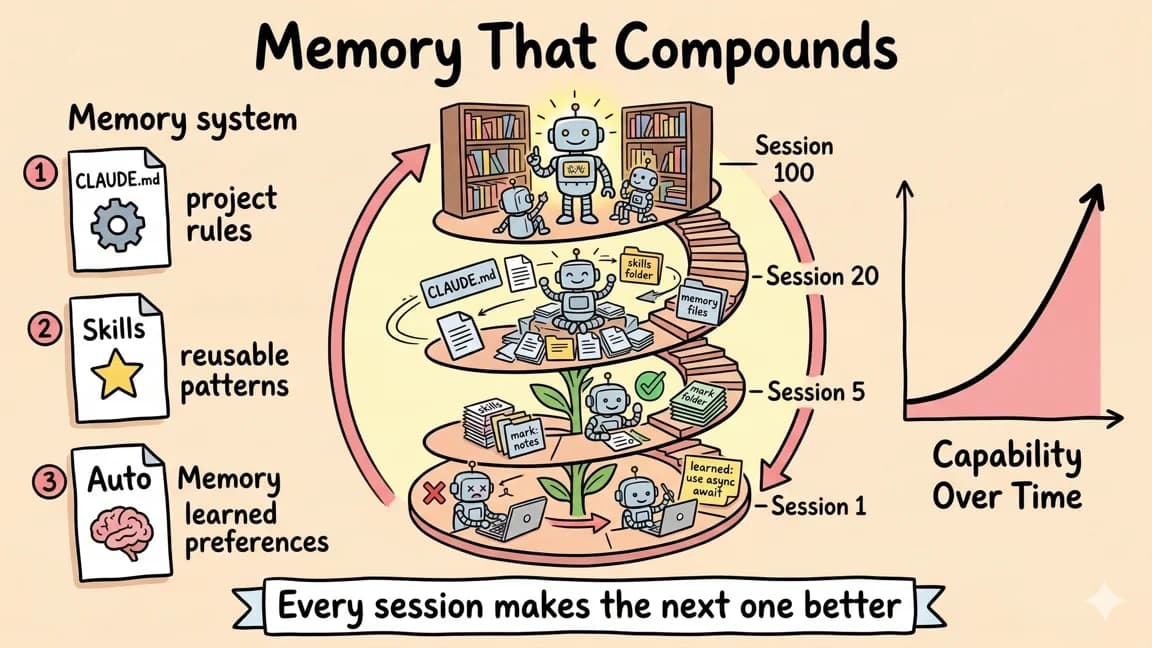
Continual Learning in Claude Code: Memory That Compounds
Continual learning in Claude Code uses skills as persistent memory. Capture successes and failures in session retrospectives and share them across teams.
Read more
237 articles - page 20 of 20
Continual learning in Claude Code uses skills as persistent memory. Capture successes and failures in session retrospectives and share them across teams.

The Ralph Loop uses Claude Code stop hooks to keep an agent working autonomously for hours. How stop hooks, completion promises and max iterations fit together.

Zed is not another Electron-based editor. It's built from the ground up in Rust, which means real performance without the memory bloat that plagues other IDEs.

GitKraken with Claude Code shows agent-created branches in a visual Git graph for instant checkout, then uses AI to write and compose clean, stacked commits.

Claude Sonnet 4.5 in Claude Code uses parallel subagents to build a Next.js site and ten arcade games from three prompts. What worked and what still broke.

Claude Code subagents are specialized assistants with their own context, tools and prompt. When to use them, how to set them up, and how to avoid merge chaos.
Create beautiful UI with Claude Code by building a style guide page as your single source of truth, then enforce it with explicit constraints and CLAUDE.md.

Claude Code is a terminal-based AI agent that writes code, runs commands and tests its own output. A 30-day review of its modes, task list and who it suits.
Showing 229-236 of 236 articles
New tutorials, open-source projects, and deep dives on coding agents - delivered weekly.
Explore 841 topics
Browse All Topics