Warp Open Sourced the Terminal. The Real Story Is Agent Operations
AI Tools Deep Dive
20 parts- 1Claude Design: Anthropic's Bet That Designers and Developers Want the Same Tool
- 2The 10 Best AI Coding Tools in 2026
- 3Cursor: The AI-Powered Code Editor That Changed How Developers Work
- 4OpenAI Codex: Terminal and Cloud AI Coding Agent
- 5Gemini CLI: Free AI Coding With 1M Token Context
- 6Kimi K2: Fast, Cheap, and Efficient Coding
- 7GitHub Copilot in 2026: Still Worth It for TypeScript Developers?
- 8Aider vs Claude Code: Open Source vs Commercial AI Coding CLI
- 9Aider vs Claude Code in 2026: Git-First Open Source vs Subagent Runtime
- 10Every AI Coding Tool Compared: The 2026 Matrix
- 11Qwen3.6-27B Is the Local Coding Model to Test First
- 12Zed Just Made Parallel AI Agents a Native Editor Primitive
- 13Warp Open Sourced the Terminal. The Real Story Is Agent OperationsCurrent
- 14AI Design Slop: 16 Patterns That Out Your App as Vibe-Coded
- 15The Claude Design Moment: AI Design Skills Just Got Their Breakout Week
- 16Codeburn: The First TUI That Actually Shows Where Your Claude Max Subscription Is Going
- 17Promptlock: Deterministic Prompt Versioning for LLM Apps
- 18Agent Replays with TraceTrail: Loom for Agent Runs
- 19Hookyard Shows Why Claude Code Hooks Need a Package Manager
- 20MCP Lens: Wireshark for Model Context Protocol Servers
TL;DR
Warp going open source is not just a terminal story. It is a signal that AI coding tools are shifting from chat UX toward agent operations, where planning, execution, review, and feedback loops live close to the shell.
Official Sources#
| Source | Link |
|---|---|
| Warp Open Source Announcement | warp.dev/blog/warp-is-now-open-source |
| Warp GitHub Repository | github.com/warpdotdev/warp |
| Warp Documentation | docs.warp.dev |
| Warp Homepage | warp.dev |
| Warp Agent Mode Docs | docs.warp.dev/agents/using-agents |
| Warp Changelog | docs.warp.dev/getting-started/changelog |
Warp open sourced its client this week, and the obvious headline is already everywhere: the AI terminal is now public on GitHub.
That is true, but it is not the interesting part.
The interesting part is that Warp is trying to make the terminal an agent operations surface. Not a better text box. Not a prettier shell. Not another place to paste a prompt. A control plane where humans describe work, agents execute inside a real development environment, and the product keeps the workflow close to commands, files, reviews, and feedback.
That is why the announcement hit both Hacker News and GitHub Trending at the same time. On Hacker News, the main Warp story reached 370 points and 117 comments. The GitHub repo is sitting around 52,000 stars as of May 2, 2026. The disagreement in the comments is the useful signal: some developers see a credible agentic development environment taking shape, while others see a VC-backed terminal wrapping AI into yet another bloated product surface.
Both sides are reacting to the same underlying shift. The terminal is no longer just where developers run commands. It is becoming one of the places where agents are managed.
What Warp actually changed#
Warp says the client is now open source under AGPL, with its UI framework released under MIT. The repository describes Warp as an "agentic development environment, born out of the terminal." The company also says OpenAI is the founding sponsor of the new open source repository, and that its agentic workflows are powered by GPT models.
For the larger agent workflow map, read AI Agents Explained: A TypeScript Developer's Guide and How to Build AI Agents in TypeScript; they give the architecture and implementation context this piece assumes.
That combination explains the mixed response.
On one side, open sourcing the client directly addresses the biggest complaint Warp has carried for years: developers were being asked to trust a closed source terminal with an unusually privileged position in their workflow. A terminal sees commands, paths, environment behavior, project structure, and often enough context to make security-minded developers uncomfortable.
On the other side, open source does not automatically make a product feel neutral. If the architecture still steers you toward a specific hosted agent platform, a specific account system, or a specific model vendor, then the practical trust question is not "can I read the source?" It is "can I own the workflow?"
That is the part developers should care about.
The terminal is a strange but logical agent surface#
At first glance, the terminal is an odd place to build an AI product. It is dense, unforgiving, and full of habits that have survived for decades because they are faster than graphical alternatives.
But for coding agents, the terminal has one huge advantage: it is already where verification happens.
An agent that can edit files is only useful if it can also run the project, inspect failures, execute tests, read logs, call local scripts, and recover when the first pass is wrong. Those loops already live in the shell. The terminal has access to the exact commands developers trust:
Terminal
pnpm test
pnpm build
git diff
rg "TODO"
curl http://localhost:3000/api/health
That makes the terminal a better agent substrate than a detached chat panel. A chat panel can suggest. A terminal-native agent can suggest, run, inspect, revise, and prove.
This is also why the category keeps converging. Claude Code, Codex, Aider, OpenCode, Cursor agents, Zed threads, and Warp are all circling the same primitive: a supervised loop where an AI system has enough local context and tool access to do real work, while a human keeps authority over scope and merge decisions.
The UX differs. The workflow shape is converging.
The best argument for Warp#
The best version of the pro-Warp argument is not "AI belongs in the terminal." That is too broad.
The better argument is: agent work needs an operations layer, and the terminal is one of the few places where that layer can stay honest.
An agent operations layer needs a few things:
- A task queue or thread model so work can be split into bounded units.
- Direct visibility into commands, file edits, and failures.
- A way to preserve context without turning every task into prompt soup.
- Feedback loops that turn repeated failures into better local behavior.
- Enough integration with git and review that changes can be evaluated before they land.
Warp's announcement leans directly into that. It frames open source contribution itself as an agent-powered workflow: humans propose plans, agents help implement, and the repository becomes the training ground for better agentic development patterns.
That is either very early or very important. Probably both.
The most interesting part is not whether Warp wins. It is that the product thesis matches where serious AI coding is already going. Developers are not asking for a more charming autocomplete. They are asking for a system that can handle a scoped engineering task, produce a diff, run checks, and leave behind enough evidence for review.
From the archive
12 Tools in One Night: An Honest Overnight Agent Report
Apr 29, 2026 • 11 min read
Agent Architecture: Building Multi-Step AI Workflows That Survive Production
Apr 29, 2026 • 11 min read
OpenAI Agents SDK Evolution: What Ships in Production
Apr 29, 2026 • 10 min read
OpenAI Apps SDK: Building MCP UIs Inside ChatGPT
Apr 29, 2026 • 12 min read
The best argument against Warp#
The skeptical HN read is also fair.
Terminals are high-trust tools. Developers have spent years getting comfortable with boring, composable, local-first shells because those shells do not try to become platforms. When a terminal starts adding accounts, AI orchestration, hosted agents, team surfaces, and product-led workflows, some developers immediately see the wrong kind of abstraction.
That skepticism is not nostalgia. It is a valid architectural instinct.
The traditional terminal is powerful because it composes. It does not care whether you use Vim, Helix, Zed, Cursor, tmux, SSH, Docker, Make, Just, pnpm, uv, or a pile of local scripts. It is a thin layer over your tools. The fear is that an "agentic development environment" becomes a thick layer around your tools, and thick layers eventually want to own the workflow.
There is also a licensing and governance question. AGPL source is meaningful, but community trust depends on more than license text. Developers will watch whether the open repo accepts real external contributions, whether local model support becomes first-class, whether hosted features remain optional, and whether the agent workflow works without surrendering too much control to a vendor platform.
The open source move earns attention. It does not automatically earn trust.
The real test is verification#
Most agentic coding tools still over-index on generation. They show the agent writing code, opening files, planning changes, or producing a patch. That is the easy part now.
The hard part is verification.
Can the tool tell whether the change actually works? Can it run the right tests? Can it understand a failing typecheck? Can it avoid celebrating a green command when the command did not test the affected path? Can it produce a diff small enough for a human to review?
This is where terminal-native workflows have an advantage. They can keep the agent close to real evidence. A good agent loop should end with something like:
Terminal
git diff --stat
pnpm typecheck
pnpm test -- --run affected
curl -s http://localhost:3000/api/health
That is also where products can become dangerous. If the interface hides too much detail, the agent can appear more competent than it is. The more autonomous the workflow becomes, the more important the receipts become. Logs, commands, diffs, test output, and review checkpoints are not implementation details. They are the trust layer.
Warp's challenge is to make agent work feel faster without making it feel opaque.
What developers should watch next#
If you are evaluating Warp after the open source move, do not judge it by whether the terminal looks polished. Judge it by whether the workflow respects developer control.
The useful questions are practical:
- Can you run meaningful agent workflows locally?
- Can you bring your own model or harness?
- Can you disable AI features without breaking the terminal experience?
- Can you inspect exactly what the agent did and why?
- Can you keep secrets, enterprise keys, and private repo context under your own rules?
- Can you review every diff before anything is merged?
- Can the open source community shape the roadmap, or is the repo mostly a visibility layer?
Those questions matter more than whether Warp is "the future of terminals." The future is probably plural. Some developers will use Ghostty plus Claude Code. Some will use Zed threads. Some will use Cursor. Some will use Codex in a terminal. Some will use Warp because the integrated agent operations model is exactly what they wanted.
The winning pattern is not one product. It is the loop.
The take#
Warp going open source is a marker for where AI coding is heading. The category is moving away from isolated chat and toward operational surfaces where agents can be scoped, monitored, verified, and improved.
That is the right direction.
But the trust bar is higher for terminals than almost any other developer tool. A terminal has to be boring in the places where boring matters: command execution, local control, transparency, security, and exit rights. If Warp can keep those properties while making multi-agent work easier to manage, the open source move will matter. If it becomes a hosted AI platform wearing terminal clothing, developers will notice fast.
The smart read is neither hype nor dismissal. Warp is testing whether the terminal can become the cockpit for agentic development. The answer will depend less on the launch post and more on whether the open repo proves the workflow in public.
FAQ#
What did Warp open source?#
Warp released its terminal client as open source under the AGPL license, with its UI framework released under MIT. The repository describes Warp as an "agentic development environment, born out of the terminal." The client code is now publicly available on GitHub.
Why is Warp open sourcing the terminal important for developers?#
Open sourcing addresses the biggest trust concern Warp has faced: developers were asked to trust a closed source terminal with an unusually privileged position in their workflow. Terminals see commands, paths, environment behavior, project structure, and sensitive context. Open source lets developers inspect exactly what the tool does.
What is agent operations in the context of Warp?#
Agent operations refers to managing AI agents as part of your development workflow. Instead of a simple chat interface, Warp positions the terminal as a control plane where humans describe work, agents execute inside the real development environment, and the product keeps the workflow close to commands, files, reviews, and feedback loops.
Why is the terminal a good surface for AI coding agents?#
The terminal has one huge advantage for coding agents: it is already where verification happens. An agent that can edit files is only useful if it can also run the project, inspect failures, execute tests, read logs, call local scripts, and recover when the first pass is wrong. Those loops already live in the shell.
Can I use Warp with my own AI models?#
Whether Warp supports local or custom models is a key question for developers evaluating the tool. The open source release allows the community to inspect the architecture and potentially contribute local model support. Watch the repository for developments on model flexibility.
How does Warp compare to Claude Code, Cursor, and other coding agents?#
Warp, Claude Code, Codex, Aider, OpenCode, Cursor agents, and Zed threads are all circling the same primitive: a supervised loop where an AI system has enough local context and tool access to do real work, while a human keeps authority over scope and merge decisions. The UX differs but the workflow shape is converging.
What license is Warp released under?#
The Warp client is released under AGPL (Affero General Public License), while the UI framework is released under MIT. AGPL requires that modifications to the code be shared if the software is used over a network, which has implications for enterprise use.
What should I look for when evaluating Warp after the open source release?#
Judge Warp by whether the workflow respects developer control. Key questions: Can you run agent workflows locally? Can you bring your own model? Can you disable AI features without breaking the terminal? Can you inspect exactly what the agent did? Can you keep secrets and private repo context under your own rules?
Continue Reading#
- Superlogical: Mitchell Hashimoto's New Company Building a Multiplexer for All Work
- Warp 2.0: The Agentic Development Environment
Sources#
Read next
Zed Just Made Parallel AI Agents a Native Editor Primitive
Zed shipped a Threads Sidebar that runs multiple agents in one window, isolated per-worktree, with per-thread agent selection. This is the first major editor to treat parallel agent orchestration as a first-class editor feature, not a plugin.
7 min readWhat Hacker News Gets Right About AI Coding Agents in 2026
Hacker News keeps arguing about Claude Code, Codex, skills, MCP, and orchestration. Under the noise, the same four truths keep surfacing: workflows matter more than demos, verification is the bottleneck, skills beat prompts, and orchestration matters more than raw autonomy.
11 min readState of AI Coding: April 2026
The AI coding market just passed 90% developer adoption. Here's what the data actually says about which tools are winning, what's shifting, and where this is all heading.
10 min readShare
Developers Digest
Technical content at the intersection of AI and development. Building with AI agents, Claude Code, and modern dev tools - then showing you exactly how it works.
300+ videos30K+ GitHub stars850+ articles
Related Tools
AI CodingAgent

OpenAI Codex
OpenAI's coding agent for terminal, cloud, IDE, GitHub, Slack, and Linear workflows. Reads repos, edits files, runs comm...
View ToolAI CodingOpen source

DeepSeek-TUI
Open-source terminal agent runtime with approval modes, rollback snapshots, MCP servers, LSP diagnostics, and a headless...
View ToolAI Coding

Aider
Open-source AI pair programming in your terminal. Works with any LLM - Claude, GPT, Gemini, local models. Git-aware ed...
View ToolAI Coding
Codex CLI
OpenAI's open-source terminal coding agent built in Rust. Runs locally, reads your repo, edits files, and executes comma...
View ToolApps from Developers Digest
Developer ToolsPlus $20/mo
TraceTrail Plus
Share agent traces with a link. Keep history long enough to find the bug.
View AppSaaS Products
Overnight Agents
Spec out AI agents, run them overnight, wake up to a verified GitHub repo.
View AppSaaS Products
Auto Company
Describe your company and agent teams handle operations.
View AppRelated Guides
Guide
Interactive Mode - Claude Code
Real-time prompt loop with history, completions, and multiline input.
Claude CodeGuide
Terminal CLI - Claude Code
The primary command-line entry point for Claude Code sessions.
Claude CodeGuide
Claude Code Setup Guide
Configure Claude Code for maximum productivity -- CLAUDE.md, sub-agents, MCP servers, and autonomous workflows.
AI AgentsRelated Videos

Buzz: Open-Source Collaboration for Humans + AI Agents
Buzz by Block: Open-Source Slack-Style Collaboration for Humans + AI Agents (Demo & Setup) Check out Arcade: https://arcade.dev.plug.dev/xiDRwlA Repo: https://github.com/block/buzz The video introd...
Video·
Zed: The Open Source Agentic IDE - Use Claude Code, Codex & Gemini CLI in one place
Check out Zed here! https://zed.dev In this video, we dive into Zed, a robust open source code editor that has recently introduced the Agent Client Protocol. This new open standard allows...
Video·
Warp 2.0: The Agentic Development Envrionment
In this video, we dive into Warp 2.0, a cutting-edg Agentic Development environment that integrates natural language processing to execute terminal commands and write code. Learn about the...
Video·
Related Posts
7 min read
Zed
Zed Just Made Parallel AI Agents a Native Editor Primitive
Zed shipped a Threads Sidebar that runs multiple agents in one window, isolated per-worktree, with per-thread agent sele...
11 min read
AI Coding
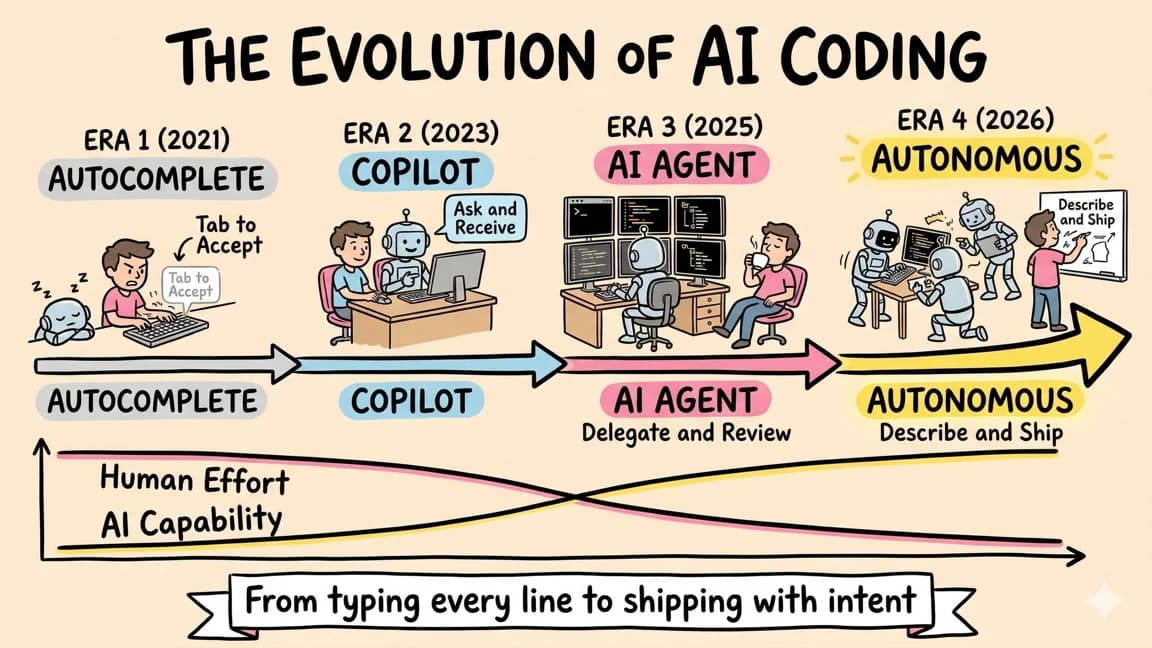
What Hacker News Gets Right About AI Coding Agents in 2026
Hacker News keeps arguing about Claude Code, Codex, skills, MCP, and orchestration. Under the noise, the same four truth...
10 min read
AI Coding
State of AI Coding: April 2026
The AI coding market just passed 90% developer adoption. Here's what the data actually says about which tools are winnin...
8 min read
AI Coding
The 10 Best AI Coding Tools in 2026
From terminal agents to cloud IDEs - these are the AI coding tools worth using for TypeScript development in 2026.
15 min read
AI Coding
Every AI Coding Tool Compared: The 2026 Matrix
12 AI coding tools across 4 architecture types, compared on pricing, strengths, weaknesses, and best use cases. The defi...
5 min read
Aider
Aider vs Claude Code: Open Source vs Commercial AI Coding CLI
Aider is open source and works with any model. Claude Code is Anthropic's commercial agent. Here is how they compare for...
Build with the member tools

Get Smarter About AI Dev
New tutorials, open-source projects, and deep dives on coding agents - delivered weekly.
One email per weekReal code, not theoryFree forever