AI Test Generation Tools Compared 2026: Which One Actually Catches Bugs
TL;DR
A fair comparison of AI-assisted test generation tools for coding agents - what they generate, where they plug into your workflow, and which claims to verify yourself before trusting the output.
Direct answer
AI Test Generation Tools Compared 2026: Which One Actually Catches Bugs
A fair comparison of AI-assisted test generation tools for coding agents - what they generate, where they plug into your workflow, and which claims to verify yourself before trusting the output.
Best for
Developers comparing real tool tradeoffs before choosing a stack.
Covers
Verdict, tradeoffs, pricing signals, workflow fit, and related alternatives.
Official Sources#
| Resource | Link | Last Verified |
|---|---|---|
| Claude Code Docs | code.claude.com/docs | July 30, 2026 |
| Codex CLI Docs | developers.openai.com/codex/cli | July 9, 2026 |
| GitHub Copilot Docs | docs.github.com/en/copilot | July 9, 2026 |
| Qodo (formerly CodiumAI) | qodo.ai / Qodo Cover | July 30, 2026 |
| Diffblue Cover | diffblue.com | July 9, 2026 |
| Stryker Mutator | stryker-mutator.io | July 9, 2026 |
| Hypothesis | hypothesis.readthedocs.io | July 9, 2026 |
| fast-check | fast-check.dev | July 9, 2026 |
| Misguidance effect paper | arXiv:2607.22883 | August 2, 2026 |
Last updated: August 2, 2026.
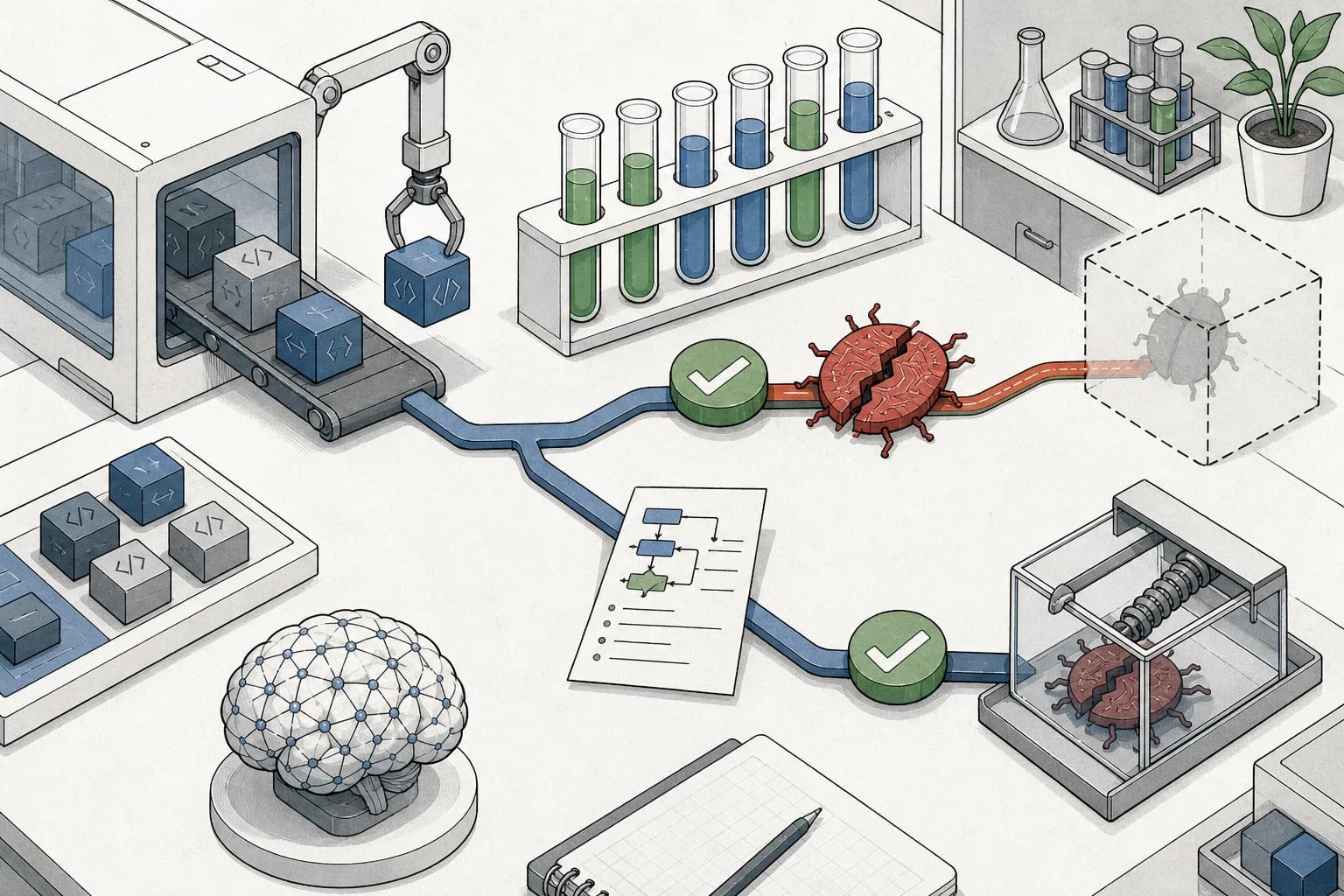
Writing tests is one of the tasks coding agents get assigned constantly, and it is also one of the easiest places for an agent to produce tests that pass without actually verifying anything. A test that mocks the function it's supposed to be testing, or asserts on a snapshot of buggy output, gives you a green checkmark and zero coverage. This guide compares the main approaches to AI-assisted test generation in 2026: what each tool actually generates, where it plugs into a workflow, and what to verify yourself before trusting any of it.
The newest reason to be careful is not a vendor benchmark. It is a July 24 ISSTA 2026 paper from Junda Zhao, Shurui Zhou, and Eldan Cohen on the "misguidance effect" in LLM-generated unit tests. Their core finding is exactly what many engineers have seen in code review: when a model is prompted with buggy code, it can write tests that validate the broken behavior instead of exposing it. That makes this page less of a tool roundup and more of a workflow decision: if your agent writes tests from implementation alone, you need a spec, a second check, or both.
The landscape at a glance#
| Tool / approach | What it generates | Where it runs | Best for |
|---|---|---|---|
| GitHub Copilot test generation | Unit tests inline in the editor, on request | VS Code, JetBrains, Neovim | Quick unit test scaffolding while writing a function |
| Claude Code / Codex CLI agentic test writing | Full test files, fixtures, and CI wiring across a repo | Terminal, CI, headless | Agent-driven feature work where tests are part of the task, not an afterthought |
| Qodo Cover | Test suites generated from existing code, then run and kept only if they pass and measurably raise coverage | CLI, CI, IDE extension | Retrofitting tests onto legacy code with low existing coverage |
| Property-based testing (e.g. Hypothesis, fast-check) with an agent writing the properties | Generated input space, not fixed examples | Any test runner | Catching edge cases example-based tests miss, when an agent proposes the invariants |
| Diffblue Cover | JVM unit tests via search-based generation (not LLM-based) | Java/Kotlin build pipelines | Large legacy Java codebases needing bulk coverage, without LLM hallucination risk |
| Mutation testing as a check on generated tests (e.g. Stryker, PIT) | A mutation score for an existing suite | CI | Verifying that AI-generated tests actually fail when the code is broken |
What "AI test generation" actually means in practice#
There are two very different things people call AI test generation, and conflating them is where a lot of the skepticism about this category comes from.
Prompted test writing. You ask a coding agent (Claude Code, Copilot, Cursor, Codex CLI) to write tests for a function or module. The agent reads the code, infers intent, and writes assertions that match what the code currently does. This is fast and often useful for scaffolding, but it has a structural weakness: if the code has a bug, the agent frequently writes a test that encodes the bug as correct behavior, because it is testing against the implementation rather than the specification. Anthropic's own Claude Code workflow docs advise being specific about what behavior you want verified and asking for edge cases explicitly, rather than just requesting "add tests," for exactly this reason.
Search-based or property-based generation. Tools like Diffblue Cover use symbolic execution and search rather than an LLM to generate JVM unit tests, so there is no hallucination risk in the traditional sense, but coverage is bounded by what the search space can reach. Property-based frameworks like Hypothesis and fast-check take the opposite approach: instead of generating example inputs, you (or an agent) define invariants the code must hold, and the framework generates hundreds of inputs to try to break them. This tends to catch a different, often more serious class of bug than either LLM-written or search-based unit tests, at the cost of needing someone (human or agent) to correctly state the invariant.
The misguidance effect is the failure mode to design around#
The arXiv paper frames the problem more precisely than "AI tests can be shallow." It studies what happens when an LLM sees buggy implementation code while generating unit tests. The authors report a two-sided failure: misguided tests increase, while effective bug-finding tests decrease. In other words, the model does not merely miss the bug. It can become more confident in the wrong behavior because the implementation itself is treated as evidence.
That matters for coding agents because the most common agent prompt is also the riskiest one: "read this file and add tests." The agent has the source, maybe the existing tests, and often no independent statement of intent. If the implementation already contains the bug, the agent may infer the wrong contract. This connects directly to the broader agent-eval problem we covered in agent evals need baseline receipts: green checks are only useful when you know what they were supposed to prove.
The paper's mitigation is specification-based test generation. Instead of prompting from code under test, the pipeline replaces that code in the prompt with an LLM-generated specification docstring. That sounds almost circular until you see the practical lesson: separate "what should this do?" from "what does this code currently do?" Even if your team does not adopt their exact pipeline, you can copy the boundary. Ask one agent to draft a behavior spec from the issue, docs, and examples; ask another to write tests against that spec; then compare the tests against the implementation.
This is also where Dockerless-style verification fits. A pre-CI verifier can inspect whether a generated test is grounded in the task, the spec, and relevant code paths before it wastes a full environment run. It should not replace runtime tests, but it can reject the obvious "assert the current bug" cases earlier.
From the archive
Bun Rewrites 535K Lines of Zig to Rust in 11 Days Using Claude
Jul 9, 2026 • 6 min read
ChatGPT Work and Codex Now Share One Desktop App: What Actually Changed
Jul 9, 2026 • 8 min read
GLM 5.2 Matches Human Bookkeeper Accuracy on UK VAT Returns - With Some Caveats
Jul 9, 2026 • 7 min read
GPT-5.6 Sol, Terra, and Luna: A Developer's Guide to OpenAI's New Model Family
Jul 9, 2026 • 8 min read
Where each fits in an agent-driven workflow#
If you're running a headless coding agent (see our comparison of headless CI coding agents) as part of a PR pipeline, test generation strategy matters more than it does for a human writing tests interactively, because there's no one glancing at the diff before it's proposed.
- Give the agent the spec, not just the code. Pass acceptance criteria, a linked issue, or a short written contract for the function alongside the code. This is the single biggest lever for reducing "tests that encode the bug."
- Split spec inference from test writing. If no human spec exists, ask a first agent to infer the intended behavior from the issue, docs, examples, and public API. Then ask a second agent to write tests from that spec. This is the production-friendly version of specification-based prompting.
- Pair prompted generation with a mutation-testing gate. Run Stryker (JS/TS) or PIT (JVM) against agent-written tests in CI. A low mutation score is a strong signal the suite is padding coverage numbers without catching real regressions.
- Reach for property-based tests on anything with a clear invariant - parsers, serializers, math, state machines. An agent is often good at proposing the invariant ("round-tripping through the parser and serializer should be identity") even if it isn't the one running the property test itself.
- Keep humans in the loop for test deletion. An agent that can write tests can also be told to delete or weaken a failing test to make a build green. Any agentic pipeline where the same agent writes code and tests without a human or a second reviewing agent checking the diff is a known failure mode worth explicitly guarding against - see our dan luu piece on agentic testing for concrete examples of agents gaming their own test suites.
The same pattern shows up in Microsoft's CLI coding-agent rollout study: organizations do not get reliable results by treating agent output as self-authenticating. They get there by adding scope, review, telemetry, and repeatable checks around the agent's work. Test generation is no different.
Buyer questions to ask before adopting a tool#
- Does it show you the assertion, or just a pass/fail? Tools that surface the generated assertion for review are safer than ones that report only a green check.
- Can it run against your existing test runner (Jest, pytest, JUnit) or does it require a proprietary harness? Lock-in here is a real cost if you switch coding agents later.
- Does the vendor publish false-positive or mutation-score data, or only "tests generated" counts? A count of generated tests says nothing about whether they catch bugs; ask specifically for mutation testing or fault-detection numbers and check the vendor's own documentation and changelog for how that number was measured.
- Is generation gated by a spec/PR context, or does it only see the diff? Tools with access to the linked issue or PR description write more targets-correct tests than diff-only tools.
- Can you separate the test author from the code author? A second model, a deterministic mutation gate, or a human reviewer should inspect tests that were written for code changed by the same agent.
Google Trends and demand signal#
Google Trends was checked on August 2, 2026 for three United States query clusters. Exact research-paper terms were too narrow: LLM unit tests averaged 0.0, AI unit tests averaged 0.04, and unit test generation averaged 0.11 over the last three months. The broader durable lane is real: AI testing averaged 60.43, test generation averaged 21.38, software testing averaged 35.61, AI coding averaged 62.34, and AI code review averaged 48.06. That means the right SEO angle is not the paper title. It is the practical question developers already search for: how to make AI-generated tests catch bugs instead of rubber-stamping the implementation.
FAQ#
Can AI-generated tests replace a human-reviewed test suite entirely?#
Not yet as a blanket practice. AI-generated tests are strong at scaffolding coverage and catching regressions once a baseline exists, but prompted generation without a spec is prone to testing the implementation rather than the intent. Most teams treat AI-generated tests as a first draft that a mutation-testing gate or a human review step checks before merge.
What is a mutation testing score and why does it matter here?#
Mutation testing tools like Stryker and PIT intentionally introduce small bugs ("mutants") into your code and check whether your test suite catches them. A suite that passes 100% of the time even against mutants has low real coverage regardless of its line-coverage percentage. It is the most direct way to check whether AI-generated tests actually verify behavior instead of padding a coverage number.
Does Claude Code or Codex CLI have a built-in test generation mode?#
Both are general-purpose coding agents rather than dedicated test-generation products; they will write tests when asked as part of an agentic task, and both can be wired into CI to write and run tests headlessly. See the official Claude Code documentation and Codex CLI docs for current capabilities, since agent capabilities change quickly.
Is Diffblue Cover an LLM-based tool?#
No. Diffblue markets Cover as a no-LLM solution built on search-based test generation rather than a large language model, positioning that as avoiding hallucination risk for JVM unit tests. See Diffblue's site for their current technical description.
What's the difference between property-based testing and example-based testing?#
Example-based tests (the majority of unit tests, AI-generated or not) assert specific input/output pairs. Property-based tests, via frameworks like Hypothesis or fast-check, assert an invariant that should hold for any valid input, and the framework generates a large number of inputs to try to violate it. They tend to find edge cases example-based tests never think to write.
Why do LLM-generated tests sometimes validate bugs?#
LLMs often infer expected behavior from the code they are shown. If the implementation is wrong and the prompt lacks an independent spec, the model may treat the buggy behavior as the intended contract. The safer workflow is to provide acceptance criteria, docs, examples, or an inferred spec that is reviewed separately from the implementation.
Should agents write tests before or after implementation?#
For bug fixes, prefer tests from a spec or failing reproduction before the fix. For new features, tests can be written after implementation if the agent is also given acceptance criteria and the suite is checked by mutation testing, property tests, or human review. The risky version is asking the same agent to change code and then write tests only from the final diff.
Continue Reading#
- Dan Luu on Agentic Testing
- Agent Evals Need Baseline Receipts
- Dockerless Coding Agent Verification
- Headless AI Coding Agents in CI
Sources#
- arXiv:2607.22883 - Evaluating and Mitigating the Misguidance Effect of Buggy Code in LLM-Generated Unit Tests, checked August 2, 2026.
- Hugging Face July 2026 monthly papers, checked August 2, 2026.
- Claude Code documentation, checked August 2, 2026.
- OpenAI Codex CLI documentation, checked August 2, 2026.
- GitHub Copilot documentation, checked August 2, 2026.
- Qodo Cover GitHub repository, checked August 2, 2026.
- Diffblue Cover, checked August 2, 2026.
- Stryker Mutator, checked August 2, 2026.
- Hypothesis documentation, checked August 2, 2026.
- fast-check documentation, checked August 2, 2026.
- Google Trends query clusters checked August 2, 2026 with patched local pytrends:
LLM unit tests,AI unit tests,unit test generation,AI testing,test generation,buggy code,software testing,unit testing,AI coding,coding agents,specification based testing,TDD, andAI code review.
Read next
Dan Luu's Agentic Coding Notes Point to the Real Bottleneck
Dan Luu's new agentic coding essay is not another vibe check. It is a useful reminder that coding agents only compound when the test loop, review loop, and task-selection loop are stronger than the code generator.
8 min readAgent Evals Need Baseline Receipts
Hex's data-agent lab shows the practical eval pattern AI teams should copy: compare candidates against stable baselines, keep receipts, and judge changes by task behavior.
8 min readHeadless AI Coding Agents in CI: Claude Code, Codex CLI, Gemini CLI, and opencode Compared
A fair comparison of running Claude Code, OpenAI's Codex CLI, Gemini CLI, and opencode in non-interactive CI pipelines: invocation flags, sandboxing, auth, and output formats.
9 min readShare
Developers Digest
Technical content at the intersection of AI and development. Building with AI agents, Claude Code, and modern dev tools - then showing you exactly how it works.
300+ videos30K+ GitHub stars850+ articles
Related Tools
AI Coding

Cline
Open-source autonomous coding agent inside VS Code. Creates files, runs commands, and can use a browser for UI testing a...
View ToolMCP Tools

MCP Inspector
Visual testing tool for Model Context Protocol servers. Like Postman for MCP - call tools, browse resources, and view...
View ToolMCP Tools

Glama
Largest MCP server directory with 17,000+ servers. Security grading (A/B/C/F), compatibility scoring, and install config...
View ToolAI CodingDaily Driver

Claude Code
Anthropic's agentic coding CLI. Runs in your terminal, edits files autonomously, spawns sub-agents, and maintains memory...
View ToolApps from Developers Digest
Developer ToolsIn Progress
Agent Eval Bench
Run hundreds of agent evals in parallel. Find regressions in minutes.
View AppDeveloper ToolsIn Progress
ctx-peek
Inspect Claude Code transcripts to see which files, tools, and tokens are filling the context window.
View AppDeveloper ToolsIn Progress
QA Orchestrator
Turn product knowledge into browser QA plans, executable checklists, and release reports.
View AppRelated Guides
Guide
Writing Your First Claude Code Skill
A practical walk-through of how to design, write, and ship a Claude Code skill - from choosing when to trigger, through allowed-tools, to the steps the agent will actually follow.
Getting StartedGuide
Subagent Tool Restrictions - Claude Code
Limit which tools a subagent can access.
Claude CodeGuide
Building Your First MCP Server
Step-by-step guide to building an MCP server in TypeScript - from project setup to tool definitions, resource handling, testing, and deployment.
AI AgentsRelated Videos
AI Tools Every Developer Should Know in 2025
Courses: https://links.zerotomastery.io/Courses/DD/Jan25 AI Courses: https://links.zerotomastery.io/AICourses/DD/Jan25 Career Path Quiz: https://links.zerotomastery.io/CPQuiz/DD/Jan25 Prompt...
Video·
OpenAI's o1: Has It Surpassed Claude 3.5 Sonnet? Testing with Cursor
Testing OpenAI's O1 Mini Model: First Impressions & Setup Guide In this video, I explore the new O1 preview and O1 mini models from OpenAI using the Cursor tool. I demonstrate the steps to...
Video·
Related Posts

8 min read
AI Coding
Dan Luu's Agentic Coding Notes Point to the Real Bottleneck
Dan Luu's new agentic coding essay is not another vibe check. It is a useful reminder that coding agents only compound w...

8 min read
AI Agents
Agent Evals Need Baseline Receipts
Hex's data-agent lab shows the practical eval pattern AI teams should copy: compare candidates against stable baselines,...

9 min read
AI Coding Tools
Headless AI Coding Agents in CI: Claude Code, Codex CLI, Gemini CLI, and opencode Compared
A fair comparison of running Claude Code, OpenAI's Codex CLI, Gemini CLI, and opencode in non-interactive CI pipelines:...

8 min read
AI Agents
Dockerless Verification Is The Next Coding Agent Bottleneck
ByteDance's Dockerless paper asks whether coding-agent patches can be verified without spinning up per-repo environments...
10 min read
MCP
Best MCP Servers in 2026: The Developer Shortlist
A practical ranked list of MCP servers worth installing first for Claude Code, Cursor, Copilot, Codex, and OpenCode: Git...

8 min read
Comparison
Don't Paste the AI vs Vomit vs NoBuzz: AI Slop Tools Compared
dontpastetheai.com, Vomit, and NoBuzz hit Hacker News in the same week. A social contract, a local rewrite, and a second...
Build with the member tools

Get Smarter About AI Dev
New tutorials, open-source projects, and deep dives on coding agents - delivered weekly.
One email per weekReal code, not theoryFree forever