DevDigest OS: The Thesis Behind Treating an Empire as One Operating System
TL;DR
What if your dev tools weren't separate apps but one operating system? The thesis behind /os and /suites - small, sharp tools that compound into a coherent layer.
One Question#
What if your dev tools weren't separate apps but one operating system?
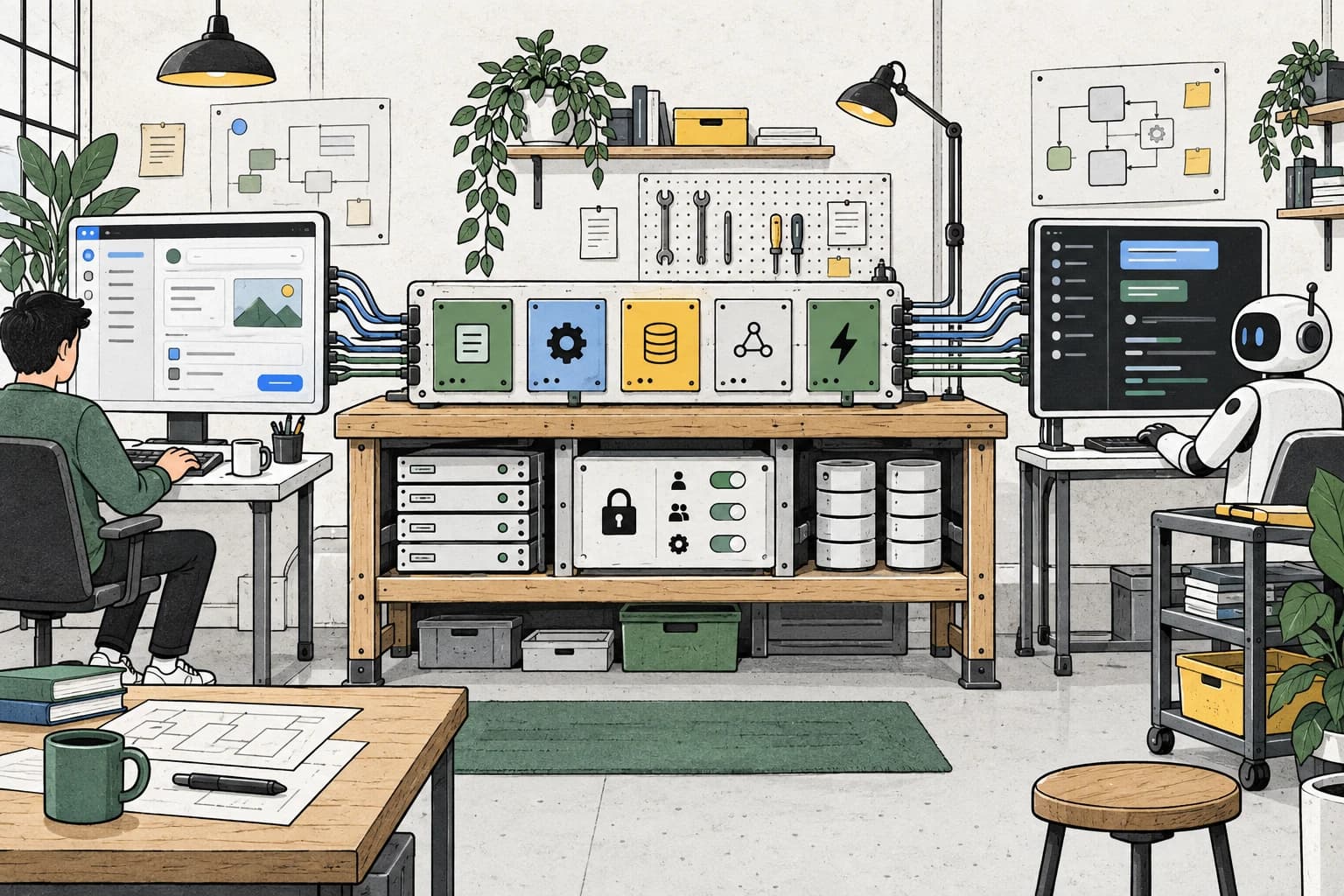
Not a suite. Not a platform. An OS - a shared substrate where every tool knows about every other tool, every output is an input somewhere else, and the catalog itself is a protocol other agents can read.
That is the thesis behind DevDigest OS. It is also why we shipped /suites. The marketing pages are the surface. This post is the argument.
The Thesis in One Paragraph#
Each DevDigest app earns its place by solving exactly one thing well. None of them are platforms. None of them try to swallow your stack. But they share conventions - design language, auth, embeds, the apps catalog - and that shared layer is what turns a portfolio of single-purpose tools into something that behaves like an operating system for shipping.
A platform asks you to migrate. An OS asks you to plug in.
Each App Earns Its Place#
The rule is simple: if you can describe what an app does in one sentence and a developer nods, it ships. If the sentence needs an "and" or a "plus," it is two apps and we split it.
- ShipBadge - embed a "shipping today" badge on any project.
- DD Pulse - uptime + status pages for indie products.
- OG Forge - generate social cards from a URL.
- ctx-peek - peek at any AI agent's context window.
- TraceTrail - replay agent runs step by step.
- SponsorKit - sponsor pages with one config file.
Each of these is a complete product on its own. None require any of the others. That is intentional. The OS only works if every component survives being used in isolation.
But Together They Loop#
The interesting work happens at the seams.
ShipBadge → DD Pulse → status pages on every app you ship. You wire ShipBadge into a new repo. ShipBadge sees you also use DD Pulse and offers a one-click upgrade: the same badge now renders live uptime data. The status page DD Pulse generates embeds the badge back. Two apps, one feedback loop, no integration code.
OG Forge → ctx-peek → public profiles for your AI work. ctx-peek captures an agent run. OG Forge auto-generates a social card from the trace. The profile page on ctx-peek embeds the OG Forge image and links back. You posted a tweet about an agent run; the tweet card was built by another DD app you forgot you owned.
TraceTrail → DD Pulse → reliability dashboards for agents. TraceTrail records agent runs. DD Pulse turns the failure rate into an uptime metric. A status page now answers "is my agent reliable today" alongside "is my API up."
These loops are not features we built. They emerged the moment two apps shared the same conventions. That is the OS dividend.
From the archive
DeepSeek-TUI: The Rust Terminal Coding Agent With MCP, Skills, and 1M-Token Context
May 7, 2026 • 6 min read
Terminal Agents Are the New Developer Runtime
May 7, 2026 • 9 min read
What Is Cline? The Open-Source AI Coding Tool That Runs in VS Code
May 7, 2026 • 9 min read
Claude Code Token Burn Is an Observability Problem
May 6, 2026 • 8 min read
Cross-App Conventions: The Real Product#
The apps are the demos. The conventions are the product.
- Every output is shareable. Every artifact in every DD app has a public URL. No login walls on outputs.
- Every output is embeddable. Every public URL has an embed variant - iframe, oEmbed, or Markdown shortcode. ShipBadge in your README, OG Forge in your blog, ctx-peek in your tweet.
- Every output links back. Embeds carry attribution. The attribution is a link to the source app. The source app is the catalog entry. The catalog entry surfaces the next adjacent tool.
Read those three rules in sequence and you have described how the empire compounds without us writing a single integration.
The Chrome Extension as Desktop Shell#
If the apps are programs, the DevDigest Chrome extension is the desktop. It overlays the browser with a launcher, a clipboard that knows about every DD app, and context-aware actions on any page you visit.
You are reading a Vercel dashboard? The extension offers "monitor with DD Pulse." You are looking at a GitHub repo? It offers "embed ShipBadge." You are debugging an agent in the Claude Code sidebar? It offers "open in TraceTrail."
The extension is the only place a user sees the OS as a single thing. Everywhere else, the apps stay sharp and singular. That separation is on purpose. The shell is opinionated; the apps are not.
/api/apps - The Catalog as Protocol#
The piece most people miss: /api/apps is a public JSON endpoint. It returns the entire DevDigest catalog - every app, its tagline, its embed schema, its OG-card endpoint, its status page.
That endpoint is consumed by:
- The Chrome extension launcher.
- The /suites page.
- Our own internal cross-promotion banners.
- Third-party agents that want to introspect the empire.
That last one is the lever. When an LLM agent asks "what tool can generate a social card from a URL," /api/apps is a single fetch away from a structured answer. The catalog is not marketing copy. It is a discovery protocol other software can consume.
If you want your own indie portfolio to compound like this, expose your catalog. Make it boring JSON. Make it fetchable without auth. The agents are coming for the rest.
What This Is Not#
DevDigest OS is not:
- A platform. You do not host on it. You do not deploy to it. There is no SDK lock-in.
- A bundle. You do not buy "the suite." Every app prices independently.
- A monolith. No app shares a database with another. The shared layer is conventions, not infrastructure.
- Finished. The catalog grows whenever a tool earns its sentence.
If any of those become true, we have lost the plot. Drift toward platform is the failure mode.
The Compounding Argument#
Here is the only number that matters: the marginal utility of the next DD app is higher than the last.
When we shipped ShipBadge alone, it was a badge service. When DD Pulse landed, ShipBadge became a status indicator. When OG Forge landed, both got social cards for free. When ctx-peek landed, all three got agent-run trace embeds.
Every new app makes the previous apps more useful - not because we rewrite them, but because the conventions hold and the catalog updates. That is the definition of an operating system: the shared substrate is what creates leverage.
A monolith compounds linearly. A pile of apps does not compound at all. An OS - small, sharp tools plus shared conventions plus a public catalog - compounds.
What To Do Next#
If you build indie products, steal the pattern:
- One app, one sentence. If you cannot explain it without "and," split it.
- Every output gets a public URL, an embed, and a link back.
- Publish a
/api/apps-style catalog. JSON, no auth, stable schema. - Build a shell only after you have three apps. Not before.
If you want to see it in motion, the /suites page is the catalog grouped by job-to-be-done. Everything on both pages is pulled from the same /api/apps endpoint that the agents read.
The empire is not the apps. The empire is the layer underneath that makes the apps stop being separate.
Continue Reading#
Read next
Build Log: Adding Product Paths to a Content Site Without Making It Salesy
A field note on adding pricing, Pro, apps, sponsors, partners, hiring, consulting, newsletter, and weekly rollup paths to DevDigest without turning the site into vague growth copy.
8 min readBuild Log: How I Shipped a Tool Directory That Feeds Search, Compare, and RSS
The DevDigest tools directory is not just a list of links. One registry now feeds tool pages, category filters, comparison routes, RSS, JSON APIs, search, sitemap discovery, and content expansion loops.
9 min readBuild Log: Turning the DevDigest Blog Into an Agent Content System
The DevDigest blog is no longer just a folder of markdown files. It is becoming a small content operating system: posts, tags, RSS, search, llms.txt, route discovery, content expansion reports, and app-linked build logs.
9 min readShare
Developers Digest
Technical content at the intersection of AI and development. Building with AI agents, Claude Code, and modern dev tools - then showing you exactly how it works.
300+ videos30K+ GitHub stars850+ articles
Related Tools
ProductivityDaily Use

Obsidian
Local-first markdown knowledge base with wikilinks. My entire DevDigest pipeline lives here - research, scripts, conte...
View ToolProductivity

Linear
Issue tracking built for speed. Keyboard-first, sub-100ms UI. Cycles, roadmaps, GitHub integration. I use it to track al...
View ToolApps from Developers Digest
SaaS Products
DevDigest Academy
Learn AI-assisted development by building, not by watching.
View AppDeveloper ToolsIn Progress
agentfs
Give your agents a filesystem that branches like git. Crash-safe by default.
View AppSaaS ProductsIn Progress
SocialOps Studio
A social media operating system for creators, founders, and content teams.
View AppRelated Guides
Guide
Getting Started with DevDigest CLI
Install the dd CLI and scaffold your first AI-powered app in under a minute.
Getting StartedGuide
Claude Code Complete Course
A complete, citation-backed Claude Code course with setup, prompting systems, MCP, CI, security, cost controls, and capstone workflows.
ai-developmentGuide
Accept Edits Mode - Claude Code
Auto-approve file edits and common filesystem commands.
Claude CodeRelated Posts
8 min read
DevDigest
Build Log: Adding Product Paths to a Content Site Without Making It Salesy
A field note on adding pricing, Pro, apps, sponsors, partners, hiring, consulting, newsletter, and weekly rollup paths t...
9 min read
DevDigest
Build Log: How I Shipped a Tool Directory That Feeds Search, Compare, and RSS
The DevDigest tools directory is not just a list of links. One registry now feeds tool pages, category filters, comparis...
9 min read
DevDigest
Build Log: Turning the DevDigest Blog Into an Agent Content System
The DevDigest blog is no longer just a folder of markdown files. It is becoming a small content operating system: posts,...
9 min read
Claude Code
How I'm Building 24 AI-Powered Apps in Parallel
One dev, one CLI, 24 subdomains, and a lot of parallel agents. The playbook for shipping an AI app portfolio.
4 min read
DevDigest
The DevDigest App Ecosystem
A tour of every app and tool in the Developers Digest network - from AI model comparisons to cron job scheduling.
7 min read
AI Agents
Agent-Native Apps Need Shared Actions, Not UI Puppeteering
BuilderIO's Agent-Native framework is trending because it gives AI apps a cleaner contract: one action layer shared by t...
Build with the member tools

Get Smarter About AI Dev
New tutorials, open-source projects, and deep dives on coding agents - delivered weekly.
One email per weekReal code, not theoryFree forever