Claude Batch API: Cutting Async Workload Costs In Half
TL;DR
How to ship Claude's Batch API in production. 50% cost savings, TypeScript SDK code, JSONL request format, and the async architecture gotchas that bite at 100k requests.
Official Sources#
| Resource | Link |
|---|---|
| Message Batches Overview | docs.anthropic.com/en/docs/build-with-claude/message-batches |
| Anthropic TypeScript SDK | github.com/anthropics/anthropic-sdk-typescript |
| Anthropic API Reference | docs.anthropic.com/en/api/messages-batch |
| Prompt Caching | docs.anthropic.com/en/docs/build-with-claude/prompt-caching |
| Anthropic Pricing | anthropic.com/pricing |
A 50% Discount Hiding In Plain Sight#
If you have a Claude workload that doesn't need to answer in real time, you are probably overpaying by 2x. The Batch API charges half - half - the per-token rate of the synchronous API in exchange for results within 24 hours. For nightly reports, content classification, synthetic data generation, document analysis, and most agent evaluations, that trade is a no-brainer. And yet most teams I look at still run those workloads through the live API because nobody wants to refactor the request loop.
This is the version of the docs I wish I had the first time I moved a real workload to batch. We will cover the request format, the SDK code you should ship, the architecture changes async forces on your stack, and the failure modes you only learn about after a 100k-request batch silently drops 4% of its results.
We walked through a real migration in our Batch Processing for Scale: 100k Requests/Day video on YouTube. This post is the production-grade companion.
When Batch Wins, And When It Loses#
Batch is the right answer when:
- The user doesn't see the result immediately. Reports, classification jobs, ETL pipelines, eval suites.
- You can tolerate up to a 24-hour SLA. Most batches finish in well under an hour, but you should not promise less than 24h to your callers.
- Volume is non-trivial. Below ~1000 requests per batch, the operational overhead of async eats the cost win.
- The cost per request matters. At 5 cents a call, 50% off is a real number; at 0.05 cents a call, the engineering cost dwarfs the savings.
Batch is the wrong answer when:
- A user is waiting on the response. Latency is unbounded.
- The workload is spiky and unpredictable. Batches benefit from steady throughput.
- Each request depends on the last. Conversations, agent loops, and anything stateful belong on the synchronous API.
The hybrid pattern - synchronous for user-facing work, batch for everything else - is what mature deployments look like. Customer-asked-a-question goes live; nightly data labeling goes batch.
What Batch Actually Is, Mechanically#
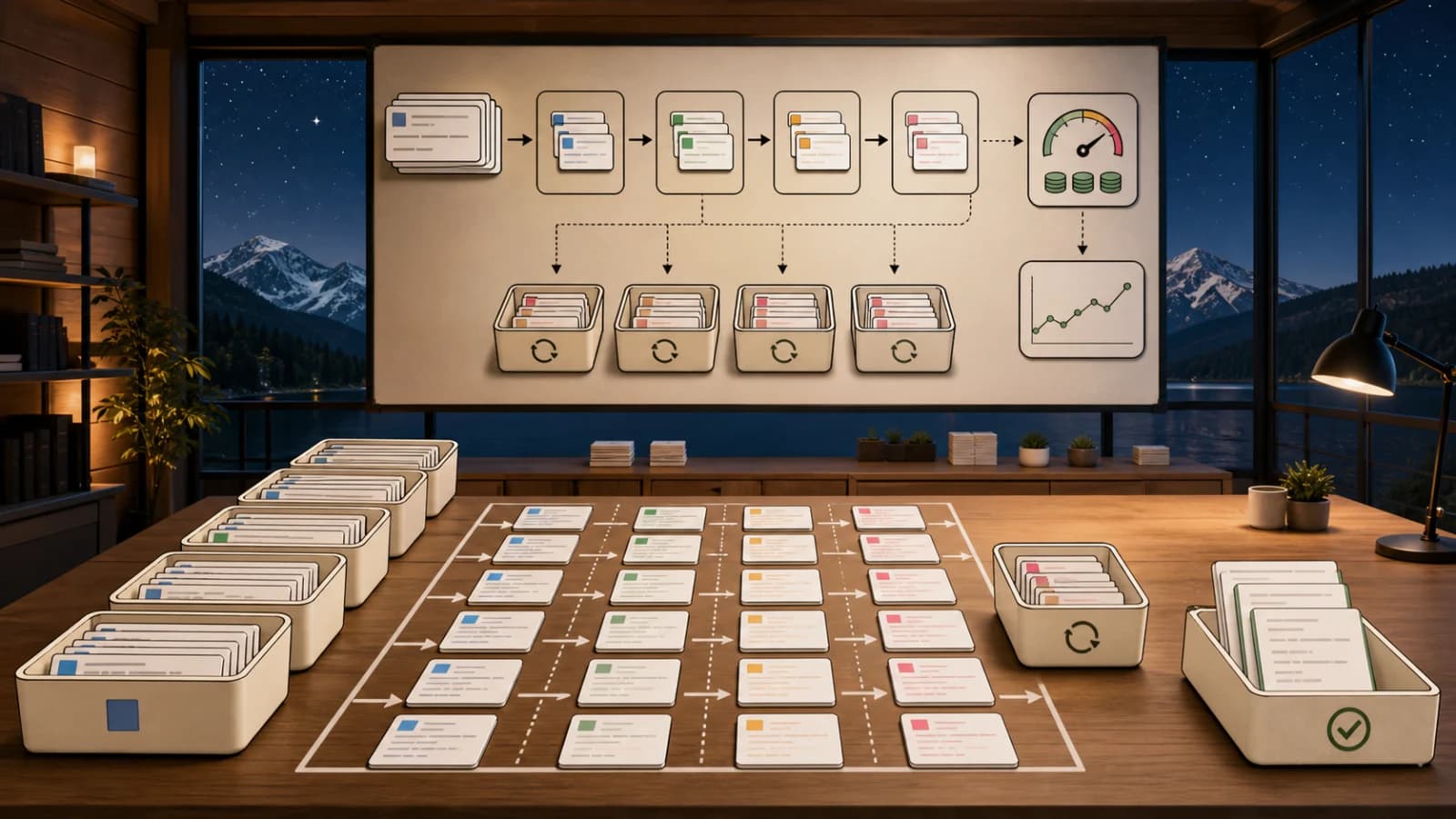
You package up to 100,000 message-create requests into a single request file. You submit it. Anthropic processes them in parallel on a separate, lower-priority infrastructure. You poll for completion or subscribe to a webhook. When done, you download a results file and match results back to your inputs by custom_id.
Three properties to internalize:
- Each row is an independent message-create call. You get the full request body - model, messages, tools, system, thinking, cache_control, everything. Batch is "synchronous API at half price with a delayed return," not a different API.
- Order is not preserved. Results come back in whatever order they finished. You match on
custom_id. Anyone who ignores this and zips inputs to outputs gets bitten. - Failures are per-request, not per-batch. Individual rows can fail (rate limit on a tool call, validation error, anything) without taking the batch down. You must scan the result file for errors.
The TypeScript Code You Should Actually Ship#
Here is a minimal but production-shaped batch submission using the official Anthropic SDK. It builds requests with stable IDs, submits, polls, and reconciles results.
TypeScript
import Anthropic from "@anthropic-ai/sdk";

const client = new Anthropic();

type ClassifyInput = { id: string; text: string };

const SYSTEM = "Classify the input as one of: bug, feature, question, spam. Return only the label.";

function buildRequests(inputs: ClassifyInput[]) {
  return inputs.map((input) => ({
    custom_id: input.id,
    params: {
      model: "claude-haiku-4-5" as const,
      max_tokens: 16,
      system: SYSTEM,
      messages: [{ role: "user" as const, content: input.text }],
    },
  }));
}

export async function classifyBatch(inputs: ClassifyInput[]) {
  const batch = await client.messages.batches.create({
    requests: buildRequests(inputs),
  });

  let status = batch;
  while (status.processing_status !== "ended") {
    await new Promise((r) => setTimeout(r, 30_000));
    status = await client.messages.batches.retrieve(batch.id);
  }

  const results: Record<string, string> = {};
  for await (const result of await client.messages.batches.results(batch.id)) {
    if (result.result.type === "succeeded") {
      const block = result.result.message.content[0];
      results[result.custom_id] = block.type === "text" ? block.text.trim() : "";
    } else {
      results[result.custom_id] = `__error__:${result.result.type}`;
    }
  }
  return results;
}
A few non-obvious things this captures:
custom_idis yours to define and must be unique per batch. We use whatever primary key the input row has in our database. This is how you reconcile results to records.- The SDK's
results()iterator streams a JSONL file. Do not try to load it into memory for large batches; iterate. - The polling loop here is naive. In production, use a webhook or a worker that wakes on schedule. A 30-second poll is fine for prototyping; do not run it for thousands of batches in parallel.
From the archive
Claude Design: Anthropic's Bet That Designers and Developers Want the Same Tool
Apr 29, 2026 • 9 min read
Claude Opus 4.7: The Developer's Guide to Anthropic's New Flagship
Apr 29, 2026 • 10 min read
Cloudflare Agent Memory: A Developer's Guide to the New Primitive
Apr 29, 2026 • 9 min read
Flagship: Cloudflare Feature Flags for AI Apps
Apr 29, 2026 • 9 min read
Webhooks Beat Polling Every Time#
Polling at scale is a trap. Each batch runs for an unknown duration, and a fleet of polling workers either churns CPU or sleeps too long. Webhooks are the right pattern.
Configure a webhook endpoint in your Anthropic console or via API, and Anthropic will POST a notification when a batch finishes. Your handler:
- Verifies the signature
- Pulls the results file via the SDK
- Iterates and writes to your database
- Marks the job as complete
Two operational notes from production: webhooks can fire more than once (idempotent handlers, please), and the events occasionally arrive out of order with the batch's own status field. Trust the batch's status when you fetch it, not the event payload alone.
Reconciliation: The Single Most Important Step#
The bug you don't notice in dev and absolutely will hit in prod: a 99,500-row result file for a 100,000-row batch, and you ship the answer assuming all rows came back.
The reconciliation pattern that survives:
TypeScript
async function reconcile(batchId: string, expectedIds: Set<string>) {
  const seen = new Set<string>();
  const errors: { id: string; reason: string }[] = [];
  const ok: { id: string; output: string }[] = [];

  for await (const r of await client.messages.batches.results(batchId)) {
    seen.add(r.custom_id);
    if (r.result.type === "succeeded") {
      const block = r.result.message.content[0];
      ok.push({ id: r.custom_id, output: block.type === "text" ? block.text : "" });
    } else {
      errors.push({ id: r.custom_id, reason: r.result.type });
    }
  }

  const missing = [...expectedIds].filter((id) => !seen.has(id));
  return { ok, errors, missing };
}
You always end up with three buckets: succeeded, errored, and missing. Each bucket needs a path. Errored rows are eligible for retry on the live API or a follow-up batch. Missing rows are the silent failure mode and almost always indicate a bug in how you constructed the batch (duplicate custom_ids, oversized rows, encoding problems).
Cost Modeling: Where The 50% Actually Lands#
The 50% discount applies to both input and output tokens. Cache reads, cache writes, thinking tokens - all 50% off in batch mode. There is no separate "batch tier" to opt into beyond using the batch endpoint.
The savings stack with caching. A nightly classification batch of 100k rows with a 4k-token shared instruction:
- Sync: 100k x 4000 input tokens + 100k x 50 output, about $1,275 at Haiku rates
- Sync + caching: instruction cached once per 5 min, about $200 if calls are bursty
- Batch + caching: about $100
For workloads with stable instructions and high request counts, batch + cache is the cheapest configuration available on the Claude API today.
For monitoring batch spend over time and catching regressions, CodeBurn tracks per-batch tokens and per-job cost so you can spot the runaway batch before the invoice shows up.
Real-World Batch Workloads#
1. Daily content classification. Tag a few hundred thousand rows of incoming user content with categories. Haiku in batch mode runs about $1 per 100k rows for short text. We have shipped this on three different products.
2. Scheduled report generation. Generate per-customer summaries overnight. The latency floor is fine because the report lands in the inbox at 7am anyway. Sonnet in batch mode is the right model.
3. Synthetic data generation. Generating eval datasets, training sets, or persona-conditioned variants. These are big, embarrassingly parallel, and not user-facing. Perfect batch fit.
4. Eval suites. Running a 10k-prompt eval against five models takes 50,000 calls. Batch all of them, reconcile, compute metrics. Cuts both cost and wall-clock time vs. naive serial calling.
5. Document re-indexing. Re-summarizing or re-extracting from a corpus when you change your prompt. Every team I know that runs RAG eventually has a "rebuild all summaries" job; this is what batch is for.
Production Gotchas Worth Pinning To Your Wall#
1. Per-batch row limits. Up to 100,000 requests or 256MB total, whichever hits first. For larger jobs, shard into multiple batches. A simple sharding scheme: hash custom_id mod N.
2. Rate limits still apply. Batches share quota with synchronous calls in a way that surprised us the first time. A huge batch can cause your synchronous calls to hit overloaded_error. If your live traffic shares the API key with batch, watch the interaction.
3. Cache reads work, cache writes do not propagate to live calls. A cache write inside a batch creates an entry usable by other batch and live calls - but the timing means you generally get cache writes per-row, not benefit from cache reads. Cache the prefix shared across all rows by ensuring the first row in the batch creates the cache, and letting subsequent rows read it. In practice the SDK handles this automatically when cache_control is set on shared prefix blocks.
4. Tool use works, but is rarely useful in batch. Batch is for one-shot calls. If a row requires a tool result, you cannot loop within the batch - you would need to take the tool calls out, run them yourself, and submit a follow-up batch. Most batch workloads should not use tools at all.
5. The 24-hour SLA is a ceiling, not a target. Median completion in our measurements is 5 to 30 minutes. Plan for 24h, but don't design dashboards that show "still processing" for the first 12 hours and panic users.
6. Batch IDs are forever in your DB. You will want to query by batch ID six months later when an auditor asks where row 47,318 of a March classification job went. Store batch IDs alongside the records they generated, not in a side table that gets pruned.
Hybrid Architecture: The Endgame#
The pattern mature production stacks land on:
Code
[user request]
    |- if interactive -> [synchronous API w/ caching]
    |- if backgroundable -> [enqueue]
                            |- [batch worker pulls every N min]
                                  |- [submits batch]
                                        |- [webhook -> reconcile -> notify]
The interesting decision is the boundary. We move workloads to batch the moment we can answer "is anyone watching the spinner" with "no." Reports, daily syncs, classification, evals, summaries, embeddings (when we still need them). Anything user-facing stays synchronous, often on Haiku, often with thinking off.
The 400-Dollar Overnight Bill post-mortem walks through what happens when this boundary blurs and a "should be batchable" job ends up on the live API at full price.
Production Checklist Before You Ship#
-
custom_idset to your stable record ID, unique per batch - Reconciliation step that produces succeeded / errored / missing buckets
- Webhook endpoint configured and signature-verifying
- Idempotent handler for duplicate webhook deliveries
- Batch ID stored alongside generated records
- Per-batch token cost logged and alertable
- Sharding strategy for jobs over 100k rows
- Retry strategy for errored rows (live API or follow-up batch)
- Monitoring on batch completion latency, alert on stragglers > 12h
- Documented latency SLA to upstream callers (24h, not 1h)
The Batch API is the cheapest legitimate cost lever on the Claude platform after prompt caching. The tax is a real architecture change to async, and you should not pretend otherwise. But for teams running any kind of bulk classification, generation, or analysis, it is straightforwardly half the bill for the same answers.
For more on optimizing Claude in production, see our writeups on prompt caching and tool use patterns.
FAQ#
How much does the Claude Batch API actually cost compared to the synchronous API?#
The Batch API charges exactly 50% of the synchronous API's per-token rate for both input and output tokens. This discount also applies to cache reads, cache writes, and thinking tokens. For a workload running 100k classification requests with Haiku, you're looking at roughly $100 with batch + caching versus $1,275 with synchronous calls at full price.
What is the maximum batch size I can submit?#
Each batch can contain up to 100,000 requests or 256MB total file size, whichever limit you hit first. For larger jobs, you'll need to shard across multiple batches - a simple approach is to hash your custom_id mod N to distribute rows evenly.
How long does a batch take to complete?#
The official SLA is 24 hours, but in practice most batches finish in 5 to 30 minutes. Don't promise users anything faster than 24 hours, but also don't design dashboards that show "still processing" for hours before anyone should actually worry.
Can I use tools and function calling with the Batch API?#
Tools technically work, but they're rarely useful in batch mode. Batch is designed for one-shot calls. If a row triggers a tool call that needs a result, you can't loop within the batch - you'd need to extract those tool calls, execute them yourself, and submit a follow-up batch. Most batch workloads should skip tools entirely.
Do results come back in the same order as my input requests?#
No. Results return in whatever order they finished processing, not the order you submitted them. You must match results to inputs using the custom_id field. Anyone who tries to zip inputs to outputs by position will get incorrect data.
Does prompt caching work with the Batch API?#
Yes, cache reads work and are also discounted 50%. However, cache writes inside a batch don't propagate the timing you might expect. The practical pattern is to set cache_control on your shared prefix blocks and let the first row create the cache entry for subsequent rows to read from.
How do I handle failed requests within a batch?#
Individual rows can fail without taking down the entire batch. You must iterate through the results file and check each result's type. Build three buckets: succeeded, errored, and missing. Errored rows are eligible for retry on the live API or a follow-up batch. Missing rows almost always indicate a bug in batch construction - duplicate custom_ids, oversized rows, or encoding problems.
Will my batch requests affect my synchronous API rate limits?#
Yes. Batches share quota with synchronous calls in ways that can surprise you. A large batch submission can cause your live API calls to hit overloaded_error. If your production traffic shares an API key with batch workloads, monitor the interaction carefully.
Continue Reading#
Read next
Claude Vision API: Image Analysis At Production Scale
How to ship Claude's vision API in production. OCR, charts, UI audits, real cost numbers, TypeScript SDK code, and the gotchas that bite at 100k images a month.
13 min readPrompt Caching in the Claude API: A Production Guide
Cut Claude API spend by up to 90% with prompt caching. Real numbers, TypeScript SDK code, and the gotchas Anthropic's docs gloss over.
11 min readExtended Thinking in Claude: When Deep Reasoning Pays For Itself
A production guide to Claude's extended thinking mode. Real cost math, TypeScript SDK code, and the tasks where reasoning tokens are worth 3x the spend.
12 min readShare
Developers Digest
Technical content at the intersection of AI and development. Building with AI agents, Claude Code, and modern dev tools - then showing you exactly how it works.
300+ videos30K+ GitHub stars850+ articles
Related Tools

Related Guides
Related Posts

12 min read
Claude API
Extended Thinking in Claude: When Deep Reasoning Pays For Itself
A production guide to Claude's extended thinking mode. Real cost math, TypeScript SDK code, and the tasks where reasonin...

11 min read
Claude API
Prompt Caching in the Claude API: A Production Guide
Cut Claude API spend by up to 90% with prompt caching. Real numbers, TypeScript SDK code, and the gotchas Anthropic's do...
10 min read
Claude API
Prompt Caching Economics on Fable 5: When the 5-Minute TTL Pays
Fable 5 prompt caching economics: cache-write vs cache-read pricing, 5-minute vs 1-hour TTL break-even math, and worked...

13 min read
Claude API
Claude Vision API: Image Analysis At Production Scale
How to ship Claude's vision API in production. OCR, charts, UI audits, real cost numbers, TypeScript SDK code, and the g...

12 min read
Claude API
Tool Use in the Claude API: Production Patterns for Reliable Agents
Master tool use in the Claude API. Schema design, retry logic, multi-step loops, and the failure modes that only show up...

6 min read
News
The Harness Is the New Cost Lever: Databricks' Benchmark and Pi's Context Discipline
Databricks measured the same model through different coding harnesses and found cost per task varied more than 2x at ide...
Build with the member tools

Get Smarter About AI Dev
New tutorials, open-source projects, and deep dives on coding agents - delivered weekly.
One email per weekReal code, not theoryFree forever