GitHub Copilot SDK for Java: Annotations, Virtual Threads, and BYOK for Enterprise Agent Harnesses

TL;DR
GitHub shipped a Java-native Copilot SDK (1.0.7-preview.1) with @CopilotTool annotations, virtual-thread support, Jakarta EE and Spring composition, and BYOK mode that works against any OpenAI-compatible endpoint with no Copilot subscription. Here is what changed and what it unlocks.
On August 10, 2026, GitHub published the first deep engineering walkthrough of the Copilot SDK for Java, written by Ed Burns, the principal engineer who led the Java binding. The post is a build-in-public look at what the Java SDK actually does: @CopilotTool annotations that turn ordinary methods into agent tools, virtual-thread execution on JDK 25, a headless server mode with no IDE, and BYOK support that makes the whole runtime work against OpenAI, Anthropic, or any OpenAI-compatible endpoint with your own key - no Copilot subscription required.
The Java binding existed at the SDK's general availability in June. What is new in the weeks since is the shape of it: this is the first language binding documented around enterprise patterns rather than CLI parity, and it reframes how the Copilot runtime can be embedded in a Jakarta EE or Spring application.
Official Sources#
| Resource | Description |
|---|---|
| Using the GitHub Copilot SDK for Java | The August 10 walkthrough: API tour, Jakarta EE 11 sample app, integration patterns |
| github/copilot-sdk repository | SDK source, README FAQ on BYOK, auth, and architecture |
| Copilot SDK Java API docs | Maven coordinates, Gradle and Maven setup |
What Shipped#
The SDK is a Maven dependency: com.github:copilot-sdk-java at version 1.0.7-preview.1. Requirements are JDK 17 or 25 (25 recommended for virtual threads), Maven 3.9+, and the Copilot CLI at version 1.0.71 or later installed locally - Java, Go, and Rust are the three bindings where the CLI is not bundled as a dependency, so server environments need it on PATH. Under the hood every SDK in the family talks to the Copilot CLI over JSON-RPC; the client manages the process lifecycle.
The headline API is annotation-based tools:
JAVA
@CopilotTool(value = "Sets the current phase of the agent. Use this to report progress.",
             name = "set_current_phase")
public String setCurrentPhase(
        @CopilotToolParam("The phase to transition to (VALIDATING, SEARCHING, ...)")
        String phaseName) {
    phase = Phase.valueOf(phaseName.trim().toUpperCase(Locale.ROOT));
    notifyUi();
    return "Phase set to " + phase.getLabel();
}
The SDK generates the JSON Schema, parses arguments, and dispatches calls. The annotation path is still experimental: the Maven build must pass -Acopilot.experimental.allowed=true to the compiler and register the SDK as an annotationProcessorPath, which generates $$CopilotToolMeta classes at compile time. Tools can also be defined inline with ToolDefinition.from(...) lambdas - including .overridesBuiltInTool(true) when you want to replace a built-in tool of the same name - and scanned from any object with ToolDefinition.fromObject(this), which is how tools registered in separate CDI beans are discovered.
Three things stand out for server-side use:
- One-line agentic loop.
session.sendAndWait(escapedEnquiry).get()runs the full loop - reasoning, tool calls, re-prompting - and returns when the model is done. On a virtual thread the blocking wait costs no platform thread. - Event streaming.
session.on(event -> ...)fires every tool call, result, and assistant message, so you can build live UIs (the sample pushes status to a browser over Jakarta WebSocket) and log pipelines for observability. - Least-privilege tool sets.
sessionConfig.setAvailableTools(new ToolSet().addCustom("*").addBuiltIn("web_fetch"))opts in per session instead of exposing the full built-in surface (filesystem, shell). The sample usesPermissionHandler.APPROVE_ALL, and the post is explicit that production needs a real permission policy.
From the archive
Encrypted Chain-of-Thought Is Not Private: New Paper Decodes Reasoning Traces From Anthropic, OpenAI, and Google APIs
Aug 11, 2026 • 7 min read
Stop Means Stop: New Paper Finds Agent Approval Gates and Cancellation Leak in Six Frameworks
Aug 11, 2026 • 6 min read
Vercel Sandbox Gets a Real Network Boundary: Why Egress Control Is the Missing Half of Agent Security
Aug 11, 2026 • 6 min read
AgentChaos: Fault Injection Shows Agent Robustness Is a Systems Problem, Not a Model Problem
Aug 10, 2026 • 6 min read
The BYOK Story Is the Bigger Change#
The walkthrough's most consequential claim is buried near the top: "Even though it's called GitHub Copilot SDK, you can use it with any direct model provider, such as OpenAI, Azure, Anthropic, or OpenAI-compatible endpoints, by passing a provider with your own baseUrl and apiKey. No Copilot subscription required."
That matches the SDK README, which lists BYOK as a first-class auth mode alongside GitHub OAuth and signed-in-user credentials. Limitations matter here: BYOK is key-based only, with no support for Entra ID, managed identities, or third-party identity providers - so enterprises on Azure-backed identity will still route through GitHub auth or wait. But for everyone else, the practical effect is that the agent runtime GitHub spent two years hardening for Copilot CLI is now a portable harness you can point at any provider your team already has accounts for. Our breakdown of Copilot CLI BYOK and AI credits covered the CLI side; this extends the same capability to server-side Java.
Why It Matters#
Enterprise Java has been the awkward guest in the agent SDK conversation. Options so far meant framework lock-in: Langchain4j disintermediates vendors but introduces its own dependency, and Spring AI ties you to Spring's design decisions. The Copilot SDK for Java deliberately sits underneath both - the sample app runs on Jakarta EE 11 with Open Liberty 26, and the post explicitly shows the Spring-compatible Executor integration point rather than a framework plugin.
The cleanest pattern in the walkthrough is the Executor hand-off: Open Liberty's ManagedThreadFactory with virtual="true" creates container-managed virtual threads that propagate CDI, JNDI, and transaction context. Pass that as the SDK's Executor, and a tool callback like searchProperties() can @Inject a JPA repository and query the database, because the container context survives the hop into the model's tool call. That is the difference between an agent harness you demo and one you can put behind a JPA transaction.
It also keeps the JVM's concurrency story intact. One CopilotClient per application (a @ApplicationScoped CDI singleton), N concurrent sendAndWait calls, each on its own virtual thread, and platform threads stay free for the request load. For teams whose blast radius is a Spring Boot service rather than a CLI, that is the deployment model that gets past architecture review.
What to Watch#
Three things are worth watching from here. First, whether the experimental annotation processor graduates - compile-time tool metadata generation is the sort of thing enterprise build teams will insist on being stable. Second, whether BYOK grows identity support beyond raw keys, since that decides whether large enterprises can adopt it at all. Third, the pattern of one language deep-dive per month: if GitHub follows the Java post with the same treatment for Go and Rust, the SDK is positioning itself less as a Copilot extension and more as a neutral agent runtime, which puts it in a different competitive lane than the SDK-vs-CLI-vs-Action tradeoffs we covered earlier.
Continue Reading#
- GitHub Copilot SDK Hits GA - the June GA post: all six language bindings, auth modes, and what the SDK exposes
- GitHub Copilot CLI, BYOK, and AI Credits - the cost-control side of BYOK and credit accounting
- Codex SDK vs CLI vs GitHub Action - when to embed an agent runtime vs drive it from a CLI
- Agents SDK Evolution - how the agent SDK landscape is consolidating
- Agent PR Governance with GitHub Copilot Review - what a governed agent pipeline looks like in practice
- OpenJDK Bans AI-Generated Code: What the New Policy Means for Java Contributors
Sources#
- Using the GitHub Copilot SDK for Java - GitHub Blog (fetched August 11, 2026)
- github/copilot-sdk - GitHub (fetched August 11, 2026)
- GitHub Copilot SDK Java API docs (fetched August 11, 2026)
Read next
GitHub Copilot SDK Hits GA: Embed the Copilot Agent Runtime in Your Own Apps
On June 2, 2026, GitHub made the Copilot SDK generally available. It exposes the same agent runtime behind Copilot - planning, tool calls, file edits, streaming, MCP - across TypeScript, Python, Go, .NET, Rust, and Java. Here is what changed at GA and what it means for builders.
8 min readGitHub Copilot CLI, BYOK, and AI Credits: The New Cost-Control Stack
GitHub's June Copilot updates point beyond autocomplete: CLI access, bring-your-own-key model routing, AI credit metrics, and external agent providers make Copilot a governed agent platform.
8 min readCodex SDK vs CLI vs GitHub Action: Which Surface Should You Build On?
Codex is no longer just a terminal agent. Here is when to use the Codex SDK, Codex CLI, or openai/codex-action, and how to avoid building the same agent loop three times.
8 min readShare
Developers Digest
Technical content at the intersection of AI and development. Building with AI agents, Claude Code, and modern dev tools - then showing you exactly how it works.
300+ videos30K+ GitHub stars850+ articles
Related Tools
AI Coding328K views

GitHub Copilot
The original AI coding assistant. 77M+ developers. Inline completions in VS Code and JetBrains. Copilot Workspace genera...
View ToolAI FrameworksEssential

Vercel AI SDK
The TypeScript toolkit for building AI apps. Unified API across OpenAI, Anthropic, Google. Streaming, tool calling, stru...
View ToolAI Frameworks
C
Composio
Gives AI agents access to 250+ external tools (GitHub, Slack, Gmail, databases) with managed OAuth. Handles the auth and...
View ToolAI Frameworks

OpenAI Agents SDK
Lightweight Python framework for multi-agent systems. Agent handoffs, tool use, guardrails, tracing. Successor to the ex...
View ToolApps from Developers Digest
Related Guides
Guide
AI Agent Frameworks Compared: LangGraph vs CrewAI vs Mastra vs CopilotKit
Deep comparison of the top AI agent frameworks - LangGraph, CrewAI, Mastra, CopilotKit, AutoGen, and Claude Code.
AI AgentsGuide
Claude Code Setup Guide
Configure Claude Code for maximum productivity -- CLAUDE.md, sub-agents, MCP servers, and autonomous workflows.
AI AgentsGuide
MCP Servers Explained
What MCP servers are, how they work, and how to build your own in 5 minutes.
AI AgentsRelated Videos
GitHub Copilot Spark Launch: New Rival to Cursor + v0? Full Update in 6 Minutes
Learn The Fundamentals Of Becoming An AI Engineer On Scrimba; https://v2.scrimba.com/the-ai-engineer-path-c02v?via=developersdigest Introducing GitHub Spark and Exciting GitHub Copilot Updates!...
Video·
Continue: Incredible Open Source Github Copilot Alternative. Use Groq + Llama-3, Ollama and more
Introducing Continue: The Open Source Alternative to GitHub Copilot for Coding The video introduces 'Continue,' an open source alternative to GitHub Copilot, designed to enhance coding with...
Video·
GitHub Copilot Chat
#Github #GithubCopilot #GitHubCopilotChat #VSCode #ProgrammingWorkflow #CodeProductivity In this video, we dive into GitHub Copilot Chat in VS Code, exploring its powerful capabilities and...
Video·
Related Posts
8 min read
GitHub Copilot
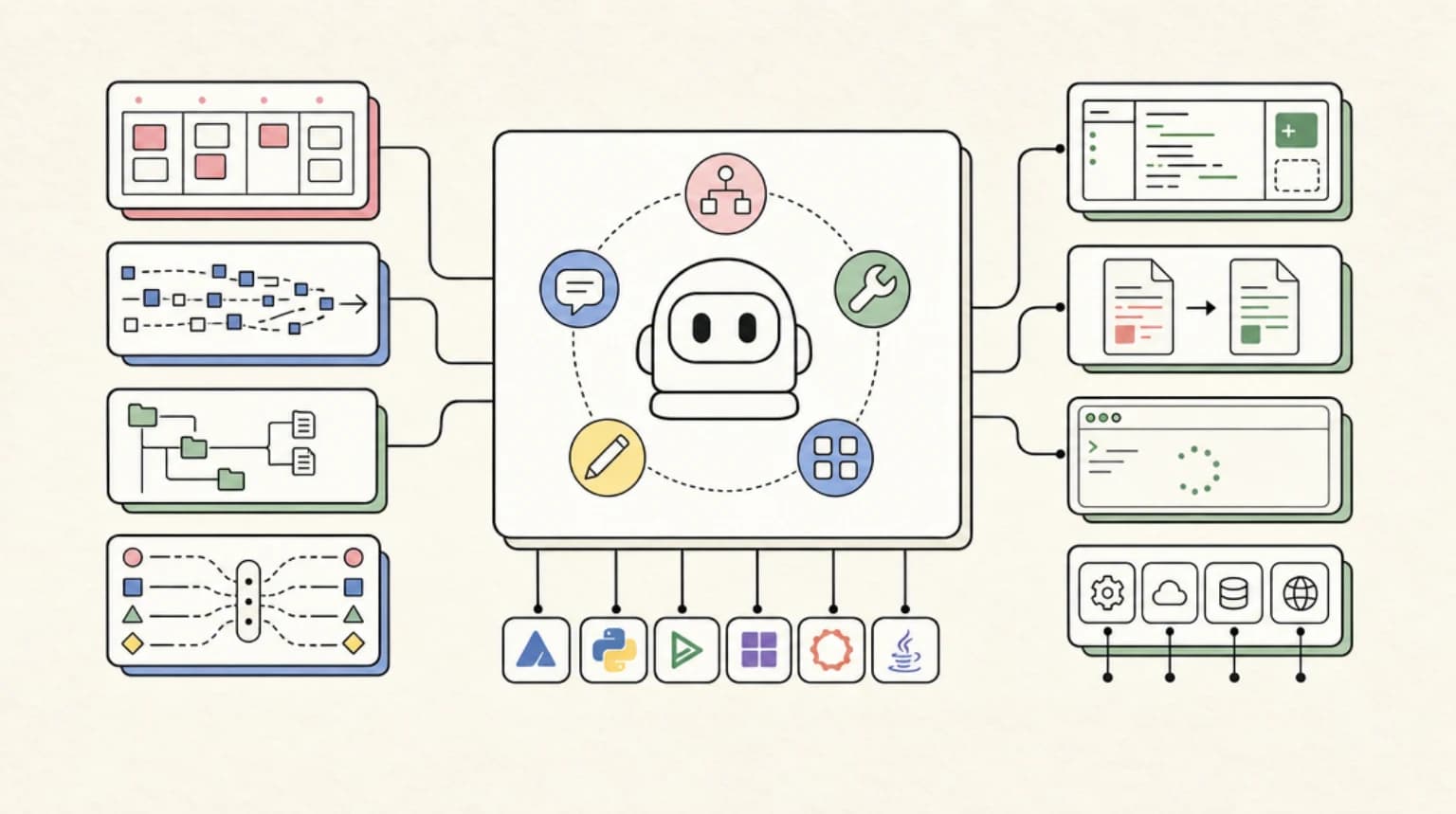
GitHub Copilot SDK Hits GA: Embed the Copilot Agent Runtime in Your Own Apps
On June 2, 2026, GitHub made the Copilot SDK generally available. It exposes the same agent runtime behind Copilot - pla...

8 min read
GitHub Copilot
GitHub Copilot CLI, BYOK, and AI Credits: The New Cost-Control Stack
GitHub's June Copilot updates point beyond autocomplete: CLI access, bring-your-own-key model routing, AI credit metrics...

8 min read
Codex
Codex SDK vs CLI vs GitHub Action: Which Surface Should You Build On?
Codex is no longer just a terminal agent. Here is when to use the Codex SDK, Codex CLI, or openai/codex-action, and how...
10 min read
OpenAI
OpenAI Agents SDK Evolution: What Ships in Production
Configurable memory, sandbox-aware orchestration, Codex-like filesystem tools. Here is how the new Agents SDK actually b...
8 min read
GitHub Copilot
Agent PR Governance: The New Rules for Copilot Reviews
GitHub's June Copilot review updates point to a practical policy stack for agent-authored pull requests: validation, rev...

5 min read
News
GitHub Copilot's September Reset: Prepaid Seats, One Unified Agent Experience, Balanced Reviews by Default
GitHub announced three Copilot changes with firm deadlines: Business and Enterprise seats go prepaid starting October 1,...
Build with the member tools

Get Smarter About AI Dev
New tutorials, open-source projects, and deep dives on coding agents - delivered weekly.
One email per weekReal code, not theoryFree forever