Mercury 2 Developer Guide: Building With a Diffusion LLM in Production
Prefer video? Watch the full tutorial with code walkthroughs.
Watch VideoTL;DR
A hands-on developer guide to Mercury 2 from Inception Labs. OpenAI-compatible API, reasoning levels, tool use, structured outputs, and when a diffusion LLM beats an autoregressive one in real apps.
| Official Sources | |
|---|---|
| Inception Labs | Mercury 2 homepage and product overview |
| Inception Labs API | OpenAI-compatible API endpoint |
| Mercury 2 (Inception Labs) | Model launch details and benchmarks |
| OpenAI SDK | Python SDK for OpenAI-compatible APIs |
| Vercel AI SDK | TypeScript SDK used in the video demo |
Why This Guide Exists#
The Mercury 2 announcement post covered what the model is and why diffusion language models matter. This post is for the developer who already gets the pitch and wants to know what it actually feels like to build with one. We will wire up the API, run a real agent loop, talk about the trade-offs nobody tweets about, and figure out where Mercury 2 belongs in your stack and where it does not.
If you have not read the primer on diffusion language models, the short version is this. Every other LLM you use generates one token at a time, locking each token before moving on. Mercury 2 does not. It generates multiple tokens per forward pass and refines the output across iterations, the same coarse-to-fine process that powers image and video diffusion. That single design choice is why it clears 1,000 tokens per second on standard hardware while staying competitive on reasoning benchmarks.
The Numbers That Matter for Production#
Before any code, here is what shapes the build decisions:
- Throughput: over 1,000 tokens per second, compared to roughly 89 t/s for Claude Haiku 4.5 and 71 t/s for GPT-5 Mini.
- Quality: ties GPT-5 Mini on AIME 2025 at 91.1, scores competitively on GPQA and LiveCodeBench.
- Pricing: $0.25 per million input tokens, $0.75 per million output tokens.
- Context window: 128,000 tokens.
- Features: tool use, structured outputs, RAG, OpenAI-compatible API.
- Reasoning levels: instant, low, medium, high.
That last point is the one most teams miss. Mercury 2 lets you pick how hard the model thinks per request. You do not have to commit to a single reasoning budget for your whole app the way you do with most reasoning models.
Wiring Up the API#
The API is OpenAI-compatible. If your app already talks to OpenAI, the migration is three changes: base URL, model string, API key.
Here is a minimal Python call using the OpenAI SDK:
Python
import os
from openai import OpenAI

client = OpenAI(
    api_key=os.environ["INCEPTION_API_KEY"],
    base_url="https://api.inceptionlabs.ai/v1",
)

response = client.chat.completions.create(
    model="mercury-2",
    messages=[
        {"role": "system", "content": "You answer concisely."},
        {"role": "user", "content": "Explain diffusion sampling in two sentences."},
    ],
    extra_body={"reasoning_effort": "low"},
)

print(response.choices[0].message.content)
The same shape in TypeScript with the Vercel AI SDK, which is what the demo in the original video uses:
TypeScript
import { createOpenAI } from "@ai-sdk/openai";
import { generateText } from "ai";

const inception = createOpenAI({
  apiKey: process.env.INCEPTION_API_KEY,
  baseURL: "https://api.inceptionlabs.ai/v1",
});

const { text } = await generateText({
  model: inception("mercury-2"),
  prompt: "Summarize the difference between diffusion and autoregressive LLMs.",
});

console.log(text);
That is the entire onboarding cost. No new SDK, no new auth pattern, no rewriting your retry logic. If you have already built an agent on top of Anthropic, OpenAI, or DeepSeek, you can swap Mercury 2 in behind a config flag.
Tool Use Without Wrapper Hell#
Tool use is where Mercury 2 starts to feel different in production. Tool calls are where autoregressive models eat your latency budget alive. Each call generates a JSON payload sequentially. Each round trip waits on token-by-token output before the orchestration layer can fire the actual tool. In a five-step agent loop you pay that latency tax five times.
Diffusion generation collapses that tax. Here is a tool definition the way the video demo uses it, with a browser tool that scrapes Hacker News:
Python
tools = [{
    "type": "function",
    "function": {
        "name": "open_url",
        "description": "Open a URL and return the page text.",
        "parameters": {
            "type": "object",
            "properties": {
                "url": {"type": "string"},
            },
            "required": ["url"],
        },
    },
}]

response = client.chat.completions.create(
    model="mercury-2",
    messages=[
        {"role": "user", "content": "Find the top three AI stories on Hacker News and summarize the comments."},
    ],
    tools=tools,
    extra_body={"reasoning_effort": "medium"},
)

for call in response.choices[0].message.tool_calls or []:
    print(call.function.name, call.function.arguments)
In a tool-heavy agent the wall clock time on Mercury 2 lands somewhere between five and ten times faster than a comparable autoregressive model running the same loop. That is not a benchmark gain, that is a UX gain.
From the archive
Model Context Protocol: A Production Guide To Building MCP Servers
Apr 29, 2026 • 13 min read
NVIDIA Nemotron 3 Super: A Developer's Guide to the 120B Hybrid MoE
Apr 29, 2026 • 9 min read
Open-Source MCP Servers Worth Installing in 2026
Apr 29, 2026 • 12 min read
OpenAI AgentKit in Production: An Honest Builder's Review
Apr 29, 2026 • 11 min read
Structured Outputs#
Diffusion is a natural fit for structured generation because the model refines the entire output at once instead of committing left to right. Schema adherence stops feeling like a fight with the sampler.
Python
schema = {
    "name": "extract_post",
    "schema": {
        "type": "object",
        "properties": {
            "title": {"type": "string"},
            "url": {"type": "string"},
            "comment_count": {"type": "integer"},
            "summary": {"type": "string"},
        },
        "required": ["title", "url", "comment_count", "summary"],
    },
}

response = client.chat.completions.create(
    model="mercury-2",
    messages=[{"role": "user", "content": page_text}],
    response_format={"type": "json_schema", "json_schema": schema},
)
The schema returns clean on the first pass at "low" reasoning effort for most extraction tasks. That is the use case I would migrate first if you are running a high-volume scraping or normalization pipeline.
Choosing a Reasoning Level#
Mercury 2 exposes four levels through the reasoning_effort parameter: instant, low, medium, high. Treat them like a knob between latency and quality, not a quality dial alone.
A working rule from a few weeks of building with it:
- instant: classification, routing, intent detection, autocomplete-style suggestions, anything where you would have used a 7B chat model.
- low: schema extraction, summarization, single-tool calls, RAG answer generation against a clean retrieval set.
- medium: multi-tool agent loops, RAG over messy retrieval, code edits across one or two files, planning steps.
- high: math, deep code reasoning, agent loops with conditional branching, anything where you would have reached for an o-series model or a Claude Sonnet thinking variant.
The key insight is that you can mix them in a single user-facing flow. Use instant for the planner, medium for the executor, low for the formatter. Most of your latency budget gets spent where reasoning actually matters.
Where Mercury 2 Beats Autoregressive#
The honest answer is, anywhere latency multiplies.
- Voice agents. The P95 of voice UX is brutal. Sub-second total turn time is table stakes, and most autoregressive reasoning models cannot get there. Mercury 2 can do tool-augmented turns inside that budget at low or medium reasoning.
- Coding iteration. Tight feedback loops where you prompt, review, tweak. The diff between a 1,000 t/s edit and an 80 t/s edit changes how you work. It moves you from "wait for the model" to "thinking with the model".
- High-fanout pipelines. Document processing, classification, normalization. If you are paying for a million extractions a day, Mercury 2 at $0.25 input and $0.75 output is hard to beat, and the speed cuts your worker count.
- Real-time UIs that need streaming structured data. Forms that fill themselves, dashboards that explain themselves, anything where the user is staring at the screen waiting for JSON.
Where I Would Not Reach for It Yet#
A few honest caveats from time in the trenches:
- Long-form creative writing where you want a specific voice. Autoregressive models still feel more natural in pure prose generation. This is shifting, but it is real today.
- Agentic workflows where the model needs to commit early and never revisit. Diffusion's strength is revision. If your task is more "stream of consciousness" than "draft and refine", you will not see the same lift.
- Anything that depends on a specific frontier model's quirks. If your prompts are tuned to Claude's RLHF flavor or GPT-5's instruction following, plan to retune. Mercury 2 follows instructions cleanly but it is its own model.
Diffusion vs Autoregressive: The Mental Model#
The framing that finally clicked for me. Autoregressive generation is a typewriter. Each keystroke is permanent. If the model commits to a wrong token early, the rest of the output has to work around that mistake. That is where reasoning models burn tokens correcting themselves mid-stream.
Diffusion generation is an editor with a draft. The model produces a rough version of the entire output, then refines it across iterations. Mistakes get caught and fixed during generation, not after. That is why diffusion and reasoning compose so naturally. The reasoning step is not bolted on, it is part of the sampling loop.
This is the same architectural shift that took image generation from GANs to Stable Diffusion. The people who built those original diffusion methods, including Stefano Ermon at Stanford, are the people who founded Inception Labs. Mercury 2 is them applying the same playbook to text.
Migration Checklist#
If you want to A/B Mercury 2 against your current model, here is the shortest path I have found:
- Add an environment variable for
INCEPTION_API_KEYand a feature flag for the model selection. - Swap the base URL and model string behind that flag. Keep your existing prompt and tool definitions.
- Start at
reasoning_effort: "low"and only step up if you see quality regressions. - Measure two things in parallel: P50 wall clock latency end-to-end, and your existing quality eval if you have one.
- For agent loops, log per-step latency. The wins are usually concentrated in the tool-call rounds, not the final answer.
- If you are running streaming UIs, make sure your frontend can actually keep up. I have seen apps where the model finishes before the React render loop catches up. Real problem to have.
The whole switch is a half-day of work for most apps. The decision after that is a quality call against your own evals.
Final Read#
Mercury 2 is the first model that makes me think the autoregressive monoculture has a real challenger, not just a faster sibling. The benchmarks land in the right zip code. The price is aggressive. The OpenAI compatibility kills the integration cost. And the reasoning-level knob means you do not have to pick a single point on the latency-quality curve for your whole app.
I would not throw out my Sonnet or GPT-5 calls today. I would route every latency-sensitive path through Mercury 2 and start measuring. That is where the wins live, and that is where the architecture actually pays off.
If you want the original deep dive, the Mercury 2 video walkthrough on the channel covers the demo and the diffusion explainer. If you want the broader context on agent frameworks, the agent frameworks comparison is the right next read.
FAQ#
What is Mercury 2 and how is it different from other LLMs?#
Mercury 2 is a diffusion-based large language model from Inception Labs. Unlike autoregressive models (GPT, Claude, Llama) that generate one token at a time, Mercury 2 generates multiple tokens per forward pass and refines the output across iterations. This architectural difference enables throughput over 1,000 tokens per second while maintaining competitive quality on reasoning benchmarks.
How fast is Mercury 2 compared to GPT-5 and Claude?#
Mercury 2 achieves over 1,000 tokens per second, compared to roughly 89 t/s for Claude Haiku 4.5 and 71 t/s for GPT-5 Mini. In tool-heavy agent workflows, wall clock time can be five to ten times faster than comparable autoregressive models running the same loop.
What is Mercury 2's pricing?#
Mercury 2 costs $0.25 per million input tokens and $0.75 per million output tokens. Combined with its high throughput, this makes it cost-effective for high-volume workloads like document processing, classification, and extraction pipelines.
Does Mercury 2 support tool use and structured outputs?#
Yes. Mercury 2 supports tool calling and structured JSON outputs through an OpenAI-compatible API. Diffusion generation is particularly effective for structured outputs because the model refines the entire output at once instead of committing left to right, improving schema adherence on the first pass.
What are Mercury 2's reasoning levels?#
Mercury 2 exposes four reasoning levels through the reasoning_effort parameter: instant, low, medium, and high. Instant is for classification and routing. Low handles extraction and summarization. Medium works for multi-tool agent loops. High is for math and deep code reasoning. You can mix reasoning levels within a single user flow.
When should I use Mercury 2 instead of GPT-5 or Claude?#
Mercury 2 excels where latency multiplies: voice agents, coding iteration loops, high-fanout document pipelines, and real-time UIs that need streaming structured data. Use autoregressive models when you need specific creative voice, stream-of-consciousness generation, or prompts already tuned to a particular model's behavior.
How do I integrate Mercury 2 with my existing OpenAI code?#
Mercury 2 uses an OpenAI-compatible API. Migration requires three changes: set the base URL to https://api.inceptionlabs.ai/v1, change the model string to mercury-2, and use your Inception Labs API key. Existing prompt and tool definitions work without modification.
Read next
Mercury 2: The LLM That Doesn't Generate Like an LLM
Inception Labs shipped the first reasoning model built on diffusion instead of autoregressive generation. Over 1,000 tokens per second, competitive benchmarks, and a fundamentally different approach to how AI generates text.
8 min readDiffusion Language Models: How Mercury Changed the LLM Speed Game
Inception Labs launched Mercury, the first commercial-grade diffusion large language model. It generates over 1,000 tokens per second on standard Nvidia hardware by replacing autoregressive generation with a coarse-to-fine diffusion process.
7 min readMesh LLM: Run 235B Models Across Your Home Lab with iroh
A new distributed inference system pools GPU resources across multiple machines and exposes them through a single OpenAI-compatible API. No RDMA, no NVLink - just QUIC and your existing hardware.
6 min readShare
Developers Digest
Technical content at the intersection of AI and development. Building with AI agents, Claude Code, and modern dev tools - then showing you exactly how it works.
300+ videos30K+ GitHub stars850+ articles
Related Tools
Local AI

Jan
Open-source ChatGPT alternative that runs 100% offline. Desktop app with local models, cloud API connections, custom ass...
View ToolAI CodingOpen source

DeepSeek-TUI
Open-source terminal agent runtime with approval modes, rollback snapshots, MCP servers, LSP diagnostics, and a headless...
View ToolAI Coding

v0
Vercel's generative UI tool. Describe a component, get production-ready React code with shadcn/ui and Tailwind. Iterate...
View ToolAI Coding

Aider
Open-source AI pair programming in your terminal. Works with any LLM - Claude, GPT, Gemini, local models. Git-aware ed...
View ToolApps from Developers Digest
Developer ToolsIn Progress
Key Vault
Document API key ownership, rotation context, and integration notes without storing secrets.
View AppDeveloper ToolsIn Progress
Migrate
Beat the August 2026 Assistants API sunset. Paste old code, get Responses API.
View AppDeveloper ToolsPlus $20/mo
Skills Pro
Unlock pro skills and share private collections with your team.
View AppRelated Guides
Guide
Getting Started with DevDigest CLI
Install the dd CLI and scaffold your first AI-powered app in under a minute.
Getting StartedGuide
Claude Code Complete Course
A complete, citation-backed Claude Code course with setup, prompting systems, MCP, CI, security, cost controls, and capstone workflows.
ai-developmentGuide
Run AI Models Locally with Ollama and LM Studio
Install Ollama and LM Studio, pull your first model, and run AI locally for coding, chat, and automation - with zero cloud dependency.
Getting StartedRelated Videos
Mercury 2: The First Reasoning Diffusion Language Model (1,000+ tokens/sec)
Mercury Two: The First Reasoning Diffusion LLM (1,000+ tokens/sec) - Speed Without Sacrificing Quality Inception Labs releases Mercury Two, a reasoning diffusion-based LLM that exceeds 1,000 tokens p
Video·

The Power of Up-to-Date AI: Getting Started with Perplexity's Online LLM APIs
In this video, I will show you the new online LLMs that are now available through perplexity's api's. I will also run through an example in how you can get started with setting it up within...
Video·
Building & Deploy AI Avatars of ANY website with Tavus in Next.js
Check out Tavus; https://tavus.plug.dev/v9tXAGz In this video, you'll discover Tavus, a powerful AI tool for creating realistic AI avatars. Learn how to build AI personas for various applications...
Video·
Related Posts
8 min read
AI
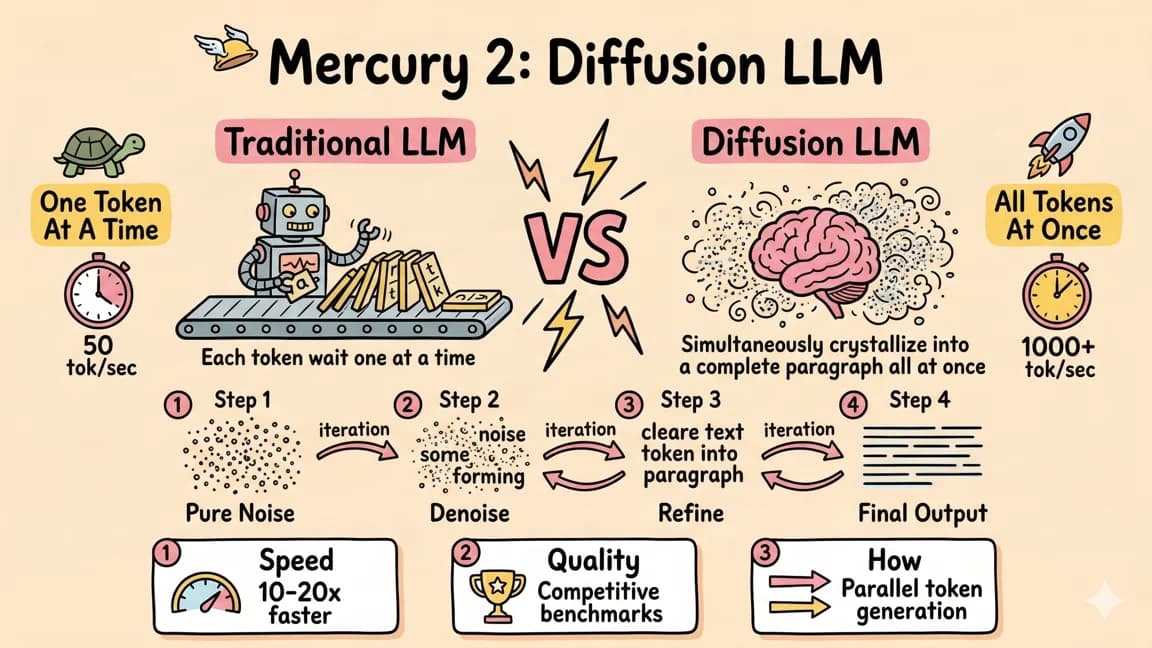
Mercury 2: The LLM That Doesn't Generate Like an LLM
Inception Labs shipped the first reasoning model built on diffusion instead of autoregressive generation. Over 1,000 tok...
7 min read
Diffusion Models
Diffusion Language Models: How Mercury Changed the LLM Speed Game
Inception Labs launched Mercury, the first commercial-grade diffusion large language model. It generates over 1,000 toke...
6 min read
News
GitHub Models Is Retired: What to Use for Model Access Now
GitHub Models is fully retired as of July 30, 2026. The playground, model catalog, inference API, and BYOK are gone for...
9 min read
News
The Underground Relay Market for AI API Tokens: How Resellers Get 97% Off
An inside look at the gray-market relay economy that resells OpenAI, Anthropic, and Google API access at up to 97.8% off...
6 min read
News
Mesh LLM: Run 235B Models Across Your Home Lab with iroh
A new distributed inference system pools GPU resources across multiple machines and exposes them through a single OpenAI...
8 min read
ai-tools
OpenRouter in 2026: Review, Setup, and When Model Routing Pays
OpenRouter gives you one API key for 300+ models, automatic fallbacks, and intelligent provider routing. Here is what it...
Build with the member tools

Get Smarter About AI Dev
New tutorials, open-source projects, and deep dives on coding agents - delivered weekly.
One email per weekReal code, not theoryFree forever