Microsoft's CLI Coding Agent Study: Adoption Is a Workflow Problem
TL;DR
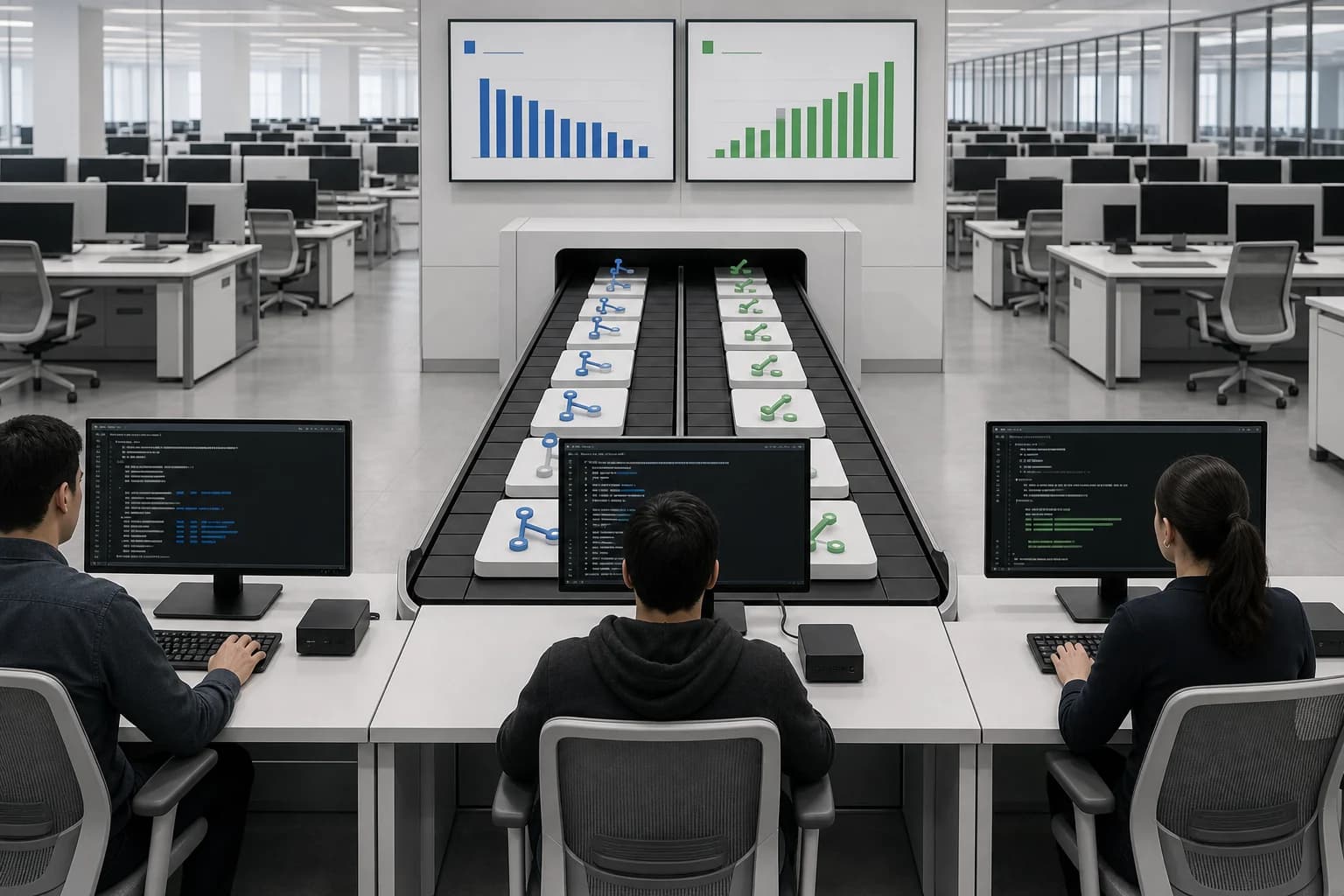
A July 2026 Microsoft study of Claude Code and GitHub Copilot CLI found roughly 24% more merged pull requests among adopters, but the interesting lesson is rollout design, not magic productivity.
Last updated: July 31, 2026
The most useful AI coding paper this month is not another benchmark leaderboard. It is a July 1 arXiv study of Microsoft's early-2026 rollout of command-line coding agents: Claude Code and GitHub Copilot CLI.
The headline number is easy to overuse: adopters merged roughly 24% more pull requests than the authors estimate they otherwise would have. The paper is careful about that claim. Merged PRs are a proxy for output, not guaranteed product value, and adoption was not uniform across the organization.
That is exactly why the study matters. It moves the conversation from "does an agent pass a benchmark" to "what happens when tens of thousands of engineers get terminal agents inside their actual workflow." If you are already using our AI coding tool ROI framework, this is the kind of evidence that belongs in the impact column.
What the Study Actually Says#
The paper, "Adoption and Impact of Command-Line AI Coding Agents," studies Microsoft engineers during the first four months of an early-2026 rollout. The tools in scope were Anthropic's Claude Code and GitHub Copilot CLI. The authors looked at who tried the tools, who kept using them, and how adopter output changed relative to a counterfactual estimate.
Three findings are worth separating:
| Finding | What it means for teams |
|---|---|
| First use spread through social networks | Peer visibility mattered more than top-down enablement alone. |
| Retention tracked coding activity more than demographics | The tool stuck with engineers who had enough code work for a terminal agent to matter. |
| Adopters merged roughly 24% more PRs | The lift is real enough to plan around, but PR count is not the same as shipped value. |
That last caveat is the important one. A merged pull request can be a meaningful feature, a tiny dependency bump, a test cleanup, or code churn that creates review load later. The paper acknowledges the proxy problem. Your rollout dashboard should too.
For Developers Digest readers, the practical takeaway is not "buy every CLI agent." It is that terminal agents appear to be crossing from novelty to measurable workflow infrastructure when the surrounding environment is right.
The 24% Number Is Not a Blanket ROI Claim#
It is tempting to turn "24% more merged PRs" into procurement copy. Do not.
First, the paper measures adopters, not every licensed engineer. That distinction matters. A company can buy seats for 5,000 people and still get most of the value from the 1,200 engineers whose work naturally fits agentic coding. If your own adoption dashboard only tracks licenses assigned, you will miss the difference between availability and use.
Second, merged PRs do not price themselves. A 24% output lift can still lose money if token burn, review load, incident risk, or low-value churn rises faster than useful work. This is why parallel Claude agent cost math and agent PR governance should sit next to productivity measurement, not after it.
Third, this was Microsoft. The rollout happened inside an organization with mature source control, code review norms, internal tooling, and dense peer networks. Smaller teams may see faster habit formation because they have less process. They may also see less measurable lift because their bottleneck is product direction, customer feedback, or review bandwidth rather than typing and local implementation.
The safer reading: CLI coding agents can move measurable engineering throughput, but the lift depends on where the tool lands in the workflow.
Social Rollout Beats Mandated Rollout#
The most under-discussed finding is that first use spread primarily through social networks.
That matches how strong developer tools normally win. A teammate posts a useful transcript. Someone sees a gnarly migration land in a day. A reviewer notices that tests and docs came with the change. The tool becomes believable because the proof is local.
For an engineering leader, this suggests a rollout pattern:
- Start with teams that already ship through small PRs, strong tests, and frequent review.
- Ask early users to publish short internal receipts: task, prompt shape, diff size, test result, review outcome.
- Measure retention by actual agent sessions and merged work, not seat assignment.
- Keep a visible channel for failures so people learn the boundaries.
- Expand after the first cohort produces repeatable examples.
This is also the better way to introduce Claude Code agent teams and subagents. Do not start by telling every engineer to run five agents in parallel. Start with one boring workflow where the receipt is obvious: test repair, migration scaffolding, docs updates, or small refactors.
From the archive
MiniMax H3: An Omni-Modal Video Model With Native Audio, 2K Output, and Open Weights Coming
Jul 31, 2026 • 8 min read
OpenAI's Efficiency Ledger: Serving Costs Down 20%, ARC-AGI-3 Up 3x With No Model Change
Jul 31, 2026 • 7 min read
OpenAI Disrupts a Cambodia Scam Network That Ran on ChatGPT
Jul 31, 2026 • 7 min read
Put an AI Agent on a Cron Job: Automating Dev Chores with OpenCode
Jul 31, 2026 • 11 min read
What to Measure Before You Trust the Lift#
If you want the Microsoft result to inform your own rollout, copy the measurement shape, not just the headline.
Track utilization:
| Metric | Why it matters |
|---|---|
| Weekly active agent users | Separates assigned seats from actual habit. |
| Sessions per active engineer | Shows whether usage is experimental or embedded. |
| Agent-assisted PR share | Ties usage to the shipping path. |
| Retained users after four weeks | Filters launch curiosity from durable behavior. |
Track output:
| Metric | Why it matters |
|---|---|
| Merged PRs per engineer | Comparable to the paper, but incomplete alone. |
| Cycle time to review | Shows whether agents speed the handoff. |
| Review comments per PR | Catches low-quality generated diffs. |
| Revert or hotfix rate | Catches shipped defects. |
| Test coverage delta | Catches whether agents add proof or only code. |
Track cost:
| Metric | Why it matters |
|---|---|
| Cost per active engineer per week | Makes adoption comparable to payroll time. |
| Cost per merged PR | Useful but easy to game. |
| High-spend sessions | Finds runaway loops and oversized contexts. |
| Model mix by task | Shows whether routine work is using premium models. |
This is the same operational lens behind Codex automations for recurring engineering work. Agent value compounds when the task has a loop, a receipt, and a clear escalation rule.
Where the HF Papers Fit#
The Hugging Face July papers page was useful for context, but less actionable for this article than the Microsoft study. The strongest developer-adjacent papers I saw were about long-context RL, agent testbeds, GUI agents, and continual skill evolution. Those are relevant, but most are still closer to research agenda than immediate team rollout guidance.
The connection is still real. Long-context and agent-evaluation papers are trying to answer the model-side version of the same question: how do agents stay useful over long horizons without drifting, over-spending, or losing the task? Microsoft gives us the organizational version: who adopts, who retains, and what output changes.
That makes the better near-term editorial line clear. Research papers are improving agent capability. Enterprise rollouts are exposing workflow constraints. The teams that win will treat both as inputs.
Google Trends Check#
Google Trends was mandatory for this topic lane, but pytrends returned repeated 429 responses for the query cluster:
- "Claude Code"
- "Copilot CLI"
- "AI coding agents"
- "coding agents"
- "command line AI"
Because reliable rows were not available, I am not using Trends numbers in this post. The query framing still shaped the SEO angle: "CLI coding agents," "AI coding agent ROI," and "Claude Code Copilot CLI study" are more durable than a launch-only headline.
What I Would Do Monday#
If you manage an engineering team, do not announce a broad "AI transformation" program. Run a four-week CLI-agent pilot with receipts.
Give each team one measurable workflow:
| Team type | Good first workflow |
|---|---|
| Platform | Dependency upgrades with tests and rollback notes. |
| Product engineering | Small bug fixes with before and after screenshots. |
| Data engineering | Schema cleanup with migration checks. |
| Internal tools | Form and table changes with browser verification. |
| QA-heavy teams | Test generation for known escaped defects. |
Then require each agent-assisted PR to include a short note: agent used, scope, commands run, tests passed, human review focus. That is enough structure to learn without turning the rollout into theater.
The Microsoft paper's real lesson is not that CLI agents magically make every engineer 24% better. It is that agent adoption becomes measurable when the tool meets a code-heavy workflow, spreads through peer proof, and is evaluated with enough humility to separate more PRs from better software.
FAQ#
Did Microsoft prove that Claude Code and Copilot CLI increase productivity?#
The study found adopters merged roughly 24% more pull requests than the authors estimate they otherwise would have. That is evidence of higher measured output, not a full proof of business value or code quality.
Should every developer use a command-line coding agent?#
No. The paper suggests retention is stronger for engineers with enough coding activity for the tool to fit naturally. Non-coding roles, heavily architectural roles, or teams blocked by review and product decisions may see less benefit.
Is PR count a good AI coding ROI metric?#
It is a useful proxy, but it is incomplete. Pair it with cycle time, review load, defect rates, revert rates, test coverage, and cost per active user.
What is the safest way to roll out CLI coding agents?#
Start with a small cohort, choose one boring workflow per team, require receipts in agent-assisted PRs, and expand only when retained usage and review quality look healthy.
Continue Reading#
- How to Measure AI Coding Tool ROI in 2026
- What a Fleet of Claude Agents Actually Costs
- Claude Code Agent Teams, Subagents, and MCP
- Codex Automations: Recurring Engineering Work
- Agent PR Governance for GitHub Copilot Review
- The New AI Superpowers: Focus and Followthrough
Sources#
- arXiv, "Adoption and Impact of Command-Line AI Coding Agents: A Study of Microsoft's Early 2026 Rollout of Claude Code and GitHub Copilot CLI," submitted July 1, 2026, fetched July 31, 2026: https://arxiv.org/abs/2607.01418
- Hugging Face Papers, July 2026 monthly page, fetched July 31, 2026: https://huggingface.co/papers/month/2026-07
- Hugging Face Papers, week 31 2026 page, fetched July 31, 2026: https://huggingface.co/papers/week/2026-W31
- Hacker News Algolia API result for the arXiv paper, fetched July 31, 2026: https://hn.algolia.com/api/v1/search_by_date?query=%22command-line%20AI%20coding%20agents%22
- Anthropic Claude Code releases, fetched July 31, 2026: https://github.com/anthropics/claude-code/releases
- Claude Code "What's new" documentation, fetched July 31, 2026: https://code.claude.com/docs/en/whats-new
Read next
How to Measure AI Coding Tool ROI in 2026
Vendor claims of 10x productivity are not verified by real data. Here is the framework enterprises use to measure actual returns from Claude Code, Cursor, Copilot, and agentic coding workflows - with benchmarks, cost models, and the metrics that matter.
8 min readWhat a Fleet of Claude Agents Actually Costs (July 2026 Math)
Claude Code parallel agents cost real money because every session draws from one quota - here is the July 2026 budgeting math, verified against live pricing.
10 min readClaude Code Agent Teams, Subagents, and MCP: The 2026 Playbook
Claude Code is turning into an orchestration layer for agent teams. Here is how subagents, MCP, hooks, and long context fit together in 2026.
9 min readShare
Developers Digest
Technical content at the intersection of AI and development. Building with AI agents, Claude Code, and modern dev tools - then showing you exactly how it works.
300+ videos30K+ GitHub stars850+ articles
Related Tools
AI CodingDaily Driver

Claude Code
Anthropic's agentic coding CLI. Runs in your terminal, edits files autonomously, spawns sub-agents, and maintains memory...
View ToolAI CodingAgent

OpenAI Codex
OpenAI's coding agent for terminal, cloud, IDE, GitHub, Slack, and Linear workflows. Reads repos, edits files, runs comm...
View ToolAI Models

Claude Opus 4.7
Anthropic's flagship reasoning model. Best-in-class for coding, long-context analysis, and agentic workflows. 1M token c...
View ToolAI Coding
C
Conductor
Mac app for running parallel Claude Code, Codex, and Cursor agents in isolated workspaces. Watch every agent work at onc...
View ToolApps from Developers Digest
Developer Tools
Agent Hub
Every coding agent in one window. Stop alt-tabbing between Claude, Codex, and Cursor.
View AppDeveloper ToolsIn Progress
Agent Benchmark Lab
Compare AI coding agents on reproducible tasks with scored, shareable runs.
View AppDeveloper ToolsIn Progress
Skill Builder
Turn a one-liner into a working Claude Code skill. From idea to installed in a minute.
View AppRelated Guides
Guide
Claude Code Setup Guide
Configure Claude Code for maximum productivity -- CLAUDE.md, sub-agents, MCP servers, and autonomous workflows.
AI AgentsGuide
Built-in Subagents - Claude Code
Researcher, auditor, reviewer, and other ready-made subagent types.
Claude CodeGuide
Subagent Context Isolation - Claude Code
Prevent bloating the main conversation with research or exploration.
Claude CodeRelated Videos
Zed: The Open Source Agentic IDE - Use Claude Code, Codex & Gemini CLI in one place
Check out Zed here! https://zed.dev In this video, we dive into Zed, a robust open source code editor that has recently introduced the Agent Client Protocol. This new open standard allows...
Video·
Streamline Your Git Workflow with GitKraken and Claude Code
Try out GitKraken here: https://gitkraken.cello.so/myw3K67IkCr to get 50% GitKraken Pro. In this video, we explore GitKraken, a robust Git GUI that not only visualizes your Git repository...
Video·
Introducing GPT-5 Codex: Optimized Agentic Coding for Developers
In this episode, we explore the newly released GPT-5 Codex by OpenAI, a specialized version of GPT-5 designed for agentic coding tasks. Codex offers advanced features, including enhanced code...
Video·
Related Posts

8 min read
ai-coding-tools
How to Measure AI Coding Tool ROI in 2026
Vendor claims of 10x productivity are not verified by real data. Here is the framework enterprises use to measure actual...
10 min read
claude-code
What a Fleet of Claude Agents Actually Costs (July 2026 Math)
Claude Code parallel agents cost real money because every session draws from one quota - here is the July 2026 budgeting...

9 min read
Claude Code
Claude Code Agent Teams, Subagents, and MCP: The 2026 Playbook
Claude Code is turning into an orchestration layer for agent teams. Here is how subagents, MCP, hooks, and long context...
9 min read
Codex
Codex Automations: Where Scheduled AI Agents Actually Help
Codex automations are useful when recurring engineering work has clear inputs, reviewable outputs, and safe boundaries....
8 min read
GitHub Copilot
Agent PR Governance: The New Rules for Copilot Reviews
GitHub's June Copilot review updates point to a practical policy stack for agent-authored pull requests: validation, rev...
9 min read
Agent Safety
HalluSquatting Makes AI Coding Agents a Supply-Chain Problem
A July 2026 paper shows how hallucinated repository and skill names can become promptware delivery paths. The practical...
Build with the member tools

Get Smarter About AI Dev
New tutorials, open-source projects, and deep dives on coding agents - delivered weekly.
One email per weekReal code, not theoryFree forever