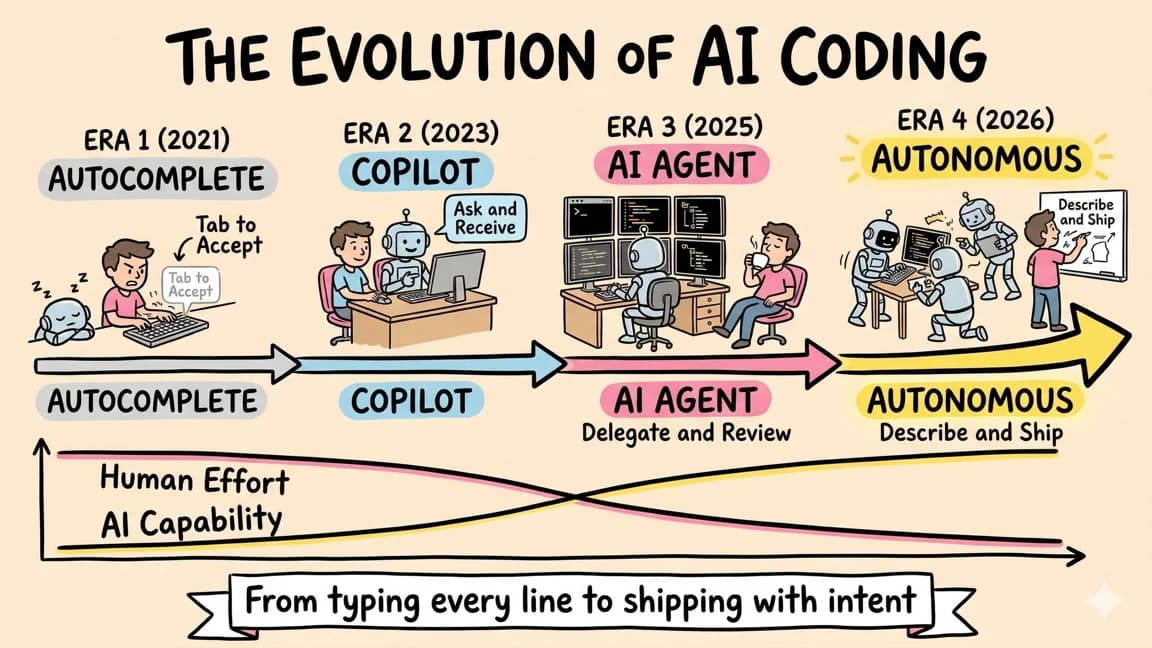
What Hacker News Gets Right About AI Coding Agents in 2026
TL;DR
What Hacker News gets right about AI coding agents: workflows beat demos, skills beat prompts, orchestration beats autonomy, and verification is the bottleneck.
Last updated: June 7, 2026
Official Sources#
| Source | Link |
|---|---|
| HN: Skills Officially Comes to Codex | news.ycombinator.com/item?id=46334424 |
| HN: Agent Skills | news.ycombinator.com/item?id=46871173 |
| HN: Hands-on Agentic Programming | news.ycombinator.com/item?id=47420814 |
| Axios: AI's "Show Me the Money" Year | axios.com |
| Claude Code Documentation | docs.anthropic.com |
| OpenAI Codex Documentation | help.openai.com |
If you want to know where AI coding is going, Hacker News is still a useful signal. Not because every comment is right. Most are not. But because the same arguments keep resurfacing, and repeated arguments usually point to real pressure in the market.
Over the last few months, Hacker News threads around Skills Officially Comes to Codex, Agent Skills, the hiring debate around hands-on agentic programming, and the broader Claude Code vs. Codex conversation have converged on the same core themes.
Those themes also show up outside HN. Axios framed 2026 as AI's "show me the money" year. Recent research on agent-generated pull requests found that no single coding agent dominates every task category, and that tool quality depends heavily on task shape rather than abstract benchmark supremacy. That is exactly the kind of nuance HN has been groping toward in public.
Here is what Hacker News gets right about AI coding agents in 2026.
1. The Real Product Is the Workflow, Not the Model#
Most surface-level comparisons still ask the wrong question. They ask whether Claude Code or Codex or Cursor has the "best" model. Hacker News has mostly moved past that.
For the broader MCP map, pair this with What Is MCP (Model Context Protocol)? A TypeScript Developer's Guide and The Complete Guide to MCP Servers; those pieces cover the concepts and server-selection layer behind this article.
The serious conversations are now about workflow fit:
- Does the tool preserve context over long sessions?
- Can it inspect a real codebase without wasting half the session rediscovering structure?
- Can it compose with shell commands, browser automation, git, and external systems?
- Can a developer supervise it without feeling like they are fighting the harness?
That is the right frame.
The model matters, obviously. But once you cross a threshold of acceptable reasoning quality, the winning product is the one that fits real development loops. That means terminal access, filesystem access, durable project context, and useful failure recovery. It also means the tool should behave well under repeated use, not just in a benchmark video.
This is why terminal-native agents keep pulling attention. They sit closer to the actual work. Developers already use the terminal for builds, tests, local servers, migrations, package management, and deployment scripts. Putting the agent there reduces translation cost.
This is also why the current category feels fragmented. Developers are not choosing one universal tool. They are choosing one tool for exploration, another for iterative editor work, another for long-running agent sessions, and sometimes a fourth for browser or infra-heavy tasks.
That fragmentation is not confusion. It is the market discovering that "AI coding" is not one job.
2. Skills Are Becoming More Important Than Raw Prompting#
Two separate HN threads about skills landed on the same point: project-specific reusable instructions are becoming more valuable than one-off prompting.
That tracks with what serious teams are already learning. The bottleneck is not "how do I ask the model nicely." The bottleneck is encoding your local rules, repo conventions, tool usage patterns, and operational expectations in a form the agent can repeatedly reuse.
Skills solve several problems at once:
- They compress context into reusable guidance.
- They make tool usage more deterministic.
- They reduce the need to restate house rules every session.
- They let teams standardize agent behavior without custom wrappers for every task.
This is also why the industry keeps arguing about file names like AGENTS.md, CLAUDE.md, and other tool-specific conventions. The naming war itself is not important. The underlying need is important. Teams want a stable place to store agent-operating knowledge close to the code.
If you are still relying on giant custom prompts pasted into every session, you are using 2025 tactics in a 2026 environment.
The better pattern is:
- Put project rules close to the repo.
- Encode repeatable workflows as skills or equivalent local instructions.
- Keep prompts short and task-specific.
That is a more scalable operating model than heroic prompting.
3. Orchestration Matters More Than Autonomy#
This is probably the most important thing HN has gotten right.
The frontier demos still focus on autonomy. Give the agent a big task, walk away, come back later. That makes for good screenshots and dramatic launch copy. But the developers actually getting value from these systems are usually doing something more boring and more effective: orchestrating multiple bounded workflows.
That means:
- one agent researching docs
- one agent modifying a specific subsystem
- one agent handling tests or verification
- one agent synthesizing the result
The supervisor is still human most of the time.
This is not a weakness. It is the current best practice.
Recent writing and research keep converging on this point. The most credible path to production value is not full autonomy. It is coherent orchestration with clear task boundaries, explicit handoffs, and deterministic checks around the model.
That is also why multi-agent systems are becoming more practical. They are not useful because "more agents" sounds futuristic. They are useful because software work already contains parallelizable subproblems.
Hacker News is right to be skeptical of grand claims about one-shot autonomous software production. But it is equally wrong when it dismisses the entire category because the most theatrical claims are overstated.
The right frame is simpler:
- autonomy is overrated as a branding term
- orchestration is underrated as a production pattern
4. Verification Is the Real Bottleneck#
HN keeps circling back to the same complaint: the agent can produce code quickly, but someone still has to decide whether the output is trustworthy.
That complaint is not resistance. It is diagnosis.
The core bottleneck in 2026 is no longer code generation speed. It is verification capacity.
You can see that in current research as well. One study on coding-agent pull requests found materially different performance by task type rather than a single universal winner. Another large-scale study of agent-generated pull requests highlighted that the shape and review characteristics of agent work differ from human-written work in ways teams need to account for.
That matches lived experience:
- Simple scaffolding gets faster.
- First drafts get faster.
- Boilerplate gets much faster.
- Final trust still costs time.
The more mature teams are responding accordingly. They are investing in:
- stronger repo conventions
- better linting and type systems
- more deterministic tests
- clearer task decomposition
- narrower agent scopes
That is not anti-AI. That is how you absorb more AI-generated output without drowning in review debt.
If an organization says "agents don't work for us," the real translation is often "our verification pipeline cannot absorb the volume or variability of generated changes."
That is a workflow problem, not just a model problem.
5. The Market Cares More About Payoff Than Spectacle Now#
Axios had the right macro framing: 2026 is the year AI has to show financial payoff, not just qualitative magic.
That shift matters for developers too.
The discourse is moving from:
- "look what the model can do"
to:
- "what part of the engineering workflow does this reliably improve"
That change is healthy.
A lot of noisy AI coding discourse still assumes the category is about replacing developers or automating software end to end. The more grounded version is narrower and more useful:
- compress setup time
- accelerate known workflows
- reduce context-switching
- parallelize bounded work
- make documentation and migration tasks less painful
The tools that win the next phase will be the ones that produce reliable economic leverage inside those constraints.
That is also why HN discussions now spend so much time on pricing, session limits, context behavior, harness design, and workflow friction. Those are not side issues. Those are the product.
What Developers Should Do With This Signal#
The practical takeaway is not "pick a winner" and stop thinking.
It is this:
Treat agents like workflow infrastructure#
Do not adopt them as entertainment products. Adopt them the same way you adopt CI, observability, or a database migration tool: with clear expectations, boundaries, and operating rules.
Standardize project context#
Use repo-local instructions, skills, and stable agent-facing documentation. The teams that externalize their operating knowledge will outperform the teams that rely on memory and ad hoc prompting.
Optimize for reviewability#
The highest-leverage improvement is often not a better model. It is making changes easier to verify. Smaller diffs, stronger types, explicit tests, and isolated scopes matter more than people want to admit.
Learn orchestration, not just prompting#
The durable skill is not writing clever prompts. It is decomposing work, deciding what can run in parallel, and designing good human checkpoints.
Stop expecting one tool to do everything#
The market is still sorting itself out. Use the best tool for the job instead of forcing one harness to be your editor, researcher, browser, release manager, and infra operator all at once.
The Bottom Line#
Hacker News is noisy, but the signal is getting sharper.
The important story in 2026 is not that coding agents exist. That story is old. The important story is that the conversation has matured. Developers are arguing less about whether these tools are "real" and more about how to make them economically useful, operationally trustworthy, and structurally repeatable.
That is progress.
The winning mental model is no longer "AI writes code for me."
It is:
AI agents are a new layer in the software production stack. They need context, supervision, reusable operating rules, and deterministic systems around them. Teams that understand that will get real leverage. Teams that keep treating agents like magic demos will keep getting inconsistent results.
That is what Hacker News is actually saying, underneath all the shouting.
Frequently Asked Questions#
What do developers on Hacker News actually think about AI coding agents?#
The HN consensus has matured beyond "is this real?" debates. The serious conversations focus on workflow fit, verification capacity, orchestration patterns, and economic payoff. Most experienced developers recognize that agents are useful for bounded tasks, not autonomous software production. The skepticism is now about specific tools and workflows rather than the entire category.
Why do skills matter more than prompting for AI coding agents?#
Skills encode project-specific rules, repo conventions, and operational patterns in reusable form. Instead of restating context every session, skills compress guidance that the agent can apply repeatedly. Teams using skills standardize agent behavior without custom wrappers. The shift from heroic prompting to structured skills is a key differentiator between 2025 and 2026 practices.
What is the difference between agent autonomy and agent orchestration?#
Autonomy is giving the agent a large task and walking away. Orchestration is decomposing work into bounded subtasks, running multiple focused agents, and maintaining human supervision at checkpoints. Orchestration is the current best practice because it produces more reliable results. Autonomy makes for better demos; orchestration makes for better production systems.
Why is verification the main bottleneck with AI coding agents?#
Agents can generate code faster than humans can verify it. The bottleneck has shifted from writing speed to review capacity. Teams absorbing more AI output need stronger conventions, better tests, smaller diffs, and clearer task decomposition. Organizations that say "agents don't work for us" often have verification pipelines that cannot handle the volume or variability of generated changes.
Should I use one AI coding tool or multiple tools?#
The market is still fragmented because "AI coding" is not one job. Many developers use different tools for exploration, iterative editing, long agent sessions, and browser or infrastructure tasks. Forcing one tool to handle everything often produces worse results than using the best tool for each job shape. Expect continued specialization rather than convergence to a single winner.
How should teams adopt AI coding agents in 2026?#
Treat agents like workflow infrastructure, not entertainment products. Standardize project context with repo-local instructions and skills. Optimize for reviewability with smaller diffs and explicit tests. Learn orchestration patterns, not just prompting tricks. The teams externalizing their operating knowledge into stable, agent-facing documentation will outperform teams relying on ad hoc prompting.
What does HN say about Claude Code vs Codex vs Cursor?#
HN discussions have moved past "which model is best" to workflow-fit questions. Claude Code wins on terminal-native development and long-session context. Codex wins on cloud sandbox execution and GitHub integration. Cursor wins on IDE-native visual editing. The right choice depends on how you work, not abstract benchmarks. Most serious users acknowledge that each tool has different strengths.
What is the difference between AGENTS.md, CLAUDE.md, and other config files?#
The naming war is not important - the underlying need is. Teams want a stable place to store agent-operating knowledge close to the code. AGENTS.md is becoming a cross-tool convention. CLAUDE.md is Claude Code specific. The point is encoding project rules, conventions, and operational expectations so agents can reuse them without restating context every session.
Get the next deep dive like this in your inbox
One email a week on AI Coding and the rest of the AI dev stack. Free.
Read next on Claude Code
State of AI Coding: April 2026
State of AI coding in April 2026: with 90% of developers using AI tools, here is which tools are winning, what is shifting and which one fits your work.
10 min readHow to Coordinate Multiple AI Agents: 6 Patterns (2026)
How to coordinate multiple AI agents: six patterns from fan-out to handoffs and consensus, with verified code for Claude, CrewAI, LangGraph, AG2 and ADK.
14 min readThe MCP Server Ecosystem: A Developer's Guide for 2026
MCP server ecosystem guide for 2026: curated picks by tier and category, real Claude Code configurations, install commands and honest assessments of what works.
13 min readTechnical content at the intersection of AI and development. Building with AI agents, Claude Code, and modern dev tools - then showing you exactly how it works.