The Coding-Agent Colony: What Gas Town Changes
TL;DR
Steve Yegge's Gas Town thesis is less about one tool than a shift from one coding agent to a durable, supervised colony of workers.
Last updated: August 3, 2026
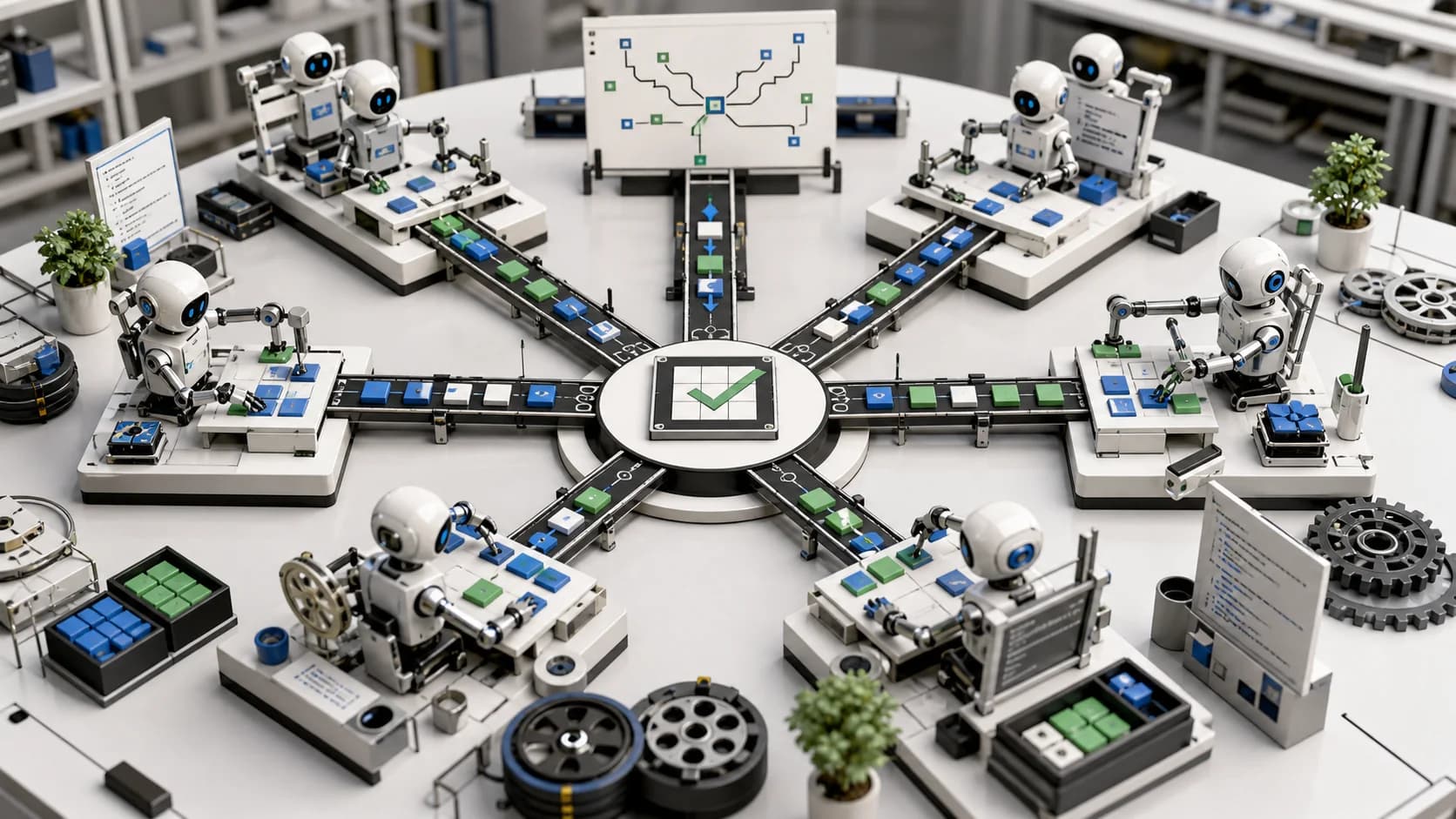
Steve Yegge's writing about Gas Town is easy to reduce to a memorable image: dozens of coding agents working at once, with names borrowed from a Mad Max settlement. The more useful idea is underneath the theme. Yegge is arguing that the basic unit of software work is changing from one agent in one session to a colony of workers coordinated by durable work records.
That is a much bigger design problem than opening more terminal windows.
From pair programmer to work system#
Most coding-agent workflows still look like an accelerated version of pair programming. A human describes a task, an agent changes a repository, and the human reviews the result. The session is the unit of progress.
Yegge's The Future of Coding Agents describes a different shape. Work is decomposed into small units, assigned to named or temporary workers, passed through handoff loops, and merged by a coordinating role. Gas Town uses Beads as its persistent work substrate and Git worktrees to give parallel workers room to operate.
This is close to the distinction between single-agent workflows and multi-agent systems, but with an important operational addition: the work must survive the agent session. A context window can disappear. A worker can crash. A task record, branch, test result, and handoff should not.
The colony has different jobs#
The key insight is not that every worker is equally smart. It is that different jobs need different lifetimes and permissions.
An ephemeral worker can take a narrowly scoped task and disappear. A persistent crew member can stay near a repository for small maintenance jobs. A merge coordinator can focus on integration. A monitor can notice stuck work. A conversational front door can summarize the activity for a human who does not want to read every log line.
This resembles a production system more than an IDE feature. There are queues, ownership, retries, artifacts, and escalation paths. The code is only one output. The other output is an explanation of what happened and why the current state can be trusted.
From the archive
The Flat Curve Society: Why AI Literacy May Matter More Than Model Access
Aug 3, 2026 • 8 min read
Vibe Maintenance: A Practical Workflow for AI-Generated Pull Requests
Aug 3, 2026 • 8 min read
AMD MI355X vs NVIDIA B200 vs B300 for Open-Weight Serving in 2026
Aug 2, 2026 • 9 min read
Auto-Narrated Changelog Videos: Build the Pipeline in Under an Hour
Aug 2, 2026 • 8 min read
What changes for a team#
The first change is task design. A colony cannot work from a vague request such as "improve the dashboard." It needs work molecules that have a bounded goal, a clear completion condition, and a location where the result can be attached.
The second change is repository architecture. Agents reason more reliably when boundaries are visible. A monolith with implicit contracts forces every worker to rediscover the same context. Small interfaces, test fixtures, typed schemas, and explicit ownership become agent infrastructure. This is why code health affects AI coding agents: clean boundaries reduce the cognitive cost of every handoff.
The third change is review. Parallel workers increase output, but they also increase the number of possible bad combinations. Merge discipline is therefore part of the product, not an afterthought. Each worker needs a receipt that names files, checks, assumptions, and unresolved risks.
The hard limit is supervision#
Yegge's factory metaphor can sound like a promise that humans will soon stop looking at code. The practical version is more constrained. Humans stop reading every line only when the system gives them better summaries, stronger tests, and clear points of intervention.
That means a colony needs:
- durable task state instead of chat-only plans
- isolated write scopes and branches
- automated tests that run before handoff
- a merge queue with one clear owner
- visible logs, costs, and retries
- escalation when a worker encounters ambiguity
Without these, concurrency only turns one uncertain session into ten uncertain sessions.
Should you use a colony today?#
Most teams should start smaller than Gas Town. Run two or three agents against disjoint tasks. Keep one integration owner. Measure elapsed time, review time, defect rate, and token cost separately. If the review surface grows faster than delivery, reduce concurrency.
The colony model becomes compelling when work is already decomposable and repeated: migrations, test expansion, documentation, issue queues, or independent adapters. It is a poor fit for a single architectural decision where every worker needs the same evolving context.
Yegge's contribution is a useful forcing function. The future of coding agents may not be a smarter chat box. It may be a work system that treats agent sessions as disposable workers and treats the work record as the durable product.
FAQ#
Is Gas Town the same as running multiple coding agents?#
No. Multiple agents are just concurrency. Gas Town adds persistent work tracking, named roles, handoffs, and coordination around a shared repository.
Does a colony remove the need for human review?#
No. It changes review from reading every keystroke to checking boundaries, tests, artifacts, and high-risk decisions. Humans still own acceptance criteria and escalation.
What is the smallest useful version of this workflow?#
Use separate branches or worktrees, assign disjoint tasks, require a short receipt from every worker, and have one integrator run the final checks.
Continue Reading#
- How to Coordinate Multiple AI Agents
- Parallel Coding Agents Need Merge Discipline
- AI Agent Memory Needs a Context Ledger
- Agent Skills Production Checklist
- Shipping OpenAI Symphony in Prod: A Real-World Guide
- Model Welfare for Agentic Engineers: Identity, Handoffs, and Recognition
Sources#
- The Future of Coding Agents, Steve Yegge, fetched August 3, 2026.
- Gas Town repository, fetched August 3, 2026.
- Beads repository, fetched August 3, 2026.
Read next
The Continuous Thunderdome: Why Agent Harnesses Become Application Infrastructure
Steve Yegge's new essay argues that long-running coding-agent loops will push teams beyond reusable harnesses and toward bespoke, graph-driven software factories.
9 min readModel Welfare for Agentic Engineers: Identity, Handoffs, and Recognition
Steve Yegge's provocative model-welfare essay contains a practical systems idea: persistent agent roles need memory, graceful handoffs, and feedback from the people who use their work.
8 min readParallel Coding Agents Need Merge Discipline
Parallel agents can move faster than one agent, but only when tasks have clean ownership, review receipts, and a merge path that does not turn speed into cleanup work.
7 min readShare
Developers Digest
Technical content at the intersection of AI and development. Building with AI agents, Claude Code, and modern dev tools - then showing you exactly how it works.
300+ videos30K+ GitHub stars850+ articles
Related Tools
AI Coding68K views

Lovable
AI app builder - describe what you want, get a deployed full-stack app with React, Supabase, and auth. No coding requi...
View ToolAI Frameworks

CrewAI
Multi-agent orchestration framework. Define agents with roles, goals, and tools, then assign them tasks in a crew. Pytho...
View ToolAI Frameworks
A
Agency Swarm
Multi-agent orchestration framework built on the OpenAI Agents SDK. Define agent roles, typed tools, and directional com...
View ToolAI Coding
C
Conductor
Mac app for running parallel Claude Code, Codex, and Cursor agents in isolated workspaces. Watch every agent work at onc...
View ToolRelated Guides
Guide
MCP Servers Explained
What MCP servers are, how they work, and how to build your own in 5 minutes.
AI AgentsGuide
Context Window Visualization - Claude Code
Interactive timeline showing what's in context at each turn.
Claude CodeGuide
Plan Mode - Claude Code
Explore and propose changes without executing them.
Claude CodeRelated Posts
9 min read
AI Coding
The Continuous Thunderdome: Why Agent Harnesses Become Application Infrastructure
Steve Yegge's new essay argues that long-running coding-agent loops will push teams beyond reusable harnesses and toward...
8 min read
AI Coding
Model Welfare for Agentic Engineers: Identity, Handoffs, and Recognition
Steve Yegge's provocative model-welfare essay contains a practical systems idea: persistent agent roles need memory, gra...
7 min read
AI Coding
Parallel Coding Agents Need Merge Discipline
Parallel agents can move faster than one agent, but only when tasks have clean ownership, review receipts, and a merge p...
7 min read
News
When Your AI-Generated App Turns Out to Be Someone Else's, Bug for Bug
A developer's Claude-built night-sky site reproduced an open source project's name, feature set, and even a bug the auth...

8 min read
Open Source
Vibe Maintenance: A Practical Workflow for AI-Generated Pull Requests
Steve Yegge's response to AI-generated pull requests suggests a better maintainer workflow: automate triage, repair good...
8 min read
Codex
Codex and Claude Code in July 2026: Agent Controls Are the Feature
The late-July Codex and Claude Code updates point in the same direction: coding agents are competing on approval modes,...
Build with the member tools

Get Smarter About AI Dev
New tutorials, open-source projects, and deep dives on coding agents - delivered weekly.
One email per weekReal code, not theoryFree forever