The Continuous Thunderdome: Why Agent Harnesses Become Application Infrastructure
TL;DR
Steve Yegge's new essay argues that long-running coding-agent loops will push teams beyond reusable harnesses and toward bespoke, graph-driven software factories.
Last updated: August 3, 2026
The next coding-agent interface may not be a chat window, an IDE panel, or even a terminal. It may be a loop that keeps decomposing, executing, checking, and handing off work while the human sleeps.
That is the central idea in Steve Yegge's new essay, The Shape of Things to Come, Part 1: The Continuous Thunderdome. The title is theatrical, but the engineering argument is concrete: long-running agent work needs graphs, durable state, identity, budgets, and a harness designed around the application being built.
From session to loop#
A normal coding-agent session has a beginning and an end. You provide context, ask for a change, inspect the result, and decide what happens next. That shape works for a bounded task. It breaks down when the project has tens of thousands of interdependent tasks.
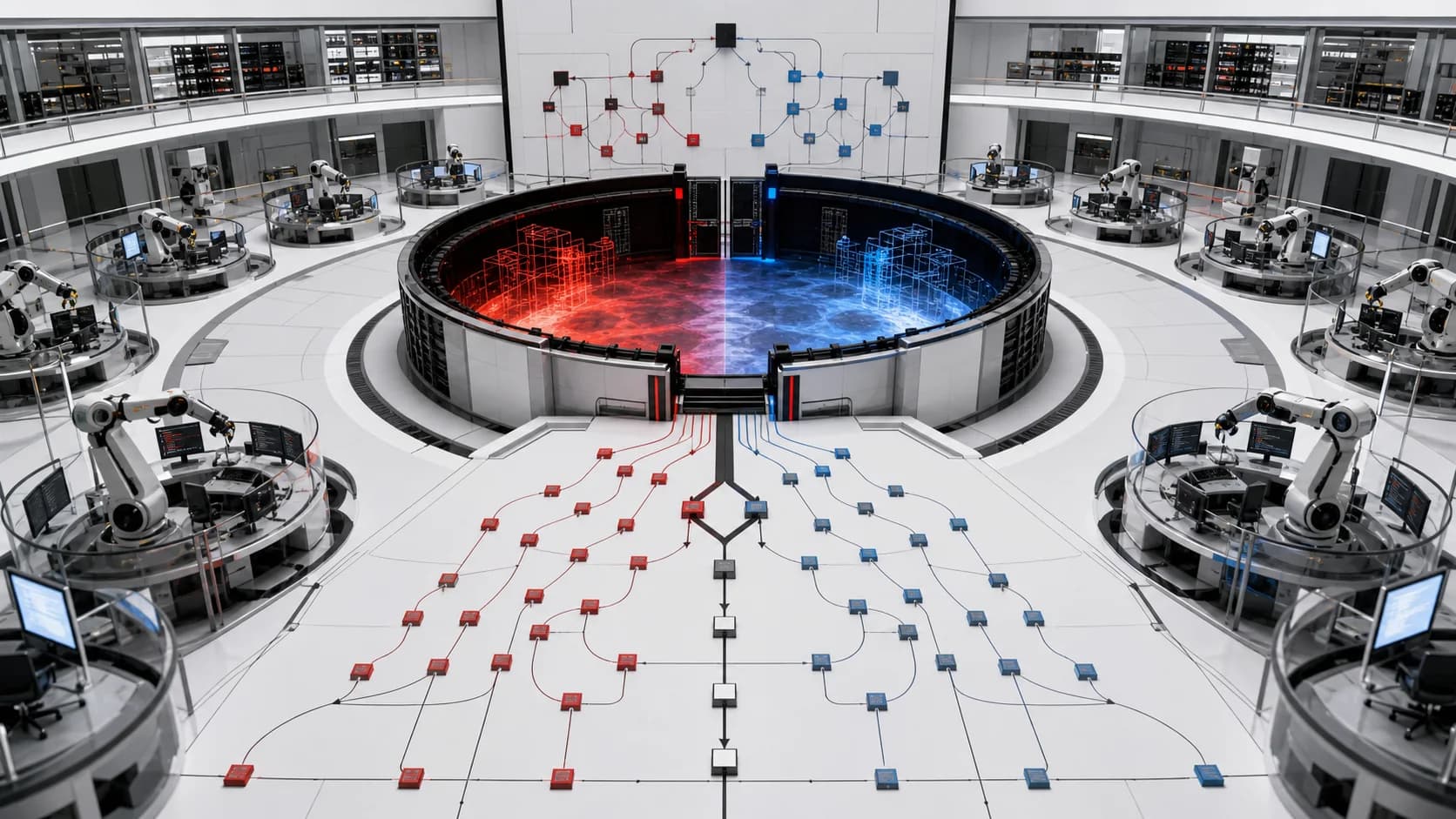
Yegge's proposed loop treats the project as a graph of work. Each node has a goal, dependencies, acceptance criteria, and a place to record the result. Workers can pick up available nodes, produce artifacts, and return control to the graph. The system keeps moving because the state of the work is not trapped in one context window.
This builds on the practical lesson behind agent memory and context ledgers: durable state is not a convenience. It is what lets a system recover from a dead session without pretending that a fresh agent remembers everything.
Why reusable harnesses may lose#
The strongest claim in the essay is that harnesses will become bespoke. Yegge describes Wheelhouse, a private harness he built for Wyvern, and argues that orchestration should eventually be chemically bonded to the application.
That is a challenge to the current framework instinct. Developers naturally want a general-purpose harness, a universal agent runtime, or a reusable orchestration layer. Those tools can be useful, but they also make the agent reason across an extra abstraction boundary. The application has its own domain language, state model, quality bar, and failure modes. A generic harness cannot know all of them.
The likely middle ground is reusable primitives with application-owned policy. A database, task graph, worker protocol, and test runner can be shared. The prompts, roles, lifecycle rules, and definition of done should live close to the project.
From the archive
The Flat Curve Society: Why AI Literacy May Matter More Than Model Access
Aug 3, 2026 • 8 min read
Vibe Maintenance: A Practical Workflow for AI-Generated Pull Requests
Aug 3, 2026 • 8 min read
AMD MI355X vs NVIDIA B200 vs B300 for Open-Weight Serving in 2026
Aug 2, 2026 • 9 min read
Auto-Narrated Changelog Videos: Build the Pipeline in Under an Hour
Aug 2, 2026 • 8 min read
The software factory needs a fuel gauge#
Continuous loops change the cost model. A human-driven session has a natural stopping point. An autonomous loop can keep spending tokens, retrying a bad decomposition, or polishing a task that should have been escalated.
Yegge describes a large token bill for Wyvern development and the operational work required to rotate capacity across accounts. The specific numbers are his experience, not a universal benchmark. The general lesson is more durable: an overnight factory needs explicit budgets and an emergency brake.
A useful harness should record:
- tokens and cost by task
- retries and time spent waiting
- model and tool used
- tests passed, failed, or skipped
- human interventions and escalations
- work that was completed but later reverted
This is the same distinction made in model routing. A loop is not efficient because it is busy. It is efficient when accepted outcomes improve faster than cost and rework.
The thunderdome is a merge protocol#
Yegge's thunderdome metaphor points at another problem: when many workers are active, competing changes need a place to resolve. A continuous loop cannot depend on a human reading every branch in sequence.
The system needs automated gates for mechanical conflicts and human gates for semantic conflicts. Tests can reject a broken API. A type checker can reject an invalid shape. Neither can decide whether two individually valid features should coexist.
That is why parallel coding agents need merge discipline. The faster the workers become, the more important it is to define ownership, acceptance tests, and an integration queue before increasing concurrency.
What to build first#
Do not start by building a city of agents. Start with one durable graph and one reliable loop.
Choose a task class that is easy to verify, such as test expansion, documentation migration, or a set of independent adapters. Give each node an explicit completion condition. Make the agent write a handoff note. Run the checks. Store the result. Then measure where the loop stalls.
Only after that should you add specialized workers, monitors, or parallel branches. The graph is the product. The workers are replaceable.
Yegge's essay is valuable because it makes the future feel operational rather than magical. Agentic development will not become autonomous merely because models can write more code. It becomes autonomous when the surrounding system can keep work legible, funded, testable, and recoverable.
FAQ#
What is a continuous coding-agent loop?#
It is an automated cycle that selects available work, gives it to an agent, validates the result, records the outcome, and continues with the next task or escalates to a human.
Do teams need a custom harness today?#
Usually not. Start with reusable task tracking, isolated branches, tests, and a small worker loop. Move application-specific orchestration into the project only when generic tooling becomes the bottleneck.
How is this different from CI/CD?#
CI/CD validates and delivers known changes. A continuous agent loop also chooses and performs the next unit of work. That makes planning, budgets, and supervision part of the runtime.
Continue Reading#
- The Coding-Agent Colony: What Gas Town Changes
- How to Coordinate Multiple AI Agents
- Parallel Coding Agents Need Merge Discipline
- AI Agent Memory Needs a Context Ledger
- Shipping OpenAI Symphony in Prod: A Real-World Guide
- Model Welfare for Agentic Engineers: Identity, Handoffs, and Recognition
Sources#
- The Shape of Things to Come, Part 1: The Continuous Thunderdome, Steve Yegge, fetched August 3, 2026.
- Steve Yegge's X post linking both essays, posted August 3, 2026.
- Beads repository, fetched August 3, 2026.
Read next
Constraint Decay Is the Coding Agent Bug Nobody Can Prompt Around
A new arXiv paper shows coding agents can pass loose backend tasks, then fall apart when architecture, database, and ORM constraints pile up. The fix is not longer markdown. It is executable constraints.
8 min readThe Coding-Agent Colony: What Gas Town Changes
Steve Yegge's Gas Town thesis is less about one tool than a shift from one coding agent to a durable, supervised colony of workers.
8 min readModel Welfare for Agentic Engineers: Identity, Handoffs, and Recognition
Steve Yegge's provocative model-welfare essay contains a practical systems idea: persistent agent roles need memory, graceful handoffs, and feedback from the people who use their work.
8 min readShare
Developers Digest
Technical content at the intersection of AI and development. Building with AI agents, Claude Code, and modern dev tools - then showing you exactly how it works.
300+ videos30K+ GitHub stars850+ articles
Related Tools
AI CodingDaily Driver

Claude Code
Anthropic's agentic coding CLI. Runs in your terminal, edits files autonomously, spawns sub-agents, and maintains memory...
View ToolAI CodingAgent

OpenAI Codex
OpenAI's coding agent for terminal, cloud, IDE, GitHub, Slack, and Linear workflows. Reads repos, edits files, runs comm...
View ToolAI CodingOpen source

DeepSeek-TUI
Open-source terminal agent runtime with approval modes, rollback snapshots, MCP servers, LSP diagnostics, and a headless...
View ToolAI Coding

Windsurf
Codeium's AI-native IDE. Cascade agent mode handles multi-file edits autonomously. Free tier with generous limits. Stron...
View ToolApps from Developers Digest
Related Guides
Guide
Claude Code Setup Guide
Configure Claude Code for maximum productivity -- CLAUDE.md, sub-agents, MCP servers, and autonomous workflows.
AI AgentsGuide
MCP Servers Explained
What MCP servers are, how they work, and how to build your own in 5 minutes.
AI AgentsGuide
Building Your First MCP Server
Step-by-step guide to building an MCP server in TypeScript - from project setup to tool definitions, resource handling, testing, and deployment.
AI AgentsRelated Videos
Related Posts
8 min read
AI Coding
The Coding-Agent Colony: What Gas Town Changes
Steve Yegge's Gas Town thesis is less about one tool than a shift from one coding agent to a durable, supervised colony...
8 min read
AI Coding
Model Welfare for Agentic Engineers: Identity, Handoffs, and Recognition
Steve Yegge's provocative model-welfare essay contains a practical systems idea: persistent agent roles need memory, gra...
8 min read
AI Agents
Constraint Decay Is the Coding Agent Bug Nobody Can Prompt Around
A new arXiv paper shows coding agents can pass loose backend tasks, then fall apart when architecture, database, and ORM...
7 min read
News
When Your AI-Generated App Turns Out to Be Someone Else's, Bug for Bug
A developer's Claude-built night-sky site reproduced an open source project's name, feature set, and even a bug the auth...
8 min read
Open Source
Vibe Maintenance: A Practical Workflow for AI-Generated Pull Requests
Steve Yegge's response to AI-generated pull requests suggests a better maintainer workflow: automate triage, repair good...
8 min read
Codex
Codex and Claude Code in July 2026: Agent Controls Are the Feature
The late-July Codex and Claude Code updates point in the same direction: coding agents are competing on approval modes,...
Build with the member tools

Get Smarter About AI Dev
New tutorials, open-source projects, and deep dives on coding agents - delivered weekly.
One email per weekReal code, not theoryFree forever