GPT-5.6 Sol vs Claude Opus 5: The $5 Workhorse Head-to-Head
TL;DR
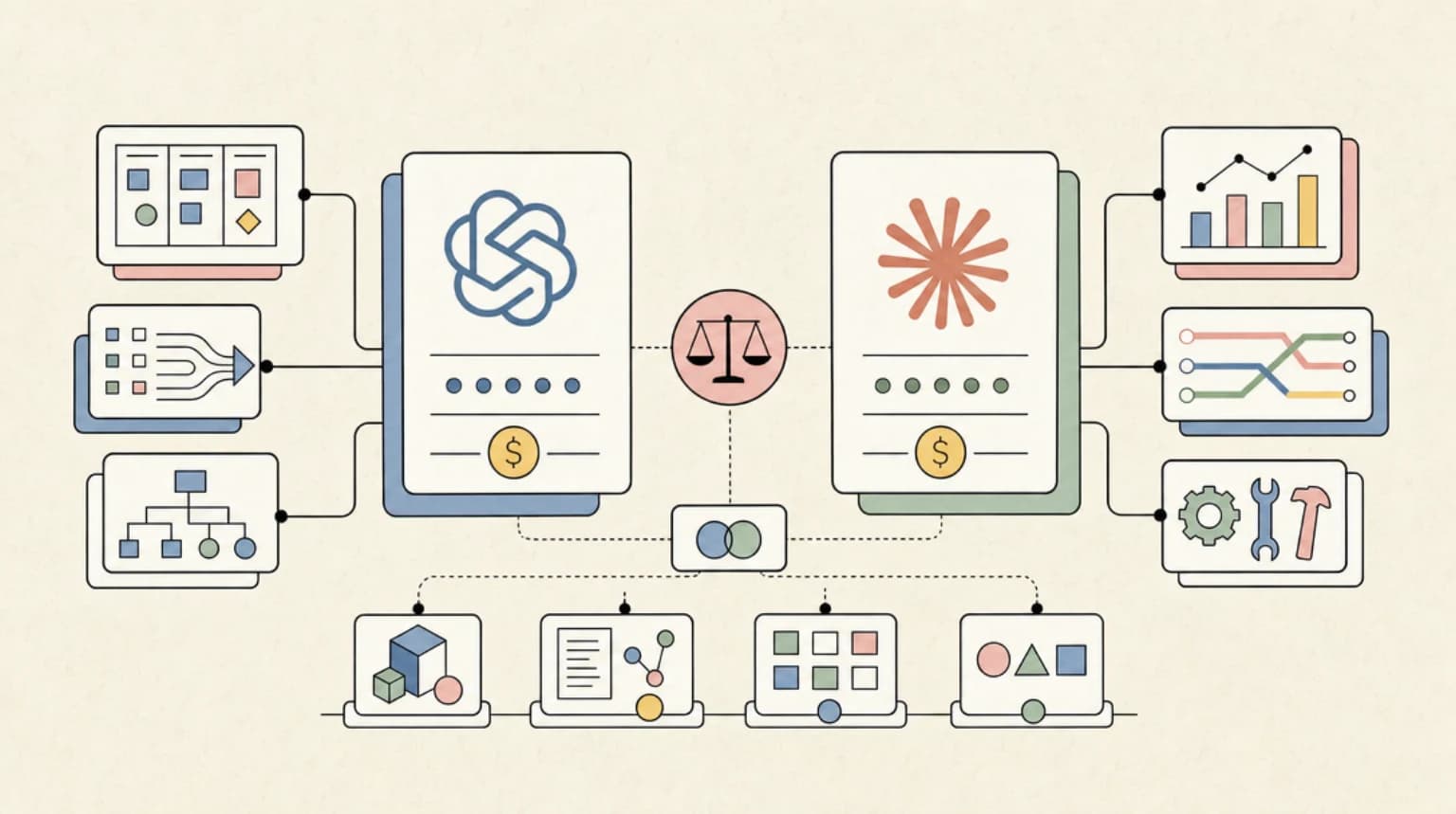
GPT-5.6 Sol vs Claude Opus 5: both cost $5 per million input tokens, so the workhorse-tier decision comes down to output pricing, benchmarks, and tooling.
Last updated: August 1, 2026
What Changed on August 1, 2026#
This post originally compared GPT-5.5 and Claude Opus 4.8. Both were retired in the July model rotation: OpenAI's GPT-5.5 family shut down on July 23 and Anthropic's docs now steer every new integration to Claude Opus 5, which launched July 24 at the same $5/$25 rates as Opus 4.8. The current matchup is GPT-5.6 Sol vs Claude Opus 5, and the structure of the fight is identical: both cost $5.00 per million input tokens, so the workhorse-tier decision comes down to output pricing, benchmarks, and tooling. All prices and specs below were re-verified against the live pricing and model pages on August 1, 2026. For the full OpenAI family context, see our GPT-5.6 Sol/Terra/Luna developer guide, and for the Anthropic side of the launch, Claude Opus 5 vs Opus 4.8 vs Fable 5.
Why the Workhorse Tier Is the Real Fight#
A quick framing note, because the naming changed. GPT-5.6 Sol is OpenAI's mainline frontier model - the model page calls it "a frontier model for complex professional work," with the gpt-5.6 alias routing to it, and Terra ($2/$12) and Luna ($0.20/$1.20) below it for cost-sensitive tiers. Claude Opus 5 is Anthropic's mainline Opus model, with Fable 5 above it at $10/$50 (API-only since July 9) and Mythos 5 in invitation-only limited availability.
Both vendors still run a two-tier-plus structure: an expensive ceiling model and a $5-input workhorse. Anthropic's own models overview now says: "If you're unsure which model to use, start with Claude Opus 5 for complex agentic coding and enterprise work," reserving Fable 5 for workloads that need the highest available capability. OpenAI's equivalent default for serious work is GPT-5.6 Sol itself. That makes this the fair fight: the model each vendor expects you to use for most serious work, at the same input price.
Head-to-Head: Specs and Pricing#
All pricing verified August 1, 2026 against developers.openai.com/api/docs/pricing and platform.claude.com/docs/en/about-claude/pricing. Benchmark figures are from Anthropic's July 24 launch materials, OpenAI's published model tables, and the Artificial Analysis Intelligence Index (July 25 snapshot).
| GPT-5.6 Sol | Claude Opus 5 | |
|---|---|---|
| Input (per MTok) | $5.00 | $5.00 |
| Output (per MTok) | $30.00 | $25.00 |
| Cached input read | $0.50 | $0.50 |
| Cache writes | $6.25 (1.25x input) | $6.25 (5-minute) / $10 (1-hour) |
| Batch input / output | $2.50 / $15.00 | $2.50 / $12.50 |
| Long context | $10 / $45 (prompts over 272K, full request) | No premium; 1M window at flat rate |
| Context window | 1,050,000 tokens | 1M tokens |
| Max output | 128K tokens | 128K tokens (300K on Batch via beta) |
| Knowledge cutoff | February 16, 2026 | May 2026 (reliable cutoff) |
| AA Intelligence Index | 59 | 61 |
| Speed premium option | Fast mode at $10.00/$60.00 (2x base rates) | Fast mode at $10/$50, about 2.5x faster (research preview, Claude API only) |
The spec convergence is striking. Both models offer a 1M-class context window and an identical 128K max output. On raw capacity, these models are interchangeable. The differences live in four places: output price, long-context pricing, benchmark profile, and ecosystem.
The Pricing Fine Print#
The headline is simple: input is a tie, and Claude is cheaper on output - $25 versus $30 per million tokens, verified August 1, 2026. That is a 17% discount on the token type that dominates agentic workloads. A team generating 50 million output tokens a month pays $1,250 on Opus 5 versus $1,500 on GPT-5.6 Sol. The same ratio holds in batch mode, where both vendors apply a 50% discount: $12.50 versus $15.00 per million output tokens.
Caching is closer to a wash than it looks - closer than it was in June, because OpenAI now bills cache writes explicitly. Both vendors charge $0.50 per million tokens for cached input reads (a 90% discount off base input) and both bill cache writes at 1.25x input ($6.25 per MTok on the 5-minute tier). The one structural difference: Anthropic also sells a 1-hour cache tier at $10, while OpenAI's single rate applies with a 30-minute minimum cache life. High cache churn adds cost on both sides now; stable system prompts read many times make it disappear into the noise.
Long-context pricing is the real new split. OpenAI prices prompts over 272K input tokens at 2x input and 1.5x output for the full request ($10/$45), while Anthropic dropped its long-context premium entirely - a 900K-token request on Opus 5 bills at the same per-token rate as a 9K one. If your workloads run deep in the context window, that difference is worth real money.
Two honest caveats before declaring Claude the value winner:
- Tokenizers differ, so per-token prices are not directly comparable across providers. Anthropic's own pricing page notes that the tokenizer introduced with Opus 4.7 "produces approximately 30% more tokens for the same text" on newer models. Cross-provider, the only meaningful comparison is cost per completed task, measured on your own workload.
- Speed premiums cut both ways. Anthropic offers a fast mode research preview on Opus 5 at $10/$50 - double the price for roughly 2.5x the speed. OpenAI renamed its priority tier to Fast mode on July 30 and sells it for GPT-5.6 Sol at $10/$60 - 2x base rates. Both buy roughly the same thing: faster completion on interactive workloads where wall-clock time is user-visible.
Benchmarks: Where Each Model Leads#
The cleanest current cross-vendor read is the Artificial Analysis Intelligence Index (July 25 snapshot): Opus 5 scores 61, Fable 5 scores 60, and GPT-5.6 Sol scores 59. Opus 5 holds the #1 spot on the leaderboard at max effort, and it holds 60 at xhigh and 59 at high effort - meaning even at reduced effort settings it matches or beats Sol's max.
On agentic coding specifically, the picture splits by benchmark. OpenAI's own published table for the GPT-5.6 family lists GPT-5.6 Sol at 64.6% on SWE-Bench Pro (Fable 5 leads at 80%, Opus 4.8 scored 69.2%). Anthropic did not publish an Opus 5 SWE-Bench Pro figure - its launch leaned on Frontier-Bench v0.1, where Opus 5 more than doubles Opus 4.8's performance, and CursorBench 3.2, where Opus 5 lands within 0.5% of Fable 5's peak at max effort. On Terminal-Bench 2.1, the CLI-workflow benchmark, OpenAI's table gives Sol 88.8% against Fable 5's 83.1%; Opus 5 has no published figure there.
The cost-per-task numbers add an important twist: on the Artificial Analysis cost-per-task metric (July 25), GPT-5.6 Sol at max effort costs about $1.04 per task while Opus 5 at max costs about $2.03. Opus 5 reaches higher peak quality but spends more output tokens doing it - which is exactly why the output-price gap and the tokenizer caveat matter. Our Claude vs GPT coding comparison goes deeper on how the two families behave in practice, and our model tiers breakdown covers Sol's max/ultra compute settings.
The fair summary: Opus 5 has the stronger published agentic-coding profile on the indexes both vendors publish, GPT-5.6 Sol is markedly cheaper per task and faster on terminal-style workloads, and both are far enough above last year's models that either feels strong day to day.
Tooling: Claude Code Defaults and the OpenAI Surface Area#
Model choice increasingly follows tooling choice. Since the July 24 launch, Opus 5 is the default model Claude Code routes serious work to - Anthropic's models overview points every unsure developer at it, and it defaults to high effort on the Claude API and Claude Code, with an effort ladder running low through max for cost control. If your team lives in Claude Code, Opus 5 is the path of least resistance, and the 512-token minimum cacheable prompt means short system prompts now create cache entries with no code changes.
OpenAI's pitch is surface area, with one honest caveat: it shrank relative to GPT-5.5. The GPT-5.6 Sol model page lists Chat Completions, Responses, and Batch support - but unlike GPT-5.5, Sol does not support Realtime, fine-tuning, image generation, or speech endpoints. If your product needs one model id wired into voice, vision, and fine-tuning pipelines, Sol is not that model - the multimodal endpoints live on separate models in the OpenAI catalog now. What Sol does add is the durable tier system: Terra and Luna share the family, so a single OpenAI account can route work across three price points with one API surface. Our GPT-5.6 family guide walks through that spread in detail.
Decision Guide by Persona#
The agent builder. Opus 5. The #1 Intelligence Index score (61 vs 59), the CursorBench 3.2 near-parity with Fable 5 at half the cost per task, and 17% cheaper output stack three advantages on the same side.
The high-volume output shop. Opus 5 on the Batch API: $12.50 per million output tokens versus $15.00. At volume, that 17% compounds. Just re-baseline token counts first, since the Opus 4.7+ tokenizer can inflate counts for identical text.
The cost-per-task shop. GPT-5.6 Sol. At roughly half Opus 5's cost per completed task at max effort ($1.04 vs $2.03 on the Artificial Analysis metric), Sol wins wherever the work is high-volume and the quality bar is "good enough on the first pass."
The long-context pipeline. Opus 5. Anthropic's flat 1M-window pricing has no 272K cliff, so deep-context workloads (monorepo analysis, long-document extraction) bill at the same rate as short prompts.
The platform consolidator. Neither, honestly - and that is the new answer. Sol dropped Realtime, fine-tuning, and speech support, so the single-model-id consolidation argument that favored GPT-5.5 is gone. Pick the model for the core workload and route the multimodal surface separately.
The undecided. Run both at $5 input on a two-week pilot against your real tasks. The pricing symmetry makes this the cheapest A/B test this tier has ever offered. Our OpenAI vs Anthropic 2026 comparison covers the platform-level factors beyond this matchup.
When to Skip Both - or Stay Put#
Neither model is the right call for everything.
- Routine tasks do not need a $5 model. Claude Sonnet 5 ($2/$10 through August 31, then $3/$15) and GPT-5.6 Terra ($2/$12) sit one tier down at less than half the cost, verified August 1, 2026 on the same pricing pages. Classification, summarization, and well-scoped edits rarely justify workhorse rates.
- The hardest problems may justify the ceiling tier. If Opus 5 fails repeatedly on a long-horizon task, Fable 5 at $10/$50 can be cheaper per completed task. That math is in our flagship comparison.
- Budget-constrained workloads have a floor far below this. GPT-5.6 Luna at $0.20/$1.20 (after the July 30 80% cut) and DeepSeek V4 Flash at $0.14/$0.28 cover a lot of production traffic. Our budget models comparison works through when the floor is the right answer.
- If you are already on Opus 4.8, the upgrade is cheap and fast. Opus 4.8 and Opus 5 share the same $5/$25 pricing, so the switch costs nothing on rates - and Anthropic's migration guide documents the move. GPT-5.5 API users are past the July 23 retirement wave; the migration guide covers the replacement family.
Official Sources#
| Provider | Official Source | Last Verified |
|---|---|---|
| OpenAI GPT-5.6 Sol Pricing | OpenAI API Pricing | August 1, 2026 |
| OpenAI GPT-5.6 Sol Model | GPT-5.6 Sol Model Page | August 1, 2026 |
| Claude Opus 5 Pricing | Anthropic Pricing | August 1, 2026 |
| Claude Models Overview | Anthropic Models Documentation | August 1, 2026 |
| Artificial Analysis Intelligence Index | AA Intelligence Index | July 25, 2026 (in-repo snapshot) |
FAQ#
Is Claude Opus 5 cheaper than GPT-5.6 Sol?#
On input, no - both cost $5.00 per million tokens (verified August 1, 2026). On output, yes: Opus 5 charges $25 versus Sol's $30, about 17% less, and the gap persists in batch mode ($12.50 vs $15.00). The caveat is tokenizer differences: compare cost per completed task, not per-token rates.
Which is better for coding, GPT-5.6 Sol or Claude Opus 5?#
On published benchmarks, Opus 5 leads: #1 on the Artificial Analysis Intelligence Index (61 vs 59), and near-Fable 5 parity on CursorBench 3.2 at max effort. OpenAI's table gives Sol the lead on Terminal-Bench 2.1 (88.8%). Those figures originate from the vendors' own materials, so run your own evaluation - but the direction matches Opus 5's role as the recommended default in Anthropic's docs.
Do GPT-5.6 Sol and Claude Opus 5 have the same context window?#
Effectively yes. GPT-5.6 Sol lists 1,050,000 tokens (922,000 max input) and Opus 5 lists 1M, both with 128K max output. One difference: OpenAI prices prompts over 272K at 2x input and 1.5x output for the full request, while Anthropic charges no long-context premium at all.
When does GPT-5.6 Sol make more sense than Opus 5?#
When your workload is high-volume and cost-per-task is the metric that matters - Sol runs about half Opus 5's cost per completed task at max effort on the Artificial Analysis measure - or when you need the OpenAI ecosystem's tool surface (web search, file search, code interpreter, hosted shell, MCP) and can live without Realtime and fine-tuning on the flagship model.
Should I use Claude Fable 5 instead of Opus 5?#
Only for workloads that need the highest available capability. Fable 5 costs exactly double ($10/$50), is API-only since July 9, and Anthropic's own models overview directs most complex work to Opus 5 first. Start at the workhorse tier and escalate only when you have evidence the cheaper model is failing.
What happened to GPT-5.5 and Opus 4.8?#
Both were retired in the July 2026 rotation: GPT-5.5 shut down July 23 (the replacement family is GPT-5.6 Sol/Terra/Luna) and Opus 4.8 now sits in Anthropic's legacy section, superseded by Opus 5 at identical pricing. Both are still listed on their pricing pages for migration windows; neither should be a new integration target.
Sources#
- OpenAI API pricing - GPT-5.6 Sol/Terra/Luna rates, batch and fast mode, cache pricing, GPT-5.5 legacy rows (accessed August 1, 2026)
- OpenAI GPT-5.6 Sol model page - context window, max output, knowledge cutoff, endpoint support, long-context pricing (accessed August 1, 2026)
- Anthropic pricing - Opus 5 and Fable 5 rates, caching, batch, fast mode, long-context policy, tokenizer note (accessed August 1, 2026)
- Anthropic models overview - Opus 5 positioning, specs, knowledge cutoffs, effort defaults (accessed August 1, 2026)
- Artificial Analysis Intelligence Index - Opus 5 61 / Fable 5 60 / GPT-5.6 Sol 59, cost-per-task figures (July 25, 2026 snapshot, cross-checked against Anthropic's launch materials)
- Anthropic: Claude Opus 5 announcement - Frontier-Bench v0.1, CursorBench 3.2, ARC-AGI 3, OSWorld 2.0 launch data (July 24, 2026)
Note: OpenAI's GPT-5.6 launch announcement page returns an error to automated requests, so launch-post-only claims are not cited in this comparison. Model-table benchmark figures (SWE-Bench Pro 64.6%, Terminal-Bench 2.1 88.8%) come from OpenAI's published model tables as cross-referenced in this repo's model tiers post.
Continue Reading#
- GPT-5.6 Sol, Terra, Luna: Developer Guide - the OpenAI family breakdown with per-tier pricing
- Claude Opus 5 vs Opus 4.8 vs Fable 5 - the full Anthropic-side benchmark comparison
- OpenAI vs Anthropic 2026 - platform-level comparison beyond the model tier
- Frontier Model API Pricing, June 2026 - the standing rate card across all providers
- Claude vs GPT for Coding - how the two families behave in real workflows
Get the next comparison like this in your inbox
One email a week on claude and the rest of the AI dev stack. Free.
Read next on Claude Code
Claude Fable 5 vs GPT-5.6 Sol: Benchmarks, Pricing, and When Each Wins
Fable 5 is API-only at 2x GPT-5.6 Sol's price with a 15-point SWE-Bench Pro gap. Here is the decision framework for choosing between them in August 2026.
12 min readOpenAI vs Anthropic in 2026 - Models, Tools, and Developer Experience
A developer's comparison of OpenAI and Anthropic ecosystems - models, coding tools, APIs, pricing, and which to choose for different use cases.
18 min readClaude vs GPT for Coding: Which Model Writes Better TypeScript?
Claude vs GPT for real TypeScript work: benchmarks, pricing, model families, and the practical differences that matter when picking a coding model.
9 min readTechnical content at the intersection of AI and development. Building with AI agents, Claude Code, and modern dev tools - then showing you exactly how it works.