Claude Fable 5 vs GPT-5.6 Sol: Benchmarks, Pricing, and When Each Wins
The Fable 5 Moment
31 parts- 1Claude Mythos 5 Explained: What It Is, Who Can Access It, and Why It's Gated
- 2Migrating to Claude Fable 5: The Practical Guide
- 3Claude Fable 5 Access After the June 22 Deadline: Where Things Stand
- 4Claude Fable 5 vs GPT-5.6 Sol: Benchmarks, Pricing, and When Each WinsCurrent
- 5Fable 5 vs Opus 4.8: A Data-Driven Decision Guide for Engineering Teams
- 6How to Model Fable 5 Costs Before They Blow Up Your Budget
- 7Claude Fable 5 API: Production Integration Patterns, Rate Limits, and Migration Gotchas
- 8Handling Fable 5 Refusals: A Working Guide to the Fallback API
- 9Why Fable 5 Refuses Your Cybersecurity Queries (And How the Fallback Works)
- 10Fable 5's Hidden Guardrails: What Developers Need to Know About Silent Degradation
- 11Fable 5 Broke Enterprise ZDR Agreements: What Dev Teams Must Do Now
- 12Claude Managed Agents: Dreaming, Outcomes, and Multi-Agent Orchestration Explained
- 13Claude Managed Agents Public Beta: What's Actually Available vs What's Gated
- 14Dario Amodei Wants FAA-Style AI Regulation: Open Questions for Developers
- 15The Exponential and the Working Developer: Sitting With Amodei's Hardest Questions
- 16The Dario Paradox: Warning About the Exponential While Shipping It
- 17The Pushback on Amodei's Exponential Essay: Too Slow, Too Convenient, or About Right?
- 18Fable 5 Before June 22: The Decision Checklist for Every Plan Tier
- 19Fable 5 on AWS Bedrock: When Your Data Leaves the AWS Boundary
- 20Why Claude Desktop Installs a 1.8 GB Hyper-V VM on Windows
- 21Anthropic Model Names Explained: Fable, Mythos, Opus, Sonnet
- 22Managed Agents vs LangGraph vs Rolling Your Own: Who Should Run Your Agent Loop in 2026
- 23Claude Usage Limits With Fable 5: Windows and Burn Rates
- 24Fable 5 for Government and Regulated Teams: The GovCloud Question
- 25Fable 5 vs DeepSeek V4: The Cost-Quality Gap Measured in Real Tasks
- 26Fable 5 Orchestrator Playbook: Smart Model, Cheap Workers
- 27Prompt Caching Economics on Fable 5: When the 5-Minute TTL Pays
- 28Fable 5 with 1M Context: What Actually Works in Practice
- 29Claude Effort Levels Explained: Fable 5, Opus 5.5, Haiku 5.5
- 30Fable 5 Effort Levels vs Switching Models: When to Dial and When to Change
- 31Recursive Self-Improvement: What Fable 5, Dario's Essay, and Anthropic's Own Data Actually Tell Us
TL;DR
Fable 5 is API-only at 2x GPT-5.6 Sol's price with a 15-point SWE-Bench Pro gap.
Anthropic shipped Claude Fable 5 on June 9, 2026, and the launch framing was not modest. Fable 5 sits above the Opus tier - a new class Anthropic calls Mythos - and the company says it is state-of-the-art on nearly every benchmark it tested. It is priced at $10/$50 per million tokens, exactly double what GPT-5.6 Sol costs on the API.
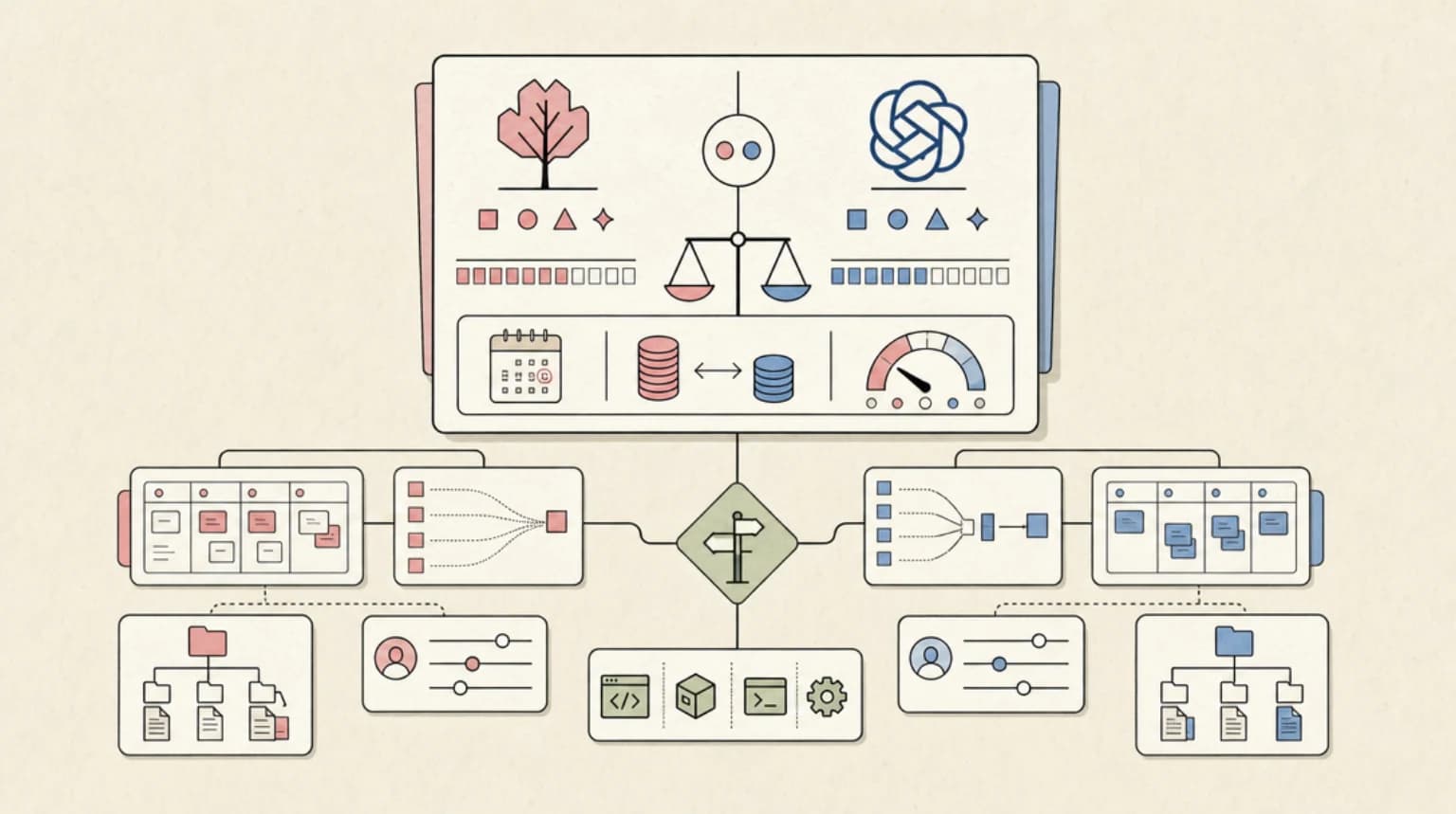
That price gap is the central question for developers right now. The benchmarks are real, but benchmark leads do not always translate into per-task value. This post breaks down where each model wins, where the gap closes, and how to pick one given your workload. All pricing and benchmark figures below were verified against the live source pages on August 1, 2026.
Last updated: August 1, 2026
What Changed on August 1, 2026#
This post originally compared Fable 5 against GPT-5.5. OpenAI retired the GPT-5.5 family on July 23 and replaced it with the GPT-5.6 lineup: Sol ($5/$30), Terra ($2/$12), and Luna ($0.20/$1.20 after the July 30 cut). The Fable 5 side changed too: since July 9, Fable 5 is API-only - no longer included in any subscription plan - at the unchanged $10/$50 rate. The shape of the comparison survives intact: Fable 5 costs exactly 2x Sol on input and 1.67x on output, and the benchmark gap narrowed but did not close. Anthropic also shipped Claude Opus 5 on July 24 at $5/$25, which we cover in Claude Opus 5 vs Opus 4.8 vs Fable 5; this post stays on the flagship matchup.
Why This Comparison Matters Now#
Both models are the top of their vendor's API line, but they are built for different jobs. Fable 5 is Anthropic's most capable widely released model - the version of the Mythos class cleared for general use, carrying safeguards that fall back to Opus 5 on a small fraction of cybersecurity and biology queries. GPT-5.6 Sol is OpenAI's frontier model for complex professional work, with the gpt-5.6 alias routing to it, plus a max compute setting and an ultra mode that coordinates four agents in parallel - OpenAI reports Sol Ultra hitting 91.9% on Terminal-Bench 2.1 versus 88.8% for single-agent Sol.
The 15-point gap on SWE-Bench Pro (80% vs 64.6%) is large enough that it cannot be handwaved away. But GPT-5.6 Sol uses meaningfully fewer output tokens on the same coding tasks - OpenAI's launch materials claim under half the output tokens and under half the time of Fable 5 on the coding-agent indexes - which changes the math considerably once you run real workloads at scale.
The practical decision comes down to: are you optimizing for raw capability on hard, long-horizon problems, or for cost-per-successful-task across a high-volume production pipeline? If Google is also on your shortlist, the Claude Fable 5 vs Gemini 3.1 Pro comparison covers the third corner of the frontier.
Benchmark Head-to-Head#
Here is the benchmark data, sourced from Anthropic's launch post, OpenAI's published model tables, and the Artificial Analysis Intelligence Index (July 25 snapshot).
| Benchmark | Fable 5 | GPT-5.6 Sol | Notes |
|---|---|---|---|
| SWE-Bench Pro | 80% | 64.6% | Real-world GitHub issue resolution, agentic |
| Terminal-Bench 2.1 | 83.1% | 88.8% | Complex CLI workflows, OpenAI-run eval |
| AA Intelligence Index | 60 | 59 | Artificial Analysis, July 25 snapshot |
| GDP.pdf Vision | 29.8% | Not published | Document reasoning, no tools |
SWE-Bench Pro is the most-cited number. It tests whether an agent can resolve real GitHub issues end-to-end in a single pass across a held-out set of repositories. The 80% vs 64.6% gap is measured on the same benchmark by OpenAI's own model table (which also lists Opus 4.8 at 69.2% as reference) - the figure for Fable 5 originates from Anthropic's launch materials and has not been disputed since. It is the largest single-vendor gap in this comparison.
Terminal-Bench 2.1 is OpenAI's CLI-workflow benchmark - planning, iteration, and tool coordination in a terminal environment. Sol posts 88.8% (91.9% in ultra parallel-agent mode). Anthropic has not published Fable 5 results on this specific benchmark, and OpenAI's table lists Fable 5 at 83.1%, so on terminal-style work Sol has the published edge.
Artificial Analysis Intelligence Index is the closest thing to an independent cross-vendor leaderboard, and here the models are nearly tied: Fable 5 at 60, Sol at 59, with Opus 5 on top at 61 (July 25 snapshot). On the index's cost-per-task metric, Sol at max effort costs about $1.04 per task versus Fable 5 at roughly $2.75 - the pricing gap, expressed in the unit that actually matters.
GDP.pdf is where Fable 5's vision-document edge lives (29.8% from Vellum's breakdown of launch materials). OpenAI has not published a Sol figure on this eval, so treat that column as one-sided.
Pricing Math: Is the 2x Premium Justified?#
| Model | Input (per 1M tokens) | Output (per 1M tokens) |
|---|---|---|
| Claude Fable 5 | $10.00 | $50.00 |
| Claude Opus 5 | $5.00 | $25.00 |
| GPT-5.6 Sol | $5.00 | $30.00 |
All prices verified August 1, 2026. Fable 5 is double GPT-5.6 Sol on input and 1.67x on output; Opus 5 is listed because it is the model Fable 5's premium is actually measured against in most budgets.
The relevant question is not token price in isolation but cost-per-successful-task. If Fable 5 completes a coding task in one pass that Sol requires two passes for, the effective cost converges. If Sol uses under half the output tokens on a task where it succeeds - which OpenAI's launch materials claim on the coding-agent indexes - the cost advantage flips hard even at lower task success rates.
A rough framework:
- Hard, one-shot agentic work (migrations, complex refactors): Fable 5's higher single-pass rate on SWE-Bench Pro likely beats Sol's lower price, though Opus 5 at half of Fable 5's price covers most of the same ground.
- High-volume, repetitive coding tasks: Sol's token efficiency and lower price per token probably win once you account for retry rates.
- Terminal-driven and multi-agent workflows: Sol's published Terminal-Bench 2.1 lead plus
ultraparallel-agent mode make it the stronger documented choice.
Availability is the other half of the pricing story. Fable 5 is API-only since July 9 - it is no longer included in Pro, Max, Team, or Enterprise subscription plans, so every Fable 5 token carries the $10/$50 API rate. Sol, by contrast, powers the Medium/High/Extra High reasoning options in standard ChatGPT on Plus and above, so ChatGPT subscribers can evaluate the model class without API spend. In Codex, Free and Go users get Terra; paid plans can choose among Sol, Terra, and Luna.
Real-World Task Matrix#
| Task Category | Fable 5 | GPT-5.6 Sol | Edge Goes To |
|---|---|---|---|
| Long-horizon agentic coding | 80% SWE-Bench Pro | 64.6% SWE-Bench Pro | Fable 5 |
| CLI workflow automation | 83.1% Terminal-Bench 2.1 | 88.8% Terminal-Bench 2.1 | Sol |
| Multi-agent parallel runs | Not published | 91.9% (ultra mode) | Sol |
| Token efficiency on coding | - | Under half Fable 5's output tokens (vendor claim) | Sol |
| Knowledge work / analysis | AA Index 60 | AA Index 59 | Tie |
| Document + vision reasoning | 29.8% GDP.pdf | Not published | Fable 5 |
| Cost per task (AA, max effort) | ~$2.75 | ~$1.04 | Sol |
| Context window | 1M tokens | 1,050,000 tokens | Tie |
| Subscription availability | None (API-only since July 9) | ChatGPT Plus and above, Codex | Sol |
Stripe's early testing - cited in Anthropic's launch post - remains the most striking real-world data point: Fable 5 completed a codebase-wide migration on a 50-million-line Ruby codebase in a day that would have taken a team two months by hand. That is the use case where the premium makes sense. The longer and more complex the task, the more Fable 5's lead compounds - and the more Sol's per-task cost advantage recedes.
For vision work, Fable 5 demonstrated reconstructing a web app's full source from screenshots. The GDP.pdf lead is one-sided (no published Sol figure), but it reflects a real capability gap on unstructured document reasoning that Anthropic's launch materials document.
When GPT-5.6 Sol Wins#
Token efficiency is Sol's clearest structural advantage. OpenAI claims under half the output tokens and under half the time of Fable 5 on the coding-agent indexes it leads. Applied to high-volume pipelines, that efficiency compounds directly into cost savings even before you account for the lower base price.
Published terminal-workflow numbers. Sol's 88.8% on Terminal-Bench 2.1 - and 91.9% in ultra mode - are the strongest published figures for CLI-driven agents. If your agents live in a terminal doing planning, iteration, and tool coordination, Sol has the documented edge.
Cost-per-task at max effort. At roughly $1.04 per task versus Fable 5's ~$2.75 on the Artificial Analysis metric, Sol covers the overwhelming majority of production workloads at a third of the effective cost.
Subscription evaluation path. ChatGPT Plus and above can route reasoning work to Sol without API spend, and Codex paid plans can pick it as the default. Fable 5 has no free or subscription path since July 9.
Structured, repeatable tasks at scale. The more your workload resembles a pipeline with predictable inputs rather than open-ended agentic loops, the more Sol's token efficiency and pricing advantage matter.
When Fable 5 Wins#
The Stripe-style migration. Month-long agentic tasks on large codebases are exactly the scenario where Fable 5 compounds. Higher single-pass success rates on SWE-Bench Pro mean fewer retries, which closes the apparent cost gap. On the hardest problems where the 80% vs 64.6% gap is live, you may get to the answer in one pass with Fable 5 where Sol needs revision loops - and the token math can converge or flip.
Long-context autonomy with memory. Anthropic's internal Slay the Spire test is illustrative: giving Fable 5 persistent file-based memory improved its performance three times more than it did for Opus 4.8, and it reached the game's final act three times as often. That asymmetric benefit of memory suggests Fable 5 is meaningfully better at planning across a long task horizon, not just at individual steps.
Vision-intensive agentic work. The screenshot-based reconstruction capability and the GDP.pdf lead are ahead of what OpenAI has published for Sol. For computer-use agents or document-processing pipelines, the gap is real.
Tasks where failure is costly. If a failed agent run burns significant compute, developer time, or downstream data, the higher single-pass success rate on hard tasks justifies Fable 5's premium regardless of per-token price.
Migration Notes#
API identifiers. The Fable 5 model ID is claude-fable-5; GPT-5.6 Sol's ID is gpt-5.6-sol with the gpt-5.6 alias routing to it. Fable 5 carries one breaking change not present in Opus models: passing thinking: {type: "disabled"} explicitly returns a 400 error - you must omit the thinking parameter entirely rather than disabling it. Review the model migration guide before updating existing integrations.
GPT-5.5 is gone; the replacement family has a different shape. OpenAI retired the GPT-5.5 line on July 23. GPT-5.6 Sol/Terra/Luna are not "GPT-5.5 but cheaper" - Terra ($2/$12) is the closer price-point successor, while Sol is the new frontier tier. If you migrated from GPT-5.5 to Terra expecting feature parity, note that the family shares one API surface: Chat Completions, Responses, and Batch, with no Realtime, fine-tuning, or speech endpoints on Sol. Our migration guide for retired GPT models covers the full replacement map.
Fable 5's safeguard fallback affects a small but real slice of sessions. On cybersecurity and biology queries, Fable 5 routes silently to Opus 5. Anthropic says this triggers in under 5% of sessions. If your application touches those domains - security tooling, bioinformatics, dual-use research - verify whether the fallback will affect your use case before depending on Fable 5 capabilities in production.
Verdict by Use Case#
Daily coding assistance and PR review: GPT-5.6 Sol, typically through Codex or Codex CLI. Token efficiency, lower price, and near-identical knowledge-work scores make it the economical default. See the GPT-5.6 Sol/Terra/Luna developer guide for integration patterns.
Autonomous agents on hard codebases: Fable 5, most often run through Claude Code. The 15-point SWE-Bench Pro gap and the vision edge are decisive for tasks where a single failed run is expensive. The Stripe migration example is the canonical case - but for most teams, Opus 5 at half of Fable 5's price closes most of the gap, so price the three-way comparison before committing.
Enterprise batch processing (document extraction, analysis pipelines, knowledge work at scale): Sol unless you specifically need Fable 5's document reasoning edge. The near-tie on the Artificial Analysis Intelligence Index (59 vs 60) suggests both models cover structured knowledge work well.
Vision and computer use: Fable 5 for now. The GDP.pdf lead and the screenshot reconstruction capability give it a meaningful edge on unstructured visual reasoning. Review the AI coding tools comparison matrix for how both fit alongside other coding tools in a multi-model workflow.
Both models represent genuine capability leaps. The decision is almost never about which is objectively better - it is about where the 2x price difference is earned back by higher task success rates on your specific workload.
FAQ#
Is Fable 5's 2x price premium worth it over GPT-5.6 Sol?#
It depends on task difficulty and retry rate. On hard, one-shot agentic work where a failed run is expensive, Fable 5's higher single-pass rate on SWE-Bench Pro (80% vs 64.6%) usually earns back the premium. On high-volume, repetitive coding tasks, Sol's token efficiency and lower price per token usually win - it runs about a third of Fable 5's cost per task at max effort on the Artificial Analysis metric.
Which model is better for high-volume production pipelines?#
GPT-5.6 Sol, in most cases. Its lower per-token price (half of Fable 5 on input) and vendor-claimed token efficiency compound directly into savings at scale, especially on structured, repeatable workloads. At the very top of the difficulty curve, the retry-rate math can still favor Fable 5.
How far apart are the models on benchmarks?#
The closest thing to an independent read - the Artificial Analysis Intelligence Index, July 25 snapshot - has them at 60 (Fable 5) and 59 (Sol), with Opus 5 on top at 61. On SWE-Bench Pro, the gap is 15 points in Fable 5's favor; on Terminal-Bench 2.1, it is about 6 points in Sol's favor. The models are close on indexes and split on coding evals.
Has the Fable 5 pricing or availability changed since launch?#
Yes, twice. Fable 5 launched June 9 included in subscription plans through June 22, was suspended in late June, and returned API-only on July 9 - it is no longer available in any subscription plan and costs $10/$50 per million tokens, unchanged since launch. GPT-5.5 was retired July 23 and replaced by GPT-5.6 Sol/Terra/Luna, with Sol at $5/$30.
Which model should I use in August 2026?#
For most teams: GPT-5.6 Sol as the default, Claude Opus 5 ($5/$25) as the coding-workhorse upgrade candidate, and Fable 5 only for the hardest long-horizon or vision-heavy tasks where single-pass success is worth a 2x token premium. Anthropic's own docs direct unsure developers to Opus 5 first, not Fable 5.
Official Sources#
| Resource | Link | Last Verified |
|---|---|---|
| Fable 5 launch post | anthropic.com/news/claude-fable-5-mythos-5 | August 1, 2026 |
| Fable 5 benchmarks explained | vellum.ai/blog/claude-fable-5-and-mythos-5-benchmarks-explained | August 1, 2026 |
| GPT-5.6 GA announcement | openai.com/index/gpt-5-6 | August 1, 2026 |
| GPT-5.6 Sol model page | developers.openai.com/api/docs/models/gpt-5.6-sol | August 1, 2026 |
| Anthropic models + pricing | platform.claude.com/docs/en/about-claude/models/overview.md | August 1, 2026 |
| OpenAI API pricing | developers.openai.com/api/docs/pricing | August 1, 2026 |
| Artificial Analysis Intelligence Index | artificialanalysis.ai/evaluations/artificial-analysis-intelligence-index | July 25, 2026 snapshot |
| Anthropic model migration guide | platform.claude.com/docs/en/about-claude/models/migration-guide | August 1, 2026 |
Sources#
- Anthropic: Introducing Claude Fable 5 and Mythos 5 - launch framing, SWE-Bench Pro figures, Stripe test, safeguard fallback (accessed June 10 and August 1, 2026)
- OpenAI: GPT-5.6 GA - family structure, Terminal-Bench 2.1 figures, ultra mode, token-efficiency claims (announcement page rejects automated requests; figures cross-checked against OpenAI's published model tables via this repo's model tiers post)
- OpenAI GPT-5.6 Sol model page - specs, endpoints, pricing, aliases (accessed August 1, 2026)
- Anthropic pricing - Fable 5 API-only status, Opus 5 rates, batch and caching (accessed August 1, 2026)
- Vellum: Claude Fable 5 and Mythos 5 benchmarks explained - GDP.pdf and FrontierCode figures (accessed June 10, 2026)
- Artificial Analysis Intelligence Index - index scores and cost-per-task figures (July 25, 2026 snapshot)
Continue Reading#
- Claude Opus 5 vs Opus 4.8 vs Fable 5 - the Anthropic-side benchmark comparison in full
- GPT-5.6 Sol, Terra, Luna: Developer Guide - OpenAI family breakdown with per-tier pricing
- GPT-5.6 Sol vs Claude Opus 5: The $5 Workhorse - the tier below this matchup
- Frontier Model API Pricing, June 2026 - the standing rate card across all providers
- Claude Fable 5 vs Gemini 3.1 Pro - the Google corner of the frontier decision
- Claude Sonnet 4.6: Approaching Opus at Half the Cost
Get the next comparison like this in your inbox
One email a week on Claude and the rest of the AI dev stack. Free.
Read next on Claude Code
AI Coding Tools Pricing Comparison 2026
AI coding tools pricing, verified Sep 28, 2026: Claude Code, Codex, Cursor, Copilot, Antigravity, Windsurf and more. Free tiers, pro plans and hidden costs.
12 min readClaude Code vs Codex vs Cursor vs OpenCode: Which Agent Ships More Code?
Four agents, same tasks: honest trade-offs between Claude Code, Codex CLI, Cursor Agent and OpenCode from a developer shipping production apps with all of them.
10 min readGPT-5.6 Sol, Terra, and Luna: A Developer's Guide to OpenAI's New Model Family
A practical guide to choosing GPT-5.6 Sol, Terra, and Luna, using programmatic tool calling, caching, and the multi-agent beta in production.
8 min readTechnical content at the intersection of AI and development. Building with AI agents, Claude Code, and modern dev tools - then showing you exactly how it works.