The Exponential and the Working Developer: Sitting With Amodei's Hardest Questions
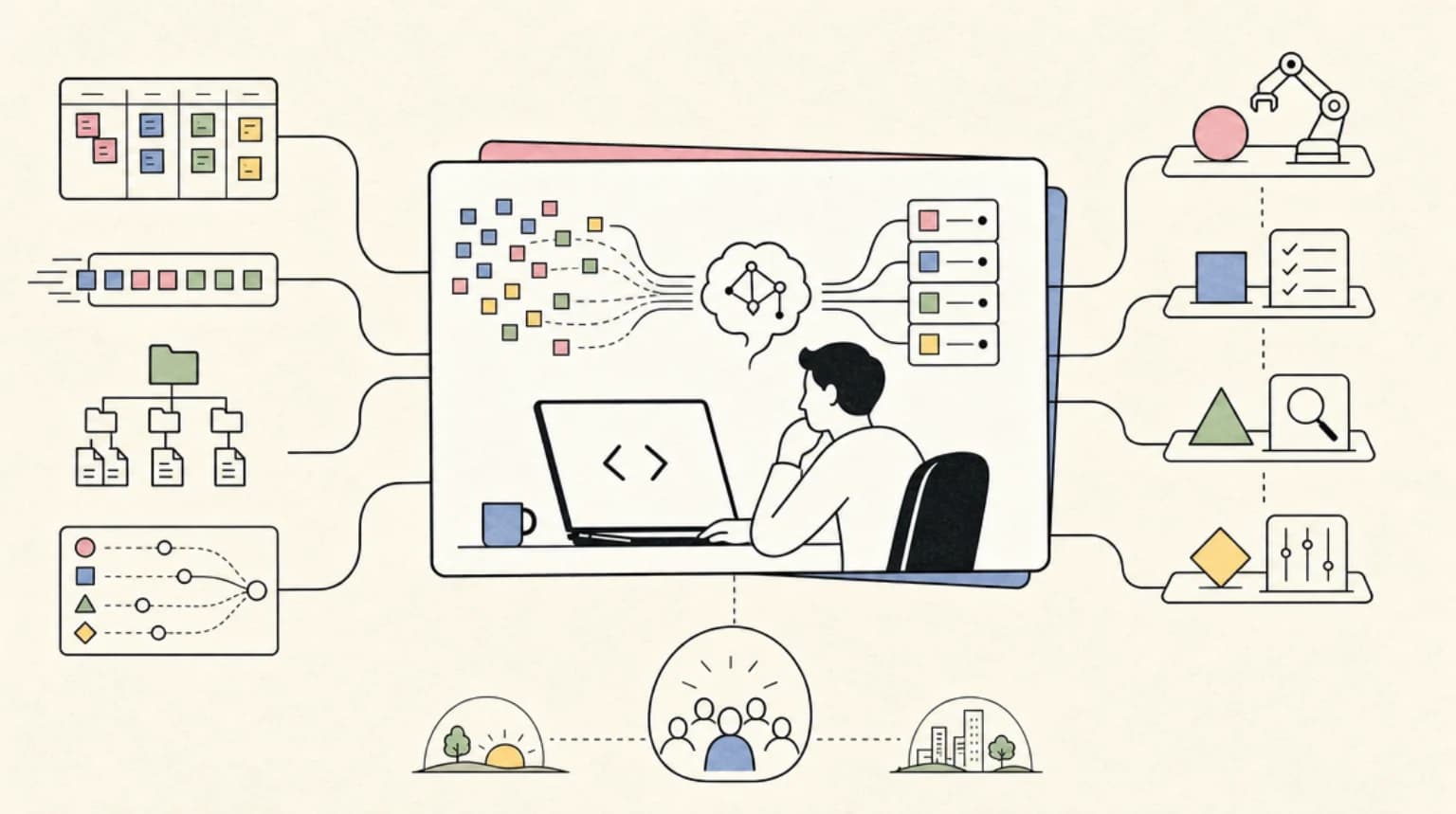
The Fable 5 Moment
31 parts- 1Claude Mythos 5 Explained: What It Is, Who Can Access It, and Why It's Gated
- 2Migrating to Claude Fable 5: The Practical Guide
- 3Claude Fable 5 Access After the June 22 Deadline: Where Things Stand
- 4Claude Fable 5 vs GPT-5.6 Sol: Benchmarks, Pricing, and When Each Wins
- 5Fable 5 vs Opus 4.8: A Data-Driven Decision Guide for Engineering Teams
- 6How to Model Fable 5 Costs Before They Blow Up Your Budget
- 7Claude Fable 5 API: Production Integration Patterns, Rate Limits, and Migration Gotchas
- 8Handling Fable 5 Refusals: A Working Guide to the Fallback API
- 9Why Fable 5 Refuses Your Cybersecurity Queries (And How the Fallback Works)
- 10Fable 5's Hidden Guardrails: What Developers Need to Know About Silent Degradation
- 11Fable 5 Broke Enterprise ZDR Agreements: What Dev Teams Must Do Now
- 12Claude Managed Agents: Dreaming, Outcomes, and Multi-Agent Orchestration Explained
- 13Claude Managed Agents Public Beta: What's Actually Available vs What's Gated
- 14Dario Amodei Wants FAA-Style AI Regulation: Open Questions for Developers
- 15The Exponential and the Working Developer: Sitting With Amodei's Hardest QuestionsCurrent
- 16The Dario Paradox: Warning About the Exponential While Shipping It
- 17The Pushback on Amodei's Exponential Essay: Too Slow, Too Convenient, or About Right?
- 18Fable 5 Before June 22: The Decision Checklist for Every Plan Tier
- 19Fable 5 on AWS Bedrock: When Your Data Leaves the AWS Boundary
- 20Why Claude Desktop Installs a 1.8 GB Hyper-V VM on Windows
- 21Anthropic Model Names Explained: Fable, Mythos, Opus, Sonnet
- 22Managed Agents vs LangGraph vs Rolling Your Own: Who Should Run Your Agent Loop in 2026
- 23Claude Usage Limits With Fable 5: Windows and Burn Rates
- 24Fable 5 for Government and Regulated Teams: The GovCloud Question
- 25Fable 5 vs DeepSeek V4: The Cost-Quality Gap Measured in Real Tasks
- 26Fable 5 Orchestrator Playbook: Smart Model, Cheap Workers
- 27Prompt Caching Economics on Fable 5: When the 5-Minute TTL Pays
- 28Fable 5 with 1M Context: What Actually Works in Practice
- 29Claude Effort Levels Explained: Fable 5, Opus 5.5, Haiku 5.5
- 30Fable 5 Effort Levels vs Switching Models: When to Dial and When to Change
- 31Recursive Self-Improvement: What Fable 5, Dario's Essay, and Anthropic's Own Data Actually Tell Us
TL;DR
Dario Amodei's AI exponential essay claims AI writes most code at major AI companies. What that means for developer jobs, and the signals worth watching.
Dario Amodei published a long policy essay in June 2026 - Policy on the AI Exponential - and most of the coverage landed on the regulation and geopolitics sections. Those are important. But tucked into the macroeconomics section is a cluster of claims that deserve a slower read from anyone who writes code for a living.
This is not a summary of the essay. It is an attempt to sit with the parts that are genuinely hard to resolve, and to think through what a working developer should actually do with them.
Last updated: June 10, 2026
The Claim That Deserves Scrutiny First#
The opening framing is already load-bearing. Amodei writes that AI models have gone from barely writing coherent code to writing "most of the code at major AI companies" - in four years. He says this as illustration of pace, not as a policy recommendation. But it is a remarkable thing to assert, and it is worth pausing before accepting it or dismissing it.
What does "most of the code" mean? Most lines? Most commits? Most features shipped? Most debugging cycles? These are not the same thing. A system that generates first drafts that humans heavily revise looks very different from one that ships production features end-to-end. The distinction matters enormously for what the labor market signal actually is.
This is not a reason to distrust the claim. It is a reason to watch what "most of the code" looks like in practice at the companies you can observe - your employer, the open source projects you follow, the tooling you use. The definition of "most" will tell you a lot about the trajectory.
The Displacement Question: Intrinsic or Solvable?#
The section on macroeconomics contains a sentence that Amodei is clearly aware is the hardest one in the essay. He writes that there is "a decent possibility" that AI causes significant enduring job loss, and that "this may be an intrinsic property of the technology and the way it broadly replicates human cognition."
Intrinsic. That word is doing a lot of work.
Previous automation waves - looms, assembly lines, spreadsheets - displaced specific task categories while leaving human judgment, creativity, and coordination largely untouched. The standard response to job displacement fears has been: yes, specific jobs change, but new categories emerge and total employment recovers. The implicit assumption is that human cognitive work is a permanent moat.
Amodei is not saying that moat is gone. He is saying it might not hold, and that policymakers and companies should plan for that possibility rather than assume it away.
There are at least three reasonable readings of this:
-
The substitution reading: AI replicates enough of the cognitive surface area of software development that demand for human developers structurally declines, similar to how demand for typographers declined after desktop publishing.
-
The augmentation reading: AI raises individual developer productivity so dramatically that the same headcount produces far more output, which expands what is buildable, which expands demand for developers who can direct AI effectively.
-
The structural change reading: The job of "developer" persists but transforms so thoroughly - toward architecture, judgment, review, and product thinking - that today's skill mix becomes largely irrelevant, and the transition period is genuinely painful even if the destination is fine.
Amodei himself holds all three possibilities open. He is explicit that he wants to minimize displacement and that Anthropic works with customers to find creative new use cases rather than just cutting headcount. But he does not claim the augmentation reading wins. He is trying to be honest about uncertainty, and that is worth crediting.
The One-Person Billion-Dollar Company#
One specific prediction in the essay stands out as both plausible and underexplored: Amodei says AI will enable single individuals to create billion-dollar companies, and that we are already seeing small teams build businesses with hundreds of millions in revenue.
This is optimistic framing, and it is probably accurate. The question is what it implies at scale.
If individual leverage expands dramatically, a smaller number of developers can capture a larger share of economic value. That is good for the developers who make that transition. It is less clear what it means for the much larger population of developers who are employed inside organizations to build products for other people's visions - the majority of working software engineers.
The one-person unicorn story is compelling. It is also, by definition, about the high end of the distribution. The relevant question for most developers is not whether they could theoretically build something enormous alone, but whether the organizations that currently employ them will continue to need them, and in what capacity.
These are different questions, and conflating them makes the picture look rosier than it may be.
The Hypergrowth-Hyperinequality Dial#
Amodei introduces a framing that is worth spending time with: a world where "the economic tradeoff dial is stuck on the hypergrowth, hyper-inequality setting."
The standard policy assumption is that growth and redistribution involve tradeoffs - you can have one, but it costs you some of the other. Amodei's suggestion is that AI may produce growth so robust that this tradeoff softens, creating the tax base for broad prosperity. But he also notes the dial might get stuck - that rapid, broad substitution of human cognition could concentrate gains faster than redistribution mechanisms can respond.
For developers specifically, this plays out in a concrete way. If the value of software compounds dramatically while the number of people needed to produce it shrinks, the question is whether the gains flow to labor (the remaining developers, who become extremely productive) or to capital (the companies that own the models and infrastructure). History suggests this is not a question with a predetermined answer - it depends heavily on bargaining power, policy, and market structure.
Amodei's policy proposals - wage insurance, retention incentives, potentially UBI financed through capital gains taxes - are worth reading as signals of how seriously he takes the concentration risk. These are not fringe proposals from a labor activist. They are coming from the CEO of one of the companies building the technology.
Signals Worth Watching#
Rather than picking a scenario, it is more useful to identify what observable signals would tell us which direction we are heading. This is something an individual developer can actually track.
| Scenario | Early signals (next 12-24 months) |
|---|---|
| Augmentation wins | Developer hiring expands at companies deploying AI tools; senior/architect roles grow faster than junior roles |
| Structural substitution | Junior developer hiring contracts while senior hiring holds; "AI engineer" roles requiring less traditional CS background proliferate |
| Concentration at the top | Small team revenue records keep breaking; mid-size engineering orgs quietly reduce headcount without replacing |
| Policy response activates | Congress or major governments pass explicit AI labor tracking or wage support legislation |
| Meaning/purpose crisis | Developer burnout narratives shift from "too much work" to "unclear what my contribution is" |
None of these signals are definitive on their own. But watching several of them together, across companies and sectors you can observe directly, will give you better information than any single prediction.
What Is Within Individual Control#
This is where the essay is least helpful, and probably appropriately so - it is a policy document, not a career guide. But it is worth being explicit about what the individual dimension looks like.
If the augmentation reading is right, the most important thing a developer can do is get deeply fluent with AI tooling, not as a substitute for understanding software but as a force multiplier for it. We have covered this in some depth in our review of Claude-managed agents and in the state of AI coding tools this year - the developers who are compounding fastest are not the ones who resisted the tools, nor the ones who outsourced all judgment to them.
If the structural change reading is right, the most durable skills are the ones that are hardest to replicate: product judgment, system architecture, the ability to ask the right question before writing any code. These have always been valuable. They may become differentially valuable.
If some version of the displacement reading is right - and Amodei is honest that this is possible - then the individual response is largely limited. Policy has to carry most of that weight. One person cannot opt out of a structural labor market shift. The honest version of "what should I do" in that scenario is: pay attention to policy proposals, understand what is being proposed and by whom, and do not assume the market will resolve it cleanly on its own.
The Meaning Question#
Amodei raises one point that does not fit neatly into the policy frame, and is probably the most important in the long run. He writes that any response to displacement must address not just economic provision but "the need for people to find meaning, purpose, and agency" - and that the latter is "ultimately more important."
He is honest that policy cannot directly address this. It is a question about how society organizes itself, what people strive for, and what constitutes a good life. He says he is optimistic that humans can live lives of deep purpose even in a world where AI exceeds them at most tasks. But he does not claim to have the answer.
For developers specifically, this question is not abstract. A lot of the meaning in technical work comes from the experience of building something that did not exist before, of debugging a system until it works, of understanding a problem deeply enough to solve it. If AI does most of that, what remains? The direction of the product? The decision of what to build? The relationship with the person who needs it?
These are real questions. They do not have clean answers yet. The right posture is probably to hold them honestly rather than resolve them prematurely in either direction - neither "coding will always be deeply meaningful because AI can't replicate the human element" nor "the job is already hollow."
We explored some of this territory in our piece on the state of AI coding in May 2026, and it remains genuinely open.
What the Essay Does Not Settle#
Reading Amodei's essay carefully, it does not predict which scenario wins. It identifies risks, proposes policy hedges, and calls for measurement and tracking - precisely because the outcomes are not determined.
The honest summary for a working developer is something like: the person building the most powerful AI currently in existence thinks enduring job displacement is a real possibility, thinks it might be intrinsic to the technology, and is proposing policy frameworks to cushion it - while also believing augmentation and new economic opportunity are possible and worth pursuing.
That is not a comfortable message. It is also probably the most honest one available. The alternative - confident declarations that developers are safe, or confident declarations that the job is over - requires certainty that no one has.
The signals are worth watching. The policy debates are worth following. The individual decisions about where to invest skill and attention are worth making deliberately.
What they should not be made on is the assumption that the question is already settled.
FAQ#
Does Dario Amodei think AI will replace software developers?#
He does not predict it outright. In Policy on the AI Exponential he writes that there is "a decent possibility" AI causes significant enduring job loss, and that this "may be an intrinsic property of the technology." He holds substitution, augmentation, and structural change open as possibilities, wants to minimize displacement, and does not claim the augmentation reading wins.
What policies does Amodei propose for AI job displacement?#
The essay's proposals include wage insurance, retention incentives, and potentially UBI financed through capital gains taxes. He also argues that any response must address not just economic provision but "the need for people to find meaning, purpose, and agency," which he calls "ultimately more important" while acknowledging policy cannot directly address it.
What signals show which way developer jobs are heading?#
Watch several together rather than any one. Augmentation would show up as developer hiring expanding at companies deploying AI tools, with senior and architect roles growing faster than junior ones. Structural substitution would look like junior hiring contracting while senior hiring holds. Concentration would show as small-team revenue records breaking while mid-size engineering orgs quietly reduce headcount. A policy response would mean governments passing explicit AI labor tracking or wage support legislation.
Official Sources#
- Policy on the AI Exponential - Dario Amodei (June 2026)
- Announcement post on X
- Anthropic Economic Index
Continue Reading#
- The New AI Superpowers: Focus and Followthrough - the HN debate on what scarce developer skills look like when starting is free
- Open-Weight AI's Kubernetes Moment: Why the Ecosystem Will Win
Get the next deep dive like this in your inbox
One email a week on AI Policy and the rest of the AI dev stack. Free.
Read next
Claude Managed Agents Public Beta: What's Actually Available vs What's Gated
Claude Managed Agents public beta reviewed: what ships today, which orchestration features are gated behind a research preview, what it costs, and when to DIY.
8 min readBest AI Coding Tools July 2026: Updated After Opus 5 and Fable 5 API-Only
Best AI coding tools for July 2026, re-ranked after Opus 5 launched at half Fable 5's price and Fable 5 went API-only - pricing, picks and stacks by profile.
10 min readState of AI Coding: What Changed This Month
State of AI coding in May 2026: control planes, UI-agent contracts, durable TypeScript workflows, usage economics, and runtime security beat leaderboards.
10 min readNew here? Start with
Technical content at the intersection of AI and development. Building with AI agents, Claude Code, and modern dev tools - then showing you exactly how it works.