Why One Agent Isn't Enough: Anthropic on Flows, UltraCode and Running 1,000 Agents
AI Engineer 2026: Anthropic Talks
21 parts- 1Claude for Long-Horizon Tasks: Lance Martin's Four Rules for Agents That Run for Hours
- 2Inside the Claude Managed Agents Workshop: Pets, Cattle, Outcomes and Dreaming
- 3How Anthropic Builds: Mike Krieger on Being Unreasonable With Claude
- 4How Jarred Sumner Ships Millions of Lines of Agent-Written Code
- 5A Field Guide to Fable: Thariq Shihipar on Unhobbling Claude and Finding Your Unknowns
- 6Claude Tag Lands 65% of Anthropic's Product PRs: Takeaways From Cat Wu and Thariq Shihipar
- 71,000 Claude Agents, Git and a Database: How Fable 5.2 Formalized Fermat Without a Custom Harness
- 8Your Old Prompts Are Making Claude Worse: Lance Martin's Checklist for Frontier Models
- 9Why One Agent Isn't Enough: Anthropic on Flows, UltraCode and Running 1,000 AgentsCurrent
- 10Tokens Should Have Jobs: Anthropic's Case for Advisors, Graders and Dreamers
- 11Give the Agent a Budget, Not a Token: Anthropic's CI Team on Safe Agent Permissions
- 12Rethinking Claude Code Best Practices: Lydia Hallie on Getting Out of the Loop Safely
- 13How Anthropic Merges 30,000 Code Changes a Day: Addy Osmani on Verifying the Software Factory
- 14Using LLMs to Secure Source Code: Eugene Yan's Six-Step Pipeline From Anthropic
- 15From Messages API to Managed Agents: Anthropic's Applied AI Team on Harnesses That Go Stale
- 16Forward Deployed Engineering 101: When Your AI Startup Needs FDEs, From Palantir to Anthropic
- 17The Enterprise Tech Stack for AI Agents: Why Your POC Stalls and How to Design Past It
- 18The Claude Certified Architect Exam as a Field Guide to Agentic Engineering
- 19The Future of MCP: David Soria Parra on Connectivity, Progressive Discovery and Skills Over MCP
- 20Gateways Are All You Need: How Anthropic Thinks About MCP in the Enterprise
- 21How to Build Agents That Run for Hours: Anthropic's Planner, Generator and Evaluator Harness
TL;DR
CJ Avilla and Harrison Stall of Anthropic on multi-agent topologies: lessons from Unix, OS/360 and Linux, Dynamic Workflows in Managed Agents, and when to use Flows vs UltraCode.
How do you organize a thousand workers on one project without the person in charge becoming the bottleneck? Software engineering has answered that question three times in sixty years, and CJ Avilla and Harrison Stall of Anthropic open their AI Engineer workshop by walking through all three before showing how Claude now answers it for agents.
The session, about 100 minutes long, introduces multi-agent orchestration in Claude Managed Agents (shipped as Dynamic Workflows, which the speakers also call Flows) and closes with a long Q&A. Here is what matters.
Source: Why One AI Agent Isn't Enough (And How to Run 1,000), CJ Avilla and Harrison Stall, Anthropic, AI Engineer.
Three Ways to Build an Operating System#
Avilla's history lesson is a framework for thinking about agent topologies:
- Unix, 1969: one person, total conceptual integrity. Ken Thompson had a month while their family was away. They gave themself a week each for a kernel, an editor, an assembler and a shell, and came out with Unix. One mind held the whole thing.
- OS/360, 1960s: a thousand engineers. IBM bet the company on a single operating system across its hardware line, estimated about 5,000 person-years, and threw up to 1,000 engineers at it. Fred Brooks wrote down the lessons in The Mythical Man-Month. One recommendation was the surgical team: one chief who holds the design, surrounded by specialists.
- Linux today: layers of trust. A recent kernel release took nine weeks with contributions from more than 2,600 developers at about 300 companies. It did not start that way. In 1998 Linus Torvalds was drowning in emailed patches and threatened to go on vacation. Larry McVoy replied that the problem was that "Linus doesn't scale." By around 2002 the project had moved from a star, where everyone sends to Linus, to a network of trusted maintainers who review and only escalate the exceptional cases.
The parallel is direct. If you orchestrate many agents today and you are the one approving every PR, you are 1998 Linus. The fix is the same: layers of trust.
Why a Single Agent Falls Over#
Stall's version uses rough, admittedly hand-waved numbers. A single agent runs for about an hour before it loses the plot. A coordinator with one level of helpers runs a bit longer. Arbitrarily nested topologies, where agents spawn agents that collaborate, are what make genuinely hard problems tractable.
They list the pain points teams hit when hand-rolling this:
- Building and maintaining your own multi-agent harness.
- Container restarts: if one of 100 agents dies two hours in, how does it resume, and how do you know the state of the whole topology?
- Coordinator overload: one agent tracking 60 sub-agents hits the same ceiling Linus did.
- Observability: how do you even inspect a graph of agents? Poke each node? Route everything through the coordinator?
They also recall the post-Opus 4.5 meme of people walking around with laptops half open so Claude Code would not die, tapping "approve" in the park. That does not scale to the ambitions Anthropic has in mind.
Dynamic Workflows in Claude Code, Then in the API#
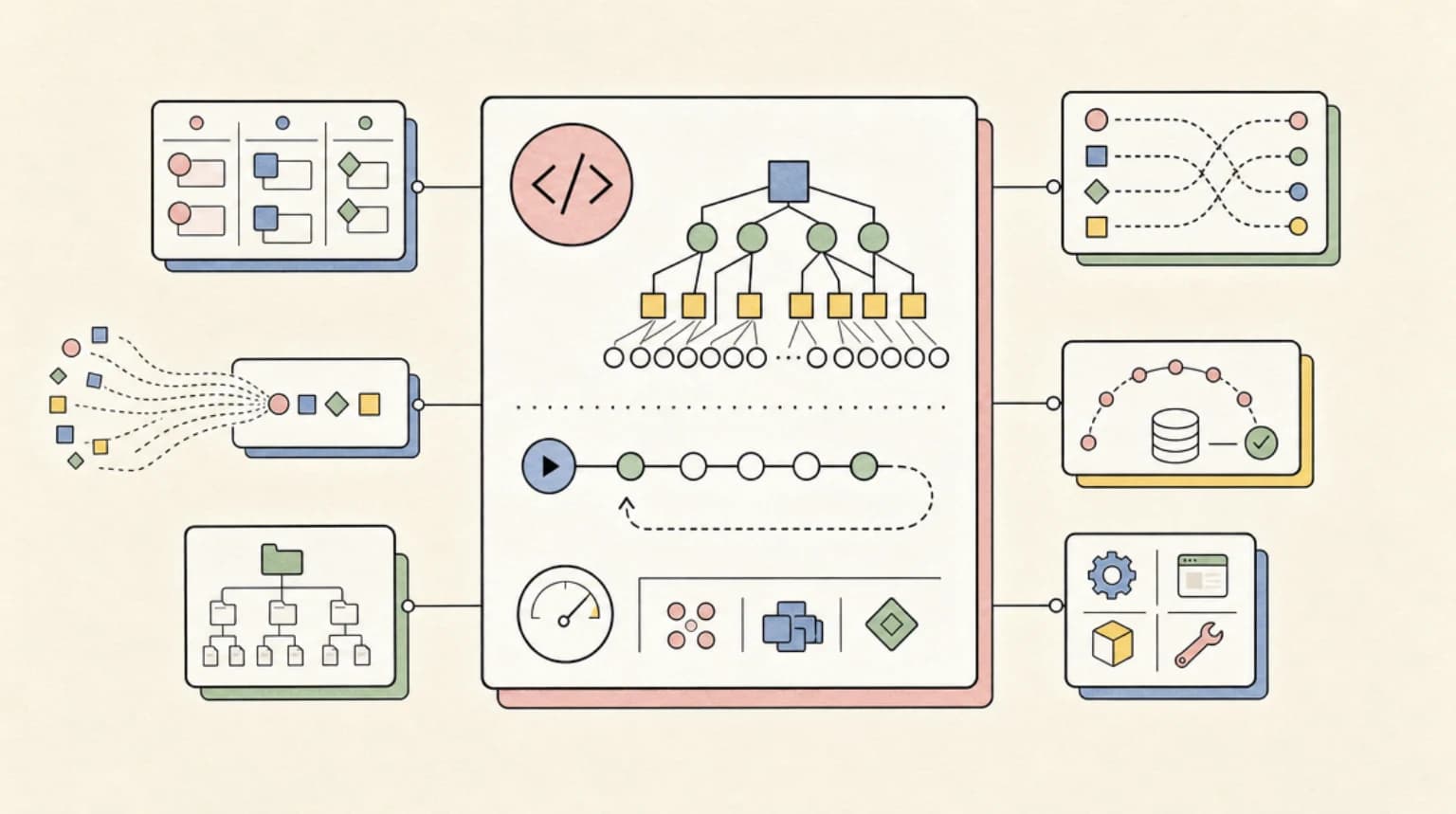
Many developers know Dynamic Workflows in Claude Code: ask Claude to do something big, and it spins up its own web of agents, using a JavaScript engine under the hood for map-reduce style work. You do not draw the topology (classifier, fan-out and synthesize, adversarial verification). You state the goal and Claude chooses how to organize itself, based on its training and capabilities. Our dynamic workflows guide covers the Claude Code side.
On the Managed Agents API the evolution went:
- Multi-agent v1 (around May 2026): you defined each sub-agent the primary could spawn and listened to every thread yourself, like managing threads in an operating system. Powerful, but not trivial to set up.
- Dynamic Workflows / Flows (shipped the Friday before the talk): a lead agent writes a plan, for example "migrate my million-line monorepo from Python to Rust," then fans out automatically according to that plan.
%% title: From star topology to layered agents
flowchart TD
  L[Lead agent: writes the plan]:::emphasis --> A[Worker group A]
  L --> B[Worker group B]
  A --> V[Verifier]
  B --> V
  V --> L
Flows vs UltraCode#
The clearest answer in the Q&A was about when to use which:
- UltraCode in Claude Code is the interactive, one-off version: you at your terminal, watching it run.
- Flows in Managed Agents generalize the same methodology into a reusable, API-driven resource you can trigger on a schedule or from your own product.
Their suggested path for a new workflow (the example was generating videos): prototype interactively in Claude Code first, have Claude encode what worked into a skill, use that skill inside a Managed Agents flow, then iterate with a hill-climbing skill, which can even be human-driven by picking the better of two outputs each round.
Q&A Details Worth Knowing#
- Nesting depth: today Flows support one layer of nesting. Arbitrarily deep fan-outs may come later, once the safety story is locked down.
- Self-hosted sandboxes: Flows are fully supported there, though a few other features are not.
- Multi-repo work: give Claude access to the repos and they are mounted in its container. With a clean dependency graph (Bazel, for example) Claude uses it; otherwise it searches for symbols. If you have a precomputed dependency graph, upload it as a file and tell Claude where it is.
- Private data behind a VPN: use MCP Tunnels, which currently run over Cloudflare Tunnels, to give agents access to an internal MCP server without exposing it to the internet.
- Event streams: the durable event log is generic enough to build any UI: chat with expandable tool calls, generative charts for a stock watchlist, or one internal demo that used the events to explain each player's choices in a simulated game of Catan.
- How Anthropic does recurring work: mostly through Claude Tag, which can take a schedule in plain language ("every day at 6 AM, do this").
Our Take#
The history framing is not just a nice intro. It gives you a test for any multi-agent design: who is Linus, and does Linus scale? If every result flows to one coordinator, or to you, you have a star topology and it will hit a ceiling. The fix is layered trust: verifiers and sub-leads that absorb routine work and escalate only exceptions.
The other takeaway is the product split. Anthropic now offers the same orchestration idea at two levels: interactive in Claude Code and reusable on the API. Prototype in the first, productionize in the second. Lance Martin's 1,000-agent Fermat result shows how far the self-organizing end of this can go when there is a hard verifier, and the Managed Agents workshop covers the building blocks underneath.
FAQ#
What are Flows in Claude Managed Agents?#
The multi-agent orchestration feature, shipped as Dynamic Workflows, where a lead agent writes a plan and automatically fans out to other agents to execute it, instead of you defining every sub-agent and thread.
What is the difference between UltraCode and Managed Agents Flows?#
UltraCode is the interactive version in Claude Code at your terminal. Flows generalize the same approach into a reusable API resource you can run on a schedule or from your own product.
How deep can Managed Agents topologies nest?#
As of the talk, one layer of nesting. Anthropic said deeper fan-outs may come once safety controls are in place.
Sources#
- Why One AI Agent Isn't Enough (And How to Run 1,000) - video
- The Mythical Man-Month - Fred Brooks
- Claude Managed Agents documentation
The Full Series#
This post is part of our coverage of Anthropic's talks at AI Engineer 2026:
- Claude for Long-Horizon Tasks: Lance Martin's Four Rules for Agents That Run for Hours
- Inside the Claude Managed Agents Workshop: Pets, Cattle, Outcomes and Dreaming
- How Anthropic Builds: Mike Krieger on Being Unreasonable With Claude
- How Jarred Sumner Ships Millions of Lines of Agent-Written Code
- A Field Guide to Fable: Thariq Shihipar on Unhobbling Claude and Finding Your Unknowns
- Claude Tag Lands 65% of Anthropic's Product PRs: Takeaways From Cat Wu and Thariq Shihipar
- 1,000 Claude Agents, Git and a Database: How Fable 5.2 Formalized Fermat Without a Custom Harness
- Your Old Prompts Are Making Claude Worse: Lance Martin's Checklist for Frontier Models
- Tokens Should Have Jobs: Anthropic's Case for Advisors, Graders and Dreamers
- Give the Agent a Budget, Not a Token: Anthropic's CI Team on Safe Agent Permissions
- Rethinking Claude Code Best Practices: Lydia Hallie on Getting Out of the Loop Safely
- How Anthropic Merges 30,000 Code Changes a Day: Addy Osmani on Verifying the Software Factory
- Using LLMs to Secure Source Code: Eugene Yan's Six-Step Pipeline From Anthropic
- From Messages API to Managed Agents: Anthropic's Applied AI Team on Harnesses That Go Stale
- Forward Deployed Engineering 101: When Your AI Startup Needs FDEs, From Palantir to Anthropic
- The Enterprise Tech Stack for AI Agents: Why Your POC Stalls and How to Design Past It
- The Claude Certified Architect Exam as a Field Guide to Agentic Engineering
- The Future of MCP: David Soria Parra on Connectivity, Progressive Discovery and Skills Over MCP
- Gateways Are All You Need: How Anthropic Thinks About MCP in the Enterprise
- How to Build Agents That Run for Hours: Anthropic's Planner, Generator and Evaluator Harness
Continue Reading#
Get the next deep dive like this in your inbox
One email a week on Anthropic and the rest of the AI dev stack. Free.
Read next on Claude Code
Claude Code Dynamic Workflows: The Complete Guide
Claude Code dynamic workflows turn orchestration into a JavaScript script that runs agents in the background. How scripts, schemas, budgets and resume work.
10 min read1,000 Claude Agents, Git and a Database: How Fable 5.2 Formalized Fermat Without a Custom Harness
Lance Martin on a 1,000-agent Claude team that formalized Fermat's Last Theorem in Lean with only Git and SQL, plus what Anthropic learned about memory and dreaming.
8 min readInside the Claude Managed Agents Workshop: Pets, Cattle, Outcomes and Dreaming
What Anthropic's Managed Agents team taught in their two-hour AI Engineer workshop: why the first architecture failed, the core APIs, multi-session orchestration and dreaming.
10 min readTechnical content at the intersection of AI and development. Building with AI agents, Claude Code, and modern dev tools - then showing you exactly how it works.