Multica Turns Coding Agents Into Teammates. The Hard Part Is Receipts.
TL;DR
Multica is pushing the agent teammate pattern: assign issues, route work to local runtimes, stream progress, and compound skills.
Last updated: June 24, 2026
Why Multica Still Matters#
Multica started as a GitHub-trending curiosity, but the more interesting story is not the star count. The useful question is whether "agents as teammates" is becoming a real product shape for software teams.
The project describes itself as an open-source managed agents platform that lets teams assign work to coding agents, track progress, and reuse skills. As of this refresh, the public GitHub API shows the repo is still active, with a push on June 24, 2026 and a latest release tagged v0.3.28 on June 23. The README lists a local daemon, a Next.js 16 frontend, a Go backend, PostgreSQL 17 with pgvector, and support for agent CLIs including Claude Code, Codex, GitHub Copilot CLI, OpenCode, OpenClaw, Gemini, Cursor Agent, Kimi, Kiro CLI, Antigravity, and Qoder CLI.
That matters because agent work is drifting from "open a chat and paste a task" toward team operations. We are seeing the same pull in Claude Code sub-agents, long-running agent harnesses, and parallel coding agent merge discipline. The agent is no longer the interesting unit. The control plane around the agent is.
Google Trends is useful here as a discovery nudge, not as a publishable fact. Searches around Claude Code, Codex, coding agents, and agentic IDEs keep clustering around practical workflow questions: how to run agents longer, how to compare tools, how to keep costs visible, and how to avoid brittle handoffs. The Multica angle fits that demand because it turns an agent run into a visible work item with state.
The Agent Teammate Pattern#
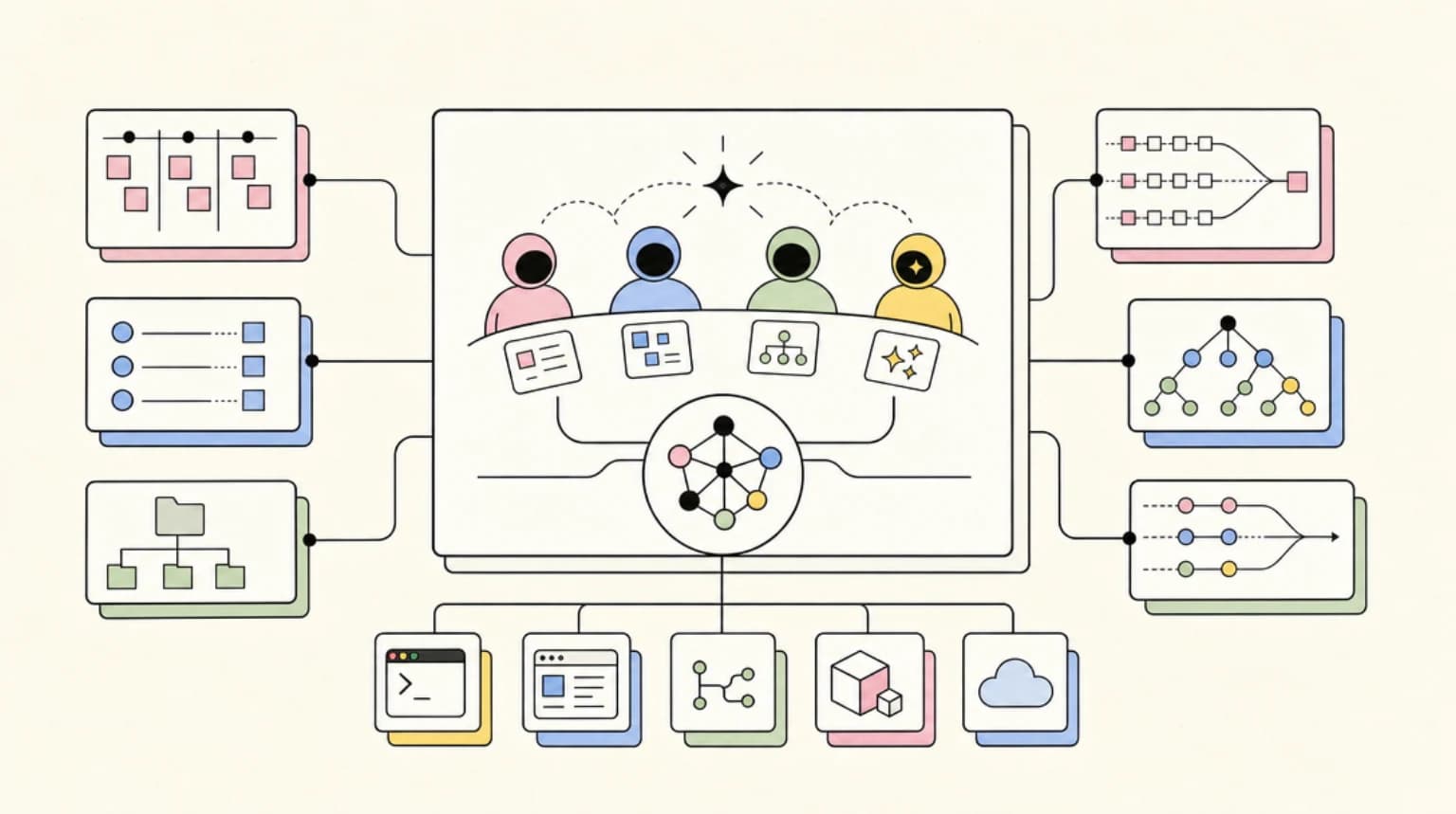
The agent teammate pattern has four parts:
- Work starts as an issue, task, or run request.
- A runtime claims it, usually from a local daemon or controlled cloud runner.
- Progress becomes visible through comments, status, logs, or a transcript.
- Completion creates something reviewable: a branch, patch, PR, handoff note, test result, or failure record.
Multica is interesting because it puts those pieces in one product surface. You create an issue, assign it to an agent, and let the runtime execute through a supported CLI. The README describes the daemon as the part that detects available CLIs on your path, runs tasks, and reports progress back to the workspace.
That is a different product promise than "better autocomplete" or "smarter chat." It is closer to a lightweight operating system for coding work. The board is the scheduler. The daemon is the runtime. The agent profile is the worker identity. The issue timeline is the audit log.
This is also why agent workspaces need filesystem contracts. The moment agents are assigned real tasks, the team needs to know which checkout, branch, environment variables, credentials, dependency cache, and test surface the agent actually touched. Without that, "teammate" becomes a nice word for an opaque terminal session.
What Multica Gets Right#
The first good decision is local execution. Multica can coordinate through a cloud app, but the agent daemon is the piece that touches your machine and installed CLIs. For developer workflows, that is often the right boundary. The codebase, local tools, SSH config, Git identity, and secrets already live on the workstation or a controlled runner. Sending only coordination state to a product surface is easier to reason about than handing the full execution environment to a black box.
The second good decision is vendor-neutral routing. A team might want Claude Code for one class of refactor, Codex for another kind of review, Copilot CLI where GitHub integration matters, and smaller local or specialized tools for narrow tasks. We have argued something similar in terminal agents need a portable runtime surface: the durable layer is not one model brand. It is the wrapper that can describe work, launch it, observe it, and recover when it fails.
The third good decision is skill compounding. Multica's README frames reusable skills as a way for deployments, migrations, and code reviews to become shared team capability. That overlaps with the larger direction in skills are how agents learn the job and agent skills need package-manager governance. If a team keeps rediscovering the same runbook, the agent platform should make the runbook executable and reviewable.
The fourth good decision is explicit task lifecycle. Agent runs fail in boring ways: missing credentials, stale branch, timeout, rate limit, test flake, dependency drift, or unclear acceptance criteria. A board with started, blocked, failed, and completed states is not just project-management decoration. It is how teams keep a fleet of agents from turning into silent background noise.
Where The Pitch Can Mislead#
The phrase "agents as teammates" is useful, but it can hide the accountability problem.
A teammate owns outcomes. A coding agent owns an attempt. The system around it has to preserve enough evidence for a human to review that attempt quickly. That means transcripts, diffs, commands, tests, environment details, and a clear reason when the agent stops. We called this the receipts problem in agent swarms need receipts. Without receipts, adding more agents mostly adds more unread work.
The star count is also not a reliability metric. Multica has strong public attention and a fast release cadence, but production readiness depends on boring surfaces: install reliability, daemon restart behavior, credential handling, queue semantics, permission boundaries, team audit logs, and how well failed runs can be resumed. An agent platform that looks polished on day one can still create messy review debt by day ten.
There is also a security boundary to watch. A local daemon that can run agent CLIs is powerful by design. That makes permissions, logs, and rollback non-negotiable. The more a system can assign work autonomously, the more it needs the controls covered in permissions, logs, and rollback for AI coding agents and agent containment needs a capability ledger.
Finally, skills can rot. A reusable skill that encoded last month's deployment flow can break silently after an infra change. Teams need versioning, ownership, test fixtures, and retirement paths for skills. Otherwise the skill library becomes a junk drawer that agents trust too much.
The Practical Evaluation Checklist#
If you are testing Multica or any similar managed-agent control plane, do not start by asking whether it feels futuristic. Start with the operational questions.
Can every run be traced back to a task, assignee, runtime, model or CLI, branch, and commit? If the answer is no, the system is not ready for serious team work.
Can a failed run explain whether it hit a tool error, model error, timeout, missing permission, test failure, or unclear task? If every failure looks like "agent stopped," humans will avoid delegating important work.
Can you enforce which repositories, directories, commands, secrets, and network targets a runtime can access? The more agent work moves into background queues, the more you need default-deny posture.
Can you replay or inspect what happened after the fact? The minimum receipt is a transcript plus final diff. Better systems also record commands, test output, tool calls, elapsed time, token or spend signals, and human approvals.
Can the agent hand back a reviewable artifact instead of a vibe? A PR, patch, migration file, design diff, or failing repro is much easier to review than a paragraph claiming success. This is why agent evals need baseline receipts before teams trust broad automation.
Can multiple agents work without merge chaos? Once you assign tasks in parallel, you need queueing, worktree or branch isolation, ownership rules, and review order. The playbook in how to coordinate multiple AI agents becomes mandatory quickly.
How It Compares To Raw Claude Code Or Codex#
Raw CLI agents are still the fastest path for individual engineers. If you know exactly what you want, a terminal session with Claude Code, Codex, OpenCode, or another agent is lower-friction than introducing a managed board.
Multica makes more sense when the bottleneck is coordination, not prompting. That usually shows up when a team is already doing some version of this manually:
- Creating small implementation tasks for agents
- Running several agents in parallel
- Asking agents to leave handoff notes
- Copying useful prompts into shared docs
- Reviewing branches after overnight or background runs
- Trying to remember which model worked best for which task type
At that stage, a control plane can be worth the overhead. It can turn a personal workflow into a team workflow. But if your current problem is "we do not know which agent can solve our tasks," Multica is probably later in the stack. First build a small harness, gather receipts, and find the work classes that agents can do reliably.
That is the same posture behind Codex maxxing long-running workflows. Longer runs are not automatically better. They are better only when the task is scoped, the environment is prepared, and the output is reviewable.
The Take#
Multica is worth watching because it is pointed at the right layer. The next wave of AI dev tooling is not just smarter agents. It is assignment, routing, state, receipts, permissions, skills, and review.
The optimistic read is that Multica becomes a shared control plane for small teams running a mixed fleet of coding agents. The skeptical read is that "agent teammate" products can add coordination theater before teams have enough reliable agent work to coordinate.
Both can be true. The right test is simple: after one week, does the system reduce review burden, or does it create more artifacts for humans to interpret?
If it reduces review burden, the teammate framing is earned. If it does not, the better move is to tighten the harness first.
FAQ#
What is Multica?#
Multica is an open-source managed agents platform for assigning work to coding agents, tracking progress, and reusing team skills across agent runs.
Is Multica a replacement for Claude Code or Codex?#
No. Multica is better understood as a coordination layer around agent CLIs. The README lists support for Claude Code, Codex, GitHub Copilot CLI, OpenCode, Gemini, Cursor Agent, Kimi, and several other runtimes.
Who should try Multica first?#
Teams that already have repeatable coding-agent workflows should try it first. If you are still comparing models and tools, start with a smaller harness before adding a managed board.
What is the biggest risk with managed agent platforms?#
The biggest risk is opaque background work. If the platform cannot show the task, runtime, transcript, commands, diff, test output, and stop reason, it will increase review burden.
Does a high GitHub star count prove Multica is production-ready?#
No. Stars prove attention. Production readiness depends on reliability, security boundaries, audit logs, install paths, failure recovery, and how well the product fits your team's actual review process.
How should teams evaluate agent teammate tools?#
Evaluate the receipts. A useful agent teammate tool should produce reviewable artifacts, clear task state, permission logs, failure reasons, and enough context for a human to approve or reject the work quickly.
Sources#
Get the next deep dive like this in your inbox
One email a week on AI Agents and the rest of the AI dev stack. Free.
Read next on AI coding tools
Entire Distributed Git Network: A Developer Guide to the Ex-GitHub CEO's Agent-Era Platform
How to set up Entire's regional Git mirrors for AI coding agents. Covers installation, mirroring, integrations with Claude Code, Codex, Cursor, and Factory AI.
7 min readCodex Computer History Turns Repeated Work Into Reusable Skills
Codex Computer History gives agents a rolling local view of your work across apps. How it works, how to turn observed workflows into skills, and privacy limits.
8 min readfx Deep Dive: Inside Vercel's Tiny Native Coding Agent
fx is Vercel Labs' experimental coding agent in Zig, a roughly 6 MiB native binary built to embed anywhere. Its surfaces, providers, guardrails and tradeoffs.
9 min readNew here? Start with
Technical content at the intersection of AI and development. Building with AI agents, Claude Code, and modern dev tools - then showing you exactly how it works.