Antigravity CLI vs Claude Code vs Codex: The Terminal Agent Field Guide (July 2026)

TL;DR
Google's Antigravity CLI replaced Gemini CLI on June 18, 2026. Here is how it compares to Claude Code and Codex on architecture, pricing, multi-agent workflows, and daily coding experience.
Direct answer
Antigravity CLI vs Claude Code vs Codex: The Terminal Agent Field Guide (July 2026)
Google's Antigravity CLI replaced Gemini CLI on June 18, 2026. Here is how it compares to Claude Code and Codex on architecture, pricing, multi-agent workflows, and daily coding experience.
Best for
Developers comparing real tool tradeoffs before choosing a stack.
Covers
Verdict, tradeoffs, pricing signals, workflow fit, and related alternatives.
Google killed Gemini CLI on June 18, 2026 and replaced it with Antigravity CLI, a ground-up Go rewrite that shares its agent harness with the Antigravity 2.0 desktop platform. That makes the terminal agent war a three-way race: Google's new agy binary against Anthropic's Claude Code and OpenAI's Codex.
This is a practical comparison for developers choosing a daily terminal agent. Every product fact below was checked against official documentation and pricing pages on July 31, 2026. Where Google has not published a number, we say so instead of guessing.
Last updated: July 31, 2026
Official Sources#
| Resource | Link | Last verified |
|---|---|---|
| Antigravity CLI announcement | developers.googleblog.com | July 31, 2026 |
| Antigravity CLI download | antigravity.google/download | July 31, 2026 |
| Antigravity CLI docs | antigravity.google/docs | July 31, 2026 |
| Gemini CLI repository | github.com/google-gemini/gemini-cli | July 31, 2026 |
| Claude Code docs | code.claude.com/docs | July 31, 2026 |
| Anthropic pricing | anthropic.com/pricing | July 31, 2026 |
| Codex docs | learn.chatgpt.com/docs | July 31, 2026 |
| Codex pricing | learn.chatgpt.com/docs/pricing | July 31, 2026 |
Quick answer#
Claude Code remains the best daily terminal agent for most developers: most mature sub-agent system, best model quality for multi-file work, and now bundled into every paid Claude plan. Codex is the strongest choice if you want the same agent across terminal, IDE, web, and cloud, or if you want to route between three model price points (Sol, Terra, Luna) from one tool. Antigravity CLI is the most interesting new entrant: fastest startup, real async multi-agent orchestration, multi-provider support (Gemini, Claude, GPT-OSS) from one binary, and free for personal use - but it is young, has a weekly compute cap instead of a daily request count, and the ecosystem is still catching up.
The honest recommendation for July 2026: if you already use Gemini CLI, Antigravity is a smooth migration with real improvements. If you are choosing your first terminal agent, Claude Code is still the safest default, and Codex is the best pick for ChatGPT-heavy workflows.
Head-to-head table#
| Antigravity CLI | Claude Code | Codex | |
|---|---|---|---|
| Vendor | Anthropic | OpenAI | |
| First shipped | June 2026 (as Antigravity) | Feb 2025 | May 2025 (CLI) |
| Binary | agy | claude | codex |
| Language | Go | TypeScript | Rust |
| Open source | Community forum, parts shared | No | CLI is open source |
| Default model | Gemini 3.x (1M context) | Opus 5 / Sonnet 5 | GPT-5.6 Sol / Terra / Luna |
| Other providers | Claude, GPT-OSS via /model | None | API-keys for third-party models |
| Async multi-agent | Yes, background orchestration | Sub-agents, parallel | Cloud background runs, subagents |
| Project memory | GEMINI.md-style context files | CLAUDE.md | AGENTS.md |
| Skills | Agent Skills, .agents/skills/ | Skills + library | Skills + plugin marketplace |
| MCP support | Yes, mcp_config.json | Yes | Yes |
| Free tier | Weekly compute cap (unpublished limit) | No | No (Plus/Pro subscription) |
| Personal plan price | Free with Google account | $20/mo Pro includes it | $20/mo Plus includes it |
The three-way landscape#
Antigravity CLI: the reboot with a harness#
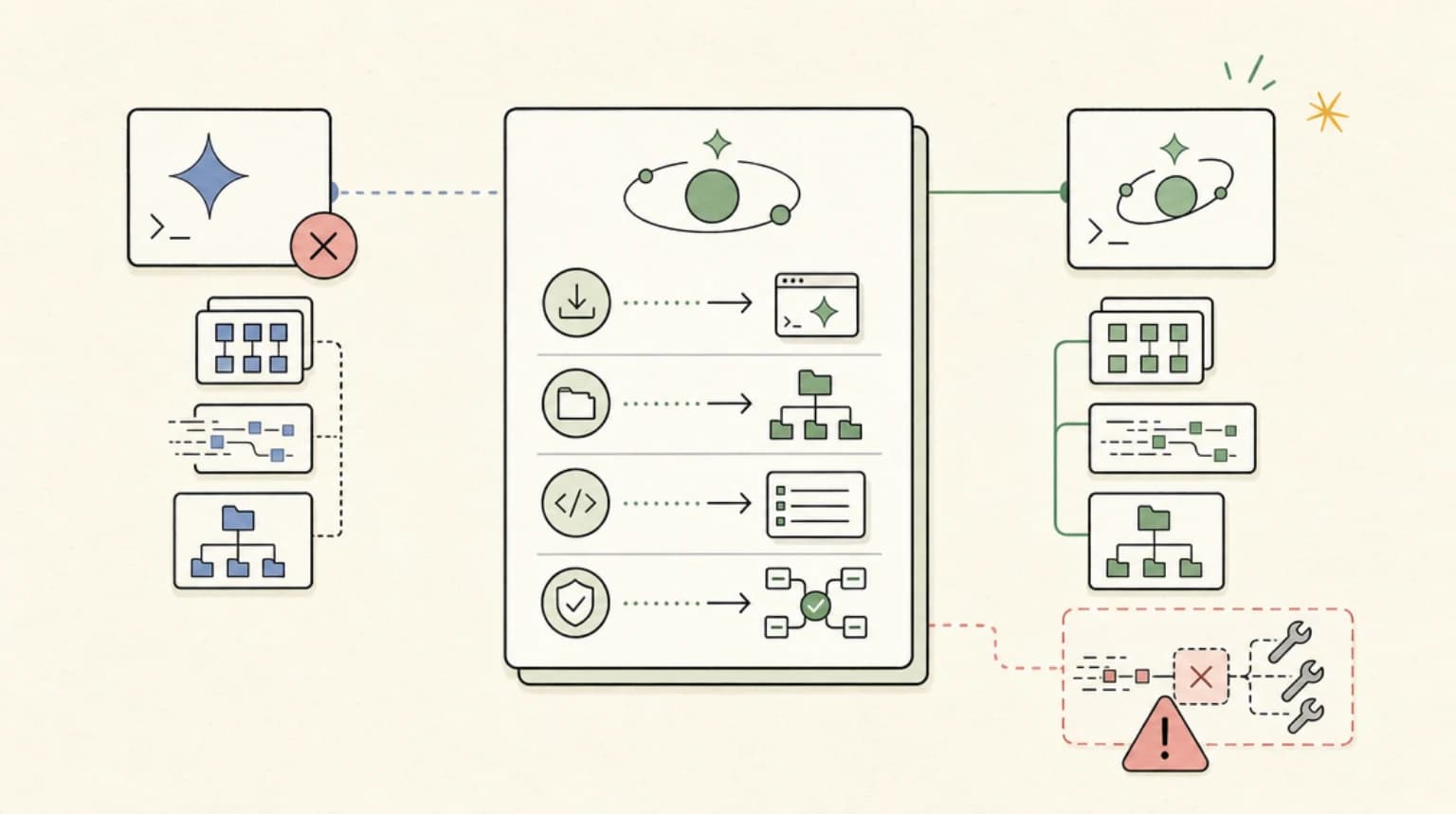
Antigravity CLI is not Gemini CLI with a new name. Google announced on May 19, 2026 that Gemini CLI would stop serving requests for free-tier, AI Pro, and AI Ultra users on June 18, and that a new Go-based CLI built on the Antigravity platform would replace it. The community forum lives at github.com/google-antigravity/antigravity-cli, and the migration guide covers everything that changed.
What carried over: Agent Skills, Hooks, Subagents, and extensions (now called plugins). What changed under the hood: the binary is agy, startup is noticeably faster (Go), and the CLI shares its agent harness with Antigravity 2.0, Google's agent-first desktop platform. That shared harness is the strategic bet: improvements to core agents land in the CLI and the desktop app together.
The interesting differentiator is provider freedom. Gemini CLI was Gemini-only; Antigravity supports Gemini, Claude, and GPT-OSS models through the /model command, which makes it the only one of the three that can run another vendor's model from your terminal agent. Given the model-routing cost math that is a real feature, not a gimmick.
The trade-offs are equally real. There is no 1:1 feature parity with Gemini CLI at launch (the ACP mode gap is tracked as issue #31 in the community repo). The daily 1,000-request limit became a weekly compute-based cap, and Google has not published the exact numbers - community reports describe throttling after roughly 2,000 lines of generated code with multi-day cooldowns. MCP servers configure through a dedicated mcp_config.json (the migration trap is url versus serverUrl for remote servers); if you are choosing which servers to wire in, our MCP clients comparison covers the full 2026 client landscape. And while the free tier is generous for interactive use, heavy generation work needs planning.
Claude Code: the incumbent with the deepest memory#
Claude Code is the terminal agent that defined the category: local-first, reads your filesystem directly, spawns parallel sub-agents, and compounds project knowledge in CLAUDE.md files. It is now included in every paid Claude plan, which changed the pricing story completely - Pro at $20/month includes it, Max at $100-200/month removes the usage anxiety.
Model quality is the moat. Opus 5, launched July 24, 2026 at $5/$25 per million tokens, is the strongest generally available coding model for multi-file work, and Sonnet 5's introductory $2/$10 pricing (through August 31, 2026, then $3/$15) covers everyday tasks cheaply. The skills system - plain markdown files plus a curated library - is the reference implementation that Codex and others are now cloning.
Its weaknesses are structural: it is not open source, it has no official multi-provider mode, and it has no hosted sandbox of its own for risky tasks (you bring your own isolation). For a deeper dive, see Claude Code vs Codex: the full head-to-head.
Codex: the multi-surface agent with three price points#
Codex is the only one of the three that is also a consumer product surface: app, web, IDE extension, CLI, and ChatGPT Work. It runs the full GPT-5.6 family - Sol for flagship work, Terra for the balanced middle, Luna for budget volume - so a single Codex account can route tasks across a 25x input-price spread. The GPT-5.6 family guide has the full per-tier pricing.
Codex closed the skills gap in 2026: it has its own skills system, a plugin marketplace, AGENTS.md project memory, and subagents. Its cloud environment enables fire-and-forget runs, GitHub integration, and scheduled tasks that Claude Code cannot match without extra tooling - and with 8 million active users across Codex and ChatGPT Work since mid-July (Codex user guide), it is the most-tested agent surface of the three. For headless and CI-driven work specifically, our headless AI coding agents comparison breaks down how each agent behaves in pipelines. The CLI itself is open source.
The weaknesses: the product surface is broad, so you have to pick a workflow (CLI vs IDE vs app vs Work) and the choice changes the experience; and local-first purists will find the hosted/cloud defaults less direct than Claude Code.
From the archive
Blind Resampling Beats Self-Repair in Small Code Models: Retry Without the Failed Code
Jul 31, 2026 • 7 min read
Budget AI Coding Models Compared August 2026: V4 Flash vs Luna vs Gemini 3.5 Flash vs Haiku 4.5
Jul 31, 2026 • 10 min read
CAPA Benchmark: Why Coding Agents Should Learn Your Habits Across Sessions
Jul 31, 2026 • 7 min read
cdnjs Runs Entirely on Cloudflare's Developer Platform: 9 Billion Requests a Day on Workers
Jul 31, 2026 • 7 min read
Pricing compared#
All prices verified July 31, 2026 against the official pages.
| Antigravity CLI | Claude Code | Codex | |
|---|---|---|---|
| Free tier | Yes, Google account (weekly compute cap) | No | No |
| Subscription | None needed for personal use | Claude Pro $20/mo or Max $100-200/mo | ChatGPT Plus $20/mo or Pro $200/mo |
| API model rates | Gemini 3.1 Pro $2/$12 under 200K ctx | Sonnet 5 $2/$10 intro, Opus 5 $5/$25 | Terra $2/$12, Sol $5/$30, Luna $0.20/$1.20 |
| Enterprise | Gemini Code Assist licenses | Claude Team/Enterprise | ChatGPT Enterprise |
The free tier is Antigravity's killer feature: a personal Google account gets you the CLI, Gemini 3 models, and Google Search grounding at no cost, within the weekly compute cap. Claude Code and Codex both effectively require a $20/month subscription for meaningful daily use. On the API side, Luna at $0.20/$1.20 is the cheapest agent-capable tier on the market - see the budget model comparison - while Opus 5 and Sol are priced within a few dollars of each other.
When to use which#
Choose Antigravity CLI if:#
- You are a Gemini CLI user: the migration is mostly mechanical, and the Go rewrite is genuinely faster
- You want a free personal terminal agent with a 1M-token context window
- You want provider freedom: one CLI that can talk to Gemini, Claude, or GPT-OSS models
- You want real background multi-agent orchestration without leaving the terminal
- You already live in the Google ecosystem (Google Cloud, Gemini Code Assist, Vertex)
Choose Claude Code if:#
- Coding is your primary daily work and you want the strongest model quality for multi-file tasks
- You value compound memory: CLAUDE.md files and skills that make each project teach the agent
- You want the most mature sub-agent and hooks ecosystem
- You already pay for Claude Pro or Max - it is included, so marginal cost is zero
Choose Codex if:#
- You want one agent across terminal, IDE, web, and cloud
- You need async cloud runs, GitHub-native workflows, or scheduled tasks
- You want to route between Sol, Terra, and Luna from one tool based on task difficulty
- You already pay for ChatGPT Plus or Pro
When to stay with what you have#
Honest counterpoint: none of these tools is so much better than the others that switching is urgent.
- If you are happy with Claude Code, do not switch for Antigravity's free tier - the weekly compute cap makes it a poor primary workhorse for heavy generation, and your plan already includes Claude Code.
- If you live in ChatGPT, Codex Plus is the path of least resistance; Antigravity's provider freedom is only valuable if you actually want to mix models.
- If you run a team on Gemini Code Assist Standard or Enterprise, your Gemini CLI access was never cut - Google exempted enterprise licenses from the June 18 deadline, and there is no migration pressure on you.
FAQ#
Is Antigravity CLI free?#
Yes for personal use. Sign in with a Google account and you get the CLI with Gemini 3 models and Google Search grounding. The free tier is a weekly compute-based cap rather than the old daily 1,000-request limit, and Google has not published exact numbers. Community reports suggest roughly 2,000 lines of generated code before throttling.
Does Antigravity CLI work with Claude or GPT models?#
Yes. Unlike Gemini CLI, which was Gemini-only, Antigravity CLI supports multiple providers including Gemini, Claude, and GPT-OSS models through the /model command. Claude Code and Codex do not offer equivalent multi-provider support out of the box.
What happened to Gemini CLI?#
Gemini CLI stopped serving requests on June 18, 2026 for free-tier, Google AI Pro, and Google AI Ultra users. Google announced the transition on May 19, 2026. Enterprise users on Gemini Code Assist Standard or Enterprise licenses kept access, as did paid API-key usage. The replacement is Antigravity CLI.
Is Claude Code included in Claude Pro?#
Yes. Claude Pro ($20/month, or $17/month billed annually) includes Claude Code, Claude Cowork, Claude Design, and Claude Science. Claude Max at $100-200/month adds 5x or 20x usage. This made Claude Code effectively free for existing Pro subscribers.
What models does Codex use in 2026?#
Codex runs the GPT-5.6 family: Sol (flagship, $5/$30), Terra (balanced, $2/$12), and Luna (budget, $0.20/$1.20), with fast mode at 2x standard rates. Model selection is per-chat, so you can route cheap work to Luna and hard work to Sol within the same session.
How do the context windows compare?#
Gemini models in Antigravity CLI carry a 1M-token context window, which is the largest of the three. Claude Code models offer 200K (with flat pricing across the full window for Opus 5), and GPT-5.6 models offer 272K in short-context mode with a long-context tier above it.
Is Antigravity CLI open source?#
The CLI has a public community repository at github.com/google-antigravity/antigravity-cli where feedback and feature requests live, and it builds on Google's open-source agent ecosystem. The old Gemini CLI repository remains public at github.com/google-gemini/gemini-cli with over 100,000 stars. Claude Code is closed source; the Codex CLI is open source.
Continue Reading#
- Claude Code vs Codex App in 2026 - the deeper two-way head-to-head on local vs cloud agent architecture
- Gemini CLI to Antigravity CLI Migration Guide - the step-by-step migration, including the MCP config trap
- Gemini 3.5 Pro Developer Guide - the model behind Google's agent tooling
- Claude Code vs Cursor vs Codex 2026 - where the IDE agents fit in
- Best CLI Tools for AI Development - the wider terminal-tool shortlist
- GPT-5.6 Sol/Terra/Luna Developer Guide - the OpenAI family and its pricing spread
Sources#
- Google Developers Blog: Transitioning Gemini CLI to Antigravity CLI - the May 19, 2026 announcement and June 18 timeline (fetched July 31, 2026)
- Antigravity CLI download and installer - the official install script and binary distribution (fetched July 31, 2026)
- Gemini CLI repository - open-source features, free tier, and Gemini 3 model support (fetched July 31, 2026)
- Anthropic pricing page - Claude plans, Claude Code inclusion, Opus 5 and Sonnet 5 rates (fetched July 31, 2026)
- OpenAI API pricing page - GPT-5.6 Sol/Terra/Luna rates and fast mode (fetched July 31, 2026)
- Codex documentation - product surfaces, model selection, skills and plugins (fetched July 31, 2026)
Read next
Claude Code vs Codex App in 2026: Local Agent Pairing vs Cloud Agent Orchestration
A deep comparison of Claude Code and OpenAI Codex app based on official docs and product updates: execution model, security controls, pricing, workflows, and when each wins.
11 min readGemini CLI to Antigravity CLI Migration Guide: The June 18 Deadline
Gemini CLI stops working June 18, 2026. Here is exactly what to do: install Antigravity CLI, migrate your config, update your scripts, and avoid the silent MCP failure that breaks tool calls.
6 min readAntigravity: Google's Agentic Code Editor
Antigravity marks the first release from a team that originated at Windsurf. After selling non-exclusive IP rights, the founding members joined Google and built this product on top of that foundation.
7 min readShare
Developers Digest
Technical content at the intersection of AI and development. Building with AI agents, Claude Code, and modern dev tools - then showing you exactly how it works.
300+ videos30K+ GitHub stars850+ articles
Related Tools
AI CodingOpen source

OpenCode
Open-source AI coding agent for terminal, desktop, and IDE. Works with 75+ LLM providers including Claude, GPT, Gemini,...
View ToolAI Coding
C
Conductor
Mac app for running parallel Claude Code, Codex, and Cursor agents in isolated workspaces. Watch every agent work at onc...
View ToolProductivityNew
A
AgentCanvas
A hosted infinite canvas your headless AI agents drive over MCP. Any MCP-speaking agent - Claude Code, Codex, Cursor, or...
View ToolAI CodingDaily Driver

Claude Code
Anthropic's agentic coding CLI. Runs in your terminal, edits files autonomously, spawns sub-agents, and maintains memory...
View ToolApps from Developers Digest
Developer Tools
Agent Hub
Every coding agent in one window. Stop alt-tabbing between Claude, Codex, and Cursor.
View AppDeveloper ToolsIn Progress
Skill Builder
Turn a one-liner into a working Claude Code skill. From idea to installed in a minute.
View AppDeveloper ToolsIn Progress
Subagent Studio
Design subagents visually instead of editing YAML by hand.
View AppRelated Guides
Guide
Terminal CLI - Claude Code
The primary command-line entry point for Claude Code sessions.
Claude CodeGuide
Claude Code Setup Guide
Configure Claude Code for maximum productivity -- CLAUDE.md, sub-agents, MCP servers, and autonomous workflows.
AI AgentsGuide
AI Agent Frameworks Compared: LangGraph vs CrewAI vs Mastra vs CopilotKit
Deep comparison of the top AI agent frameworks - LangGraph, CrewAI, Mastra, CopilotKit, AutoGen, and Claude Code.
AI AgentsRelated Videos
Zed: The Open Source Agentic IDE - Use Claude Code, Codex & Gemini CLI in one place
Check out Zed here! https://zed.dev In this video, we dive into Zed, a robust open source code editor that has recently introduced the Agent Client Protocol. This new open standard allows...
Video·
Introducing GPT-5 Codex: Optimized Agentic Coding for Developers
In this episode, we explore the newly released GPT-5 Codex by OpenAI, a specialized version of GPT-5 designed for agentic coding tasks. Codex offers advanced features, including enhanced code...
Video·
OpenAI Open Sources Codex: The CLI Coding Agent
Exploring Codex: AI Coding in Terminal In this video, I explore Codex, a new lightweight CLI tool for AI coding that runs in the terminal. This tool, possibly a response to Anthropic's CLI,...
Video·
Related Posts
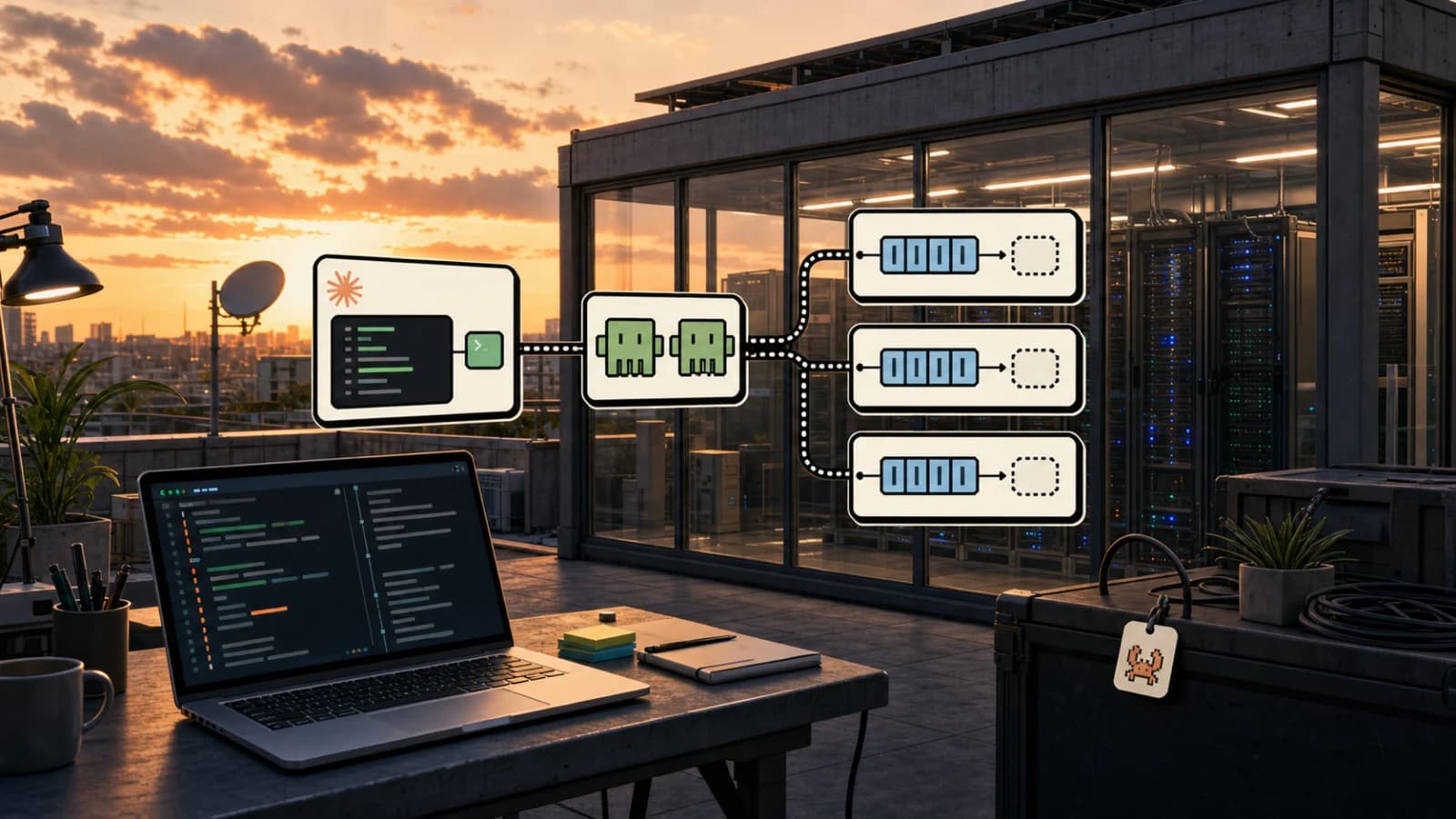
11 min read
Claude Code
Claude Code vs Codex App in 2026: Local Agent Pairing vs Cloud Agent Orchestration
A deep comparison of Claude Code and OpenAI Codex app based on official docs and product updates: execution model, secur...
6 min read
gemini
Gemini CLI to Antigravity CLI Migration Guide: The June 18 Deadline
Gemini CLI stops working June 18, 2026. Here is exactly what to do: install Antigravity CLI, migrate your config, update...

7 min read
Google
Antigravity: Google's Agentic Code Editor
Antigravity marks the first release from a team that originated at Windsurf. After selling non-exclusive IP rights, the...

8 min read
Gemini
Gemini 3.5 Pro Developer Guide: 2M Context Window and Deep Think Mode
Google's Gemini 3.5 Pro arrives with a 2-million-token context window and Deep Think reasoning mode. Here is how to acce...

8 min read
CLI
10 CLI Tools Reshaping AI Development in 2026
From Claude Code to Gladia, the ten CLIs every AI-native developer should know. Install commands, trade-offs, and when t...

10 min read
pi
pi vs Claude Code vs OpenCode: Picking Your Agentic CLI
A decision-intent comparison of pi, Claude Code, OpenCode and Codex CLI as your main agentic coding harness in late 2026...
Build with the member tools

Get Smarter About AI Dev
New tutorials, open-source projects, and deep dives on coding agents - delivered weekly.
One email per weekReal code, not theoryFree forever