The Agentic Development Tech Stack for 2026
AI Agents Deep Dive
10 parts- 1AI Agents Explained: A TypeScript Developer's Guide
- 2How to Build AI Agents in TypeScript
- 3Multi-Agent Systems: How to Orchestrate Multiple AI Agents in TypeScript
- 4The Agentic Development Tech Stack for 2026Current
- 5How to Debug AI Agent Workflows
- 6AI Agent Memory Patterns
- 7Over-Editing: Why Your AI Coding Agent Rewrites What Isn't Broken
- 8Intent Debt: The AI-Era Debt Nobody Is Tracking
- 97 AI Agent Orchestration Patterns Developers Should Know
- 10The Agent Reliability Cliff: Why Your 10-Step Chain Only Succeeds 20% of the Time
TL;DR
Coding changed more in the past two years than in the previous decade. We moved from manual typing to autocomplete, then to multi-file edits.
Last updated: May 24, 2026
| Official Sources | |
|---|---|
| Next.js Documentation | Framework reference for App Router, deployment, and features |
| Vercel Platform | Deployment, environment variables, and hosting docs |
| Clerk Documentation | Authentication, organizations, and billing integration |
| Convex Docs | Backend-as-a-service with real-time data and server functions |
| Cursor Documentation | AI code editor with Composer and agentic features |
| Claude Code | Anthropic's agentic coding assistant |
The Shift to Agentic Development#
Coding changed more in the past two years than in the previous decade. We moved from manual typing to autocomplete, then to multi-file edits. Now we have agentic systems that run for minutes - or hours - handling complex tasks autonomously.
The inflection point came roughly a year ago with Sonnet 3.5. That release marked the moment when applications could dynamically build other applications. Tools like Lovable, Bolt, and Cursor's multi-file editing capabilities emerged shortly after. Since then, the focus has shifted from tab completion and function generation to agentic reasoning. For the current layered buyer's map, read the new AI coding stack I would pick today.
Claude Code was among the first truly capable agentic systems, particularly when paired with the Claude 4 series. Codex followed, expanding from web apps to IDE integrations. If you want the buyer's map before picking a stack, the AI coding tools comparison matrix and the Codex vs Claude Code comparison frame the trade-offs. These agent harnesses share one critical trait: you can give them increasingly complex tasks and trust the output, even when they run for extended periods.
Current models from major labs focus squarely on agentic reasoning. Instead of manually writing code, tabbing through suggestions, or managing multi-file edits, you can now provide a prompt - simple or detailed - and let the system generate the solution.
Why Velocity Beats Raw Power#
Cursor's Composer is not the most powerful model available. It does not outperform Sonnet 4.5 or the latest Anthropic and OpenAI state-of-the-art models. What it offers instead is velocity.
The faster feedback loops matter when you are building with ambiguous requirements. You iterate quicker, test assumptions sooner, and course-correct without waiting for lengthy completions. For exploratory development, this trade-off often wins.
The 2026 Stack: Next.js, Clerk, and Convex#
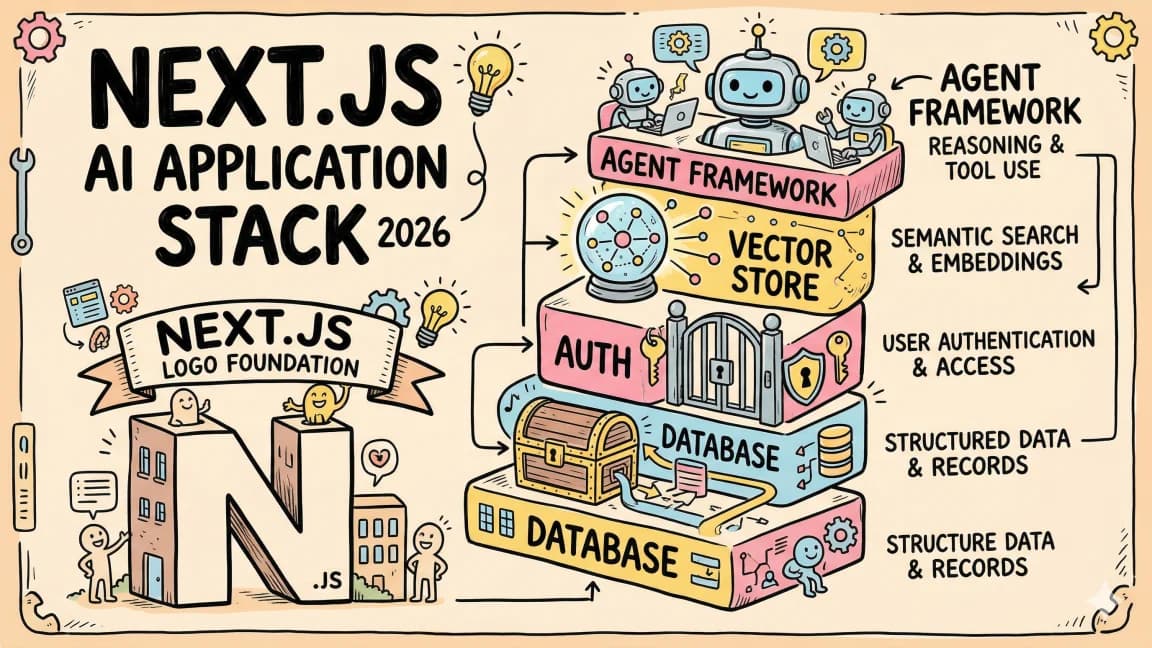
When building the demonstration application, the stack choices reflected a core principle: do not rebuild what specialized services already do well. The combination of Next.js, Clerk, and Convex provides a foundation that handles deployment, authentication, and data without custom infrastructure.
Next.js with Vercel handles the frontend and deployment. The free tier covers early development, and the $20 tier handles significant traffic. You avoid DevOps complexity while maintaining the option to migrate specific services to GCP or AWS as you scale.
Clerk manages authentication, but it extends beyond basic login. Organizations support comes built-in - no custom tables for invites, role management, or password resets. Their new billing functionality removes the need to wire up Stripe webhooks manually.
Convex provides the database layer with type safety, real-time updates, server functions, and cron jobs. The schema definition is straightforward, and changes reflect immediately in the dashboard.
The key advantage is reducing complexity for both you and your agent. When the underlying services handle authentication, real-time sync, and scaling concerns, your prompts stay focused on business logic rather than infrastructure. The same stack shows up in the more implementation-heavy Next.js AI app stack guide and the practical build apps with AI workflow.
Building in Real-Time#
The demonstration started with npx create convex, selecting Next.js and Clerk as providers. The installation includes Cursor rules - examples covering API setup, schema definition, and function calling. These rules reduce the need to reference documentation repeatedly.
Clerk's keyless mode lets you experiment before configuring API credentials. Once claimed, you create a JWT template named "convex" and add the issuer URL to your environment configuration. The application then has authentication, backend, and frontend working in minutes.
Cursor's latest interface defaults to the agent panel rather than the editor - a telling design decision suggesting where coding workflows are heading.
Adding Organization Support#
Organizations enable multi-tenant functionality: personal accounts, business workspaces, team invites, and role-based access. Clerk handles the SMTP for invites, the UI components for management, and the permission logic.
Using the Context7 MCP server, the agent retrieves current documentation automatically. When prompted to add organization switching to the navigation, the system references Clerk's docs directly, reducing hallucination and ensuring correct implementation.
The result is a dropdown menu for organization switching, creation, and management - functional without writing custom user management code.
Rapid Feature Development#
With the foundation set, the demonstration moved to feature development. The first request: a neo-brutalist landing page with accessibility-compliant colors, social proof, pricing, and header/footer components. The agent generated the page in one pass.
Next came the authenticated dashboard. The user profile section allows saving name, persona, Twitter handle, and other fields - with data persisting to Convex and reflecting immediately in the dashboard.
The core feature was a tweet scheduling system: a 3x3 tile grid with pagination, a "create tweet" button, scheduling controls, and AI enhancement capabilities. The agent defined the database schema (content, scheduled date, status, enhanced version), created the convex functions for CRUD operations, and wired the UI components.
When organization-scoped data became a requirement, the schema updated to include organizationId. The queries switched from user-based to organization-based filtering. After a schema mismatch error surfaced, the agent resolved it by updating the data structure and re-scoping the queries.
Scope and Iterate#
The workflow throughout the demonstration emphasized contained prompts. Rather than requesting multiple unrelated features simultaneously, each prompt focused on a single coherent concept: the landing page, then the profile section, then the tweet scheduler, then organization scoping.
This approach works better with agentic tools. Clear, bounded instructions with contained context windows produce more reliable results than sprawling multi-part requests. For the operating model behind that habit, read the context engineering guide and the Claude Code sub-agents tutorial. The token estimator is the fastest way to confirm a request actually fits the window you think it does.
Deployment Path#
Deploying the stack is straightforward. Vercel handles the Next.js application with a production instance. Clerk provides a production environment toggle. The convex dashboard manages the production database. Domain configuration and environment variable updates complete the transition from local development to live application.
Clerk's billing component extends this further - subscriptions, plan management, and payment processing without custom Stripe integration. With AI features and a refined design system, a functional SaaS emerges from an afternoon of agent-assisted development.
The New Baseline#
The barrier to building has dropped. Frontend specialists can ship full-stack applications. Backend developers can prototype interfaces. New developers can focus on product logic rather than framework configuration.
Composer 1 is not the most capable agentic tool available - Sonnet 4.5 and GPT-5 produce higher-quality output when you can tolerate longer wait times. But for rapid iteration and ambiguous requirements, the velocity-first approach wins.
What matters now is knowing which foundation tools to leverage. Next.js, Clerk, and Convex eliminate entire categories of complexity. Combined with agentic coding assistants, they enable shipping production applications in hours rather than weeks.
Frequently Asked Questions#
What is agentic development?#
Agentic development is a coding workflow where AI assistants run autonomously for extended periods, handling complex multi-step tasks rather than just providing autocomplete suggestions. Instead of manually writing code line by line, you describe what you want and the agent reads files, writes code, runs tests, and iterates until the task is complete. The agent operates with increasing autonomy, making decisions about implementation details while you focus on higher-level direction.
What is the best tech stack for agentic development in 2026?#
The recommended stack for 2026 combines Next.js, Clerk, and Convex. Next.js with Vercel handles frontend and deployment. Clerk manages authentication, organizations, and billing. Convex provides the database with type safety, real-time updates, and server functions. This combination minimizes infrastructure complexity, letting you and your AI agent focus on business logic rather than boilerplate.
Why use Cursor for agentic coding instead of more powerful models?#
Cursor's Composer prioritizes velocity over raw capability. While models like Sonnet 4.5 or GPT-5 produce higher quality output, they take longer to complete. For exploratory development with ambiguous requirements, faster feedback loops matter more than maximum capability. You can iterate quickly, test assumptions sooner, and course-correct without waiting for lengthy completions.
How do I structure prompts for agentic coding assistants?#
Keep prompts focused on single, coherent concepts. Request one feature at a time rather than multiple unrelated changes. Clear, bounded instructions with contained context produce more reliable results than sprawling multi-part requests. For example, first request a landing page, then a profile section, then a specific feature - not all three simultaneously.
What is Convex and why use it for AI-assisted development?#
Convex is a backend-as-a-service that provides a database with type safety, real-time updates, server functions, and cron jobs. Its schema definitions are straightforward and changes reflect immediately. For agentic development, Convex reduces complexity because the AI agent has clear patterns to follow and does not need to generate infrastructure code for common database operations.
Can beginners use agentic development tools effectively?#
Yes. The barrier to building has dropped significantly. New developers can focus on product logic rather than framework configuration. Frontend specialists can ship full-stack applications. Backend developers can prototype interfaces. The combination of managed services (Clerk, Convex, Vercel) and agentic assistants handles the complexity that previously required years of experience.
How long does it take to build a SaaS with agentic tools?#
A functional SaaS with authentication, organizations, database, dashboard, and payment processing can be built in an afternoon using the agentic development stack. The demonstration in this post went from empty directory to deployed application with tweet scheduling, user profiles, and organization support in a single session.
What are the limitations of agentic development?#
Agentic tools work best with contained, well-scoped prompts. They can struggle with sprawling requirements or highly ambiguous instructions. Cost scales with usage - heavy users may hit rate limits or need premium tiers. Context windows are finite, so very large codebases require careful session management. The AI may also make confident mistakes that require human review before deployment.
Watch the Video#
Related apps#
- Agent Hub - One control panel for Claude Code, Codex, Gemini, Cursor, and 10+ AI coding harnesses. Desktop app for Mac.
- Agent Eval Bench Plus - Evaluation harness for AI coding agents. Plus tier adds private benchmarks, CI hooks, and historical comparisons.
Related#
- Subscribe to DevDigest on YouTube for hands-on walkthroughs
Sources#
- Next.js Documentation
- Vercel Documentation
- Clerk Documentation
- Convex Docs
- Cursor Documentation
- Claude Code Documentation
Continue Reading#
Get the next deep dive like this in your inbox
One email a week on AI and the rest of the AI dev stack. Free.
Read next
The New AI Coding Stack I Would Pick Today
The AI coding stack I would pick today: terminal agent, editor, background agent, Mastra, CopilotKit, MCP, context, security, and cost controls as layers.
11 min readMy AI Developer Workflow in 2026
The exact tools, patterns, and processes I use to ship code 10x faster with AI. From morning briefing to production deploy.
9 min readThe Next.js AI App Stack for 2026
Next.js AI app stack for 2026: Next.js 16, Vercel AI SDK, Convex, Clerk and Tailwind - why each piece matters and how they fit together.
12 min readNew here? Start with
Technical content at the intersection of AI and development. Building with AI agents, Claude Code, and modern dev tools - then showing you exactly how it works.